gRPC Studio
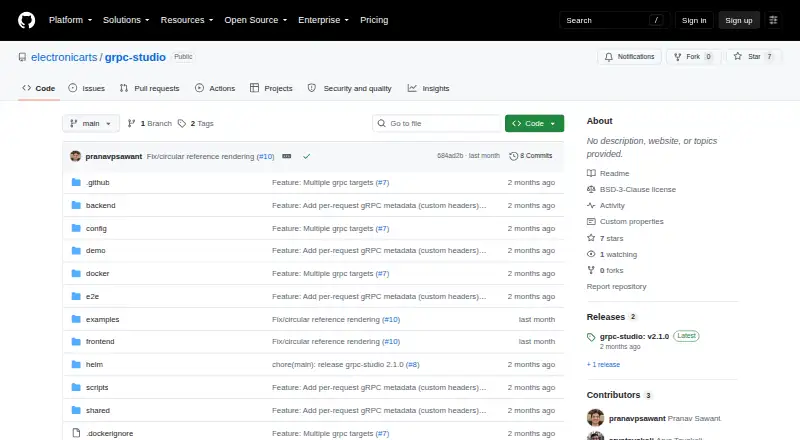
What gRPC Studio is
gRPC Studio is a free, open-source web interface for exploring and calling gRPC services. It discovers methods through gRPC reflection v1 and v1alpha, so the target server must support reflection. The interface handles unary, server-streaming, client-streaming, and bidirectional-streaming RPCs, and builds request forms from protobuf definitions, including nested messages, repeated fields, maps, oneofs, enums, bytes, timestamps, and wrapper types.
One instance can connect to multiple targets and switch between them in the UI. Outbound connections can use TLS or mTLS configured for each target. Authentication plugins can provide outbound metadata, while the web UI can optionally use Microsoft Entra ID authentication. Users can edit per-request headers, but binary -bin keys are unsupported, and configured authentication-plugin and trusted-user headers take precedence. The tool keeps request history per method and creates shareable request links. Its backend exposes Prometheus metrics for HTTP requests, gRPC calls, WebSocket connections, caches, and Node.js process activity. Docker images and Docker Compose and Kubernetes deployment documentation are provided.
Who it suits
gRPC Studio suits developers or operators exploring and invoking gRPC services. It requires a reflection-enabled target server for service discovery.
What it does well
- Handles all four unary and streaming RPC patterns.
- Builds dynamic forms from protobuf definitions.
- Supports TLS or mTLS per target.
- Keeps per-method request history and shareable links.
- Provides Docker images and Kubernetes deployment documentation.
What to know first
- Target servers must support reflection for discovery.
- Binary -bin request header keys are unsupported.
- Configured authentication and trusted-user headers override supplied metadata.
Limits
The target gRPC server must support reflection for service discovery. Custom binary -bin headers are unsupported, and configured authentication-plugin and trusted-user headers take precedence over user-supplied request metadata.
Getting started
- Open the project repository.
- Deploy using the provided Docker image, Docker Compose, or Kubernetes documentation.
- Connect to a gRPC server that supports reflection.
- Configure TLS or mTLS for the target if needed.
- Use the interface to select a service and make a request.
Verdict
gRPC Studio provides a web UI for exploring services, making calls, and reviewing method history. Confirm server reflection support and header behavior before relying on it for a workflow.
Questions
Is gRPC Studio free?
Yes. It is free and open source under the BSD-3-Clause license.
Which platforms does it support?
The listed platforms are Linux, self-hosted deployment, and web. The project provides Docker images and Docker Compose and Kubernetes deployment documentation.
Does the target server need a particular capability?
Yes. It must support gRPC server reflection for service discovery; gRPC Studio supports reflection v1 and v1alpha.
What kinds of RPCs can it call?
It supports unary, server-streaming, client-streaming, and bidirectional-streaming RPCs.
Can connections be secured?
Outbound gRPC connections support TLS and mTLS configured per target. Authentication plugins can provide outbound metadata, and the web UI can optionally use Microsoft Entra ID authentication.
What are the limits on custom request headers?
Binary -bin keys are unsupported. Authentication-plugin and trusted-user headers take precedence over user-supplied metadata.
Facts from gRPC Studio's own pages
- Authentication
- The backend supports outbound metadata auth plugins, and the web UI can optionally use Microsoft Entra ID authentication. · github.com, 7 Oct 2026
- Compatibility limit
- The target gRPC server must support reflection for gRPC Studio to discover services. · github.com, 4 Oct 2026
- Connection security
- Outbound gRPC connections can use TLS or mTLS, configured per target. · github.com, 7 Oct 2026
- Deployment
- The project documents Docker Compose, prebuilt GitHub Container Registry images, and Kubernetes deployment. · github.com, 7 Oct 2026
- Deployment security
- The Docker deployment guide says both images run as non-root users and recommends read-only config mounts; it also describes TLS/mTLS support for backend gRPC connections. · github.com, 4 Oct 2026
- Intended users
- The project is for people exploring and invoking gRPC services; its quick start recommends connecting it to a reflection-enabled server. · github.com, 7 Oct 2026
- License
- The repository identifies the project as BSD-3-Clause licensed. · github.com, 7 Oct 2026
- Multiple targets
- One instance can connect to multiple gRPC targets and switch between them in the UI. · github.com, 7 Oct 2026
- Observability
- The backend exposes Prometheus metrics, and its deployment guide describes optional OpenTelemetry tracing. · github.com, 7 Oct 2026
- Prerequisite
- The target gRPC server must support server reflection for service discovery. · github.com, 7 Oct 2026
- Protobuf forms
- It renders dynamic protobuf request forms, including nested messages, maps, oneofs, enums, bytes, timestamps, and wrapper types. · github.com, 4 Oct 2026
- Purpose
- gRPC Studio is a reflection-based UI for exploring and calling gRPC services. · github.com, 7 Oct 2026
- Request forms
- It renders dynamic protobuf request forms, including nested messages, repeated fields, maps, oneofs, enums, bytes, timestamps, and wrapper types. · github.com, 7 Oct 2026
- Request history
- It supports per-method request history and shareable request links. · github.com, 7 Oct 2026
- Request history and sharing
- It provides per-method request history and shareable request links. · github.com, 4 Oct 2026
- Request metadata
- Users can edit custom gRPC headers per request; binary -bin keys are not supported, and configured auth-plugin and trusted user headers take precedence over user-supplied metadata. · github.com, 4 Oct 2026
- RPC support
- It supports unary, server-streaming, client-streaming, and bidirectional-streaming RPCs. · github.com, 7 Oct 2026
- Security
- Outbound gRPC connections support TLS and mTLS, configurable per target. · github.com, 4 Oct 2026
- Security details
- The Docker guide says both images run as non-root users, configuration can be mounted read-only, and secrets are provided through mounted volumes rather than included in images. · github.com, 7 Oct 2026
- Service discovery
- It discovers services through gRPC reflection v1 and v1alpha. · github.com, 4 Oct 2026
Where gRPC Studio stands on Freedom251
- gRPC Tools#19 of 24