Freedom251 › In-Memory Databases
GridGain
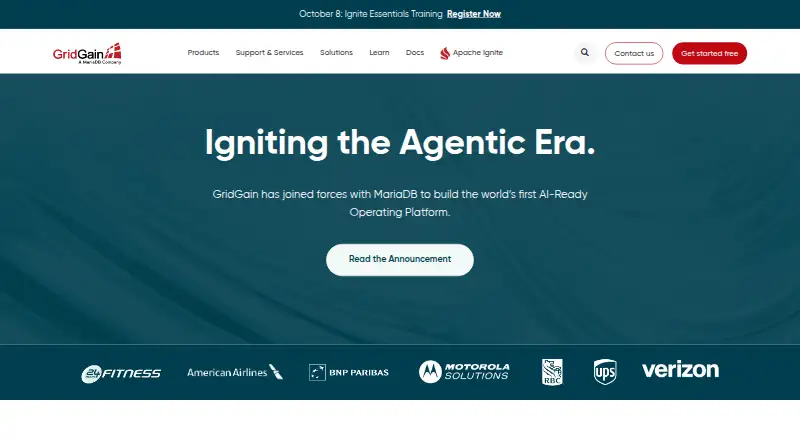
What GridGain is
GridGain Platform is an in-memory computing platform for transactional, streaming, and analytical processing across distributed clusters. It supports ANSI SQL, key-value APIs, and ACID transactions, and can keep data in memory, on disk, or both through configurable persistence. GridGain says its horizontally scalable architecture can grow to petabytes of in-memory data, with clusters deployed on premises or in public and private clouds.
The platform’s listed capabilities include transaction processing, advanced analytics, AI/ML operations, data hub, system of record, and stream processing. Integrations include a certified Kafka connector, Oracle Golden Gate, Data Lake Accelerator, Spring, Spark, Hibernate L2 Cache, MyBatis L2 Cache, and Cassandra. GridGain 9 supports SSL/TLS for cluster and client connections. Enterprise and Ultimate editions add role-based authorization and transparent data encryption, which supports Java keystores and AWS KMS. Pricing is on request, with no free plan; Enterprise and Ultimate include a 30-day trial license. GridGain Systems became part of MariaDB in March 2026.
Who it suits
GridGain is aimed at organizations with workloads requiring speed and scalability, including financial services, fintech, retail, telecommunications, and healthcare. It may suit teams needing transactions, stream processing, or analytics across distributed clusters.
What it does well
- Supports ANSI SQL, key-value APIs, and ACID transactions.
- Configurable persistence stores data in memory and on disk.
- Clusters can run on premises or in public and private clouds.
- Lists integrations including Kafka, Spark, and Cassandra.
- Enterprise and Ultimate editions include a 30-day trial.
What to know first
- No free plan is listed.
- Pricing is available on request.
- Role-based authorization is limited to Enterprise and Ultimate editions.
- Several capabilities, including point-in-time recovery, are Ultimate-only.
Limits
The platform has no free plan, and pricing is available on request. Enterprise and Ultimate include a 30-day trial; data center replication, remote snapshots with heterogeneous restore, point-in-time recovery, and z/OS support are listed for Ultimate only.
Plans
| Plan | Billed and limits | Price |
|---|---|---|
| Attached Nebula cluster — Apache Ignite | Hourly per monitored server node · 3 GB monitoring storage per server node | $0.11 a month |
| Attached Nebula cluster — Community Edition | Hourly per monitored server node · 3 GB monitoring storage per server node | $0.20 a month |
| Attached Nebula cluster — Enterprise Edition | Hourly per monitored server node · 3 GB monitoring storage per server node | $0.30 a month |
| Attached Nebula cluster — Ultimate Edition | Hourly per monitored server node · 3 GB monitoring storage per server node | $0.53 a month |
| Managed Nebula cluster S | Hourly · 4 CPU · 30.5 GB RAM · 16 GB off-heap storage · 8 GB Java heap · 400 GB SSD · 25 GB WAL Archive | $1.98 a month |
| Managed Nebula cluster M | Hourly · 8 CPU · 61 GB RAM · 32 GB off-heap storage · 16 GB Java heap · 800 GB SSD · 50 GB WAL Archive | $3.96 a month |
| Managed Nebula cluster L | Hourly · 16 CPU · 122 GB RAM · 64 GB off-heap storage · 31 GB Java heap · 1600 GB SSD · 100 GB WAL Archive | $7.92 a month |
As gridgain.com lists them, read 29 Sept 2026. The maker's own page has the final word.
Getting started
- Visit the GridGain website.
- Choose an on-premises or public or private cloud cluster deployment.
- Select an edition; Enterprise and Ultimate include a 30-day trial license.
- Use the installation requirements for Linux or Windows when installing GridGain 8.
Verdict
GridGain combines in-memory processing with transactions, analytics, and configurable disk persistence. Check edition requirements for security and recovery features, and request a quote for pricing.
Questions
How much does GridGain cost?
Pricing is available on request. Nebula cluster plans are listed from $0.11 a month for an attached Apache Ignite cluster to $7.92 a month for a managed L cluster; each is billed hourly as described for that plan.
Is there a free plan or trial?
There is no free plan. GridGain Enterprise and Ultimate editions come with a 30-day trial license.
Where can GridGain be deployed?
Clusters can be deployed on premises or in public and private clouds. GridGain 8 installation requirements list Linux and Windows.
What integrations does GridGain list?
The integrations include a certified Kafka connector, Oracle Golden Gate, Data Lake Accelerator, Spring, Spark, Hibernate L2 Cache, MyBatis L2 Cache, and Cassandra.
Which editions include role-based authorization and encryption?
Enterprise and Ultimate include role-based authorization. Transparent data encryption is available in those editions and supports Java keystores and AWS KMS.
What features are exclusive to Ultimate?
The edition comparison lists data center replication, remote snapshots with heterogeneous restore, point-in-time recovery, and z/OS support for Ultimate only.
Facts from GridGain's own pages
- At-rest encryption
- Transparent data encryption is available in GridGain 9 Enterprise and Ultimate editions and supports Java keystores and AWS KMS. · gridgain.com, 29 Sept 2026
- Capabilities
- The platform lists transaction processing, advanced analytics, AI/ML operations, data hub, system of record, and stream processing as key capabilities. · gridgain.com, 29 Sept 2026
- Company ownership
- GridGain Systems says it became part of MariaDB in March 2026. · gridgain.com, 29 Sept 2026
- Deployment platforms
- GridGain 8 installation requirements list Linux and Windows, and the product page says clusters can be deployed on premises or in public and private clouds. · gridgain.com, 29 Sept 2026
- Edition limits
- The official comparison lists data center replication, remote snapshots with heterogeneous restore, point-in-time recovery, and z/OS support for Ultimate Edition only. · gridgain.com, 29 Sept 2026
- Integrations
- The official extensions page lists a certified Kafka connector, Oracle Golden Gate, and Data Lake Accelerator; it also names Spring, Spark, Hibernate L2 Cache, MyBatis L2 Cache, and Cassandra integrations. · gridgain.com, 29 Sept 2026
- Intended users
- The company describes GridGain as serving use cases that need speed and scalability across financial services, fintech, software, eCommerce, retail, telecommunications, online services, and healthcare. · gridgain.com, 29 Sept 2026
- Product
- GridGain Platform is an in-memory computing platform for real-time transactional, streaming, and analytical processing at massive scale. · gridgain.com, 29 Sept 2026
- Scalability
- GridGain distributes workloads across horizontally scalable clusters on premises or in the cloud and says its architecture can scale to petabytes of in-memory data. · gridgain.com, 29 Sept 2026
- Security
- GridGain 9 supports SSL/TLS for cluster and client connections, and Enterprise and Ultimate editions include role-based authorization. · gridgain.com, 29 Sept 2026
- Storage
- The platform supports configurable disk-based persistence and can store data in memory and on disk. · gridgain.com, 29 Sept 2026
- Support
- The official edition comparison lists support for Enterprise and Ultimate, while GridGain documentation says production support and professional services are available for all editions and Apache Ignite deployments. · gridgain.com, 29 Sept 2026
- Transactions
- The platform supports ANSI SQL, key-value APIs, and ACID transactions. · gridgain.com, 29 Sept 2026
- Trial
- GridGain Enterprise and Ultimate editions come with a 30-day trial license. · gridgain.com, 29 Sept 2026
Where GridGain stands on Freedom251
- In-Memory Databases#18 of 25