Freedom251 › In-Memory Databases
Dragonfly
What Dragonfly is
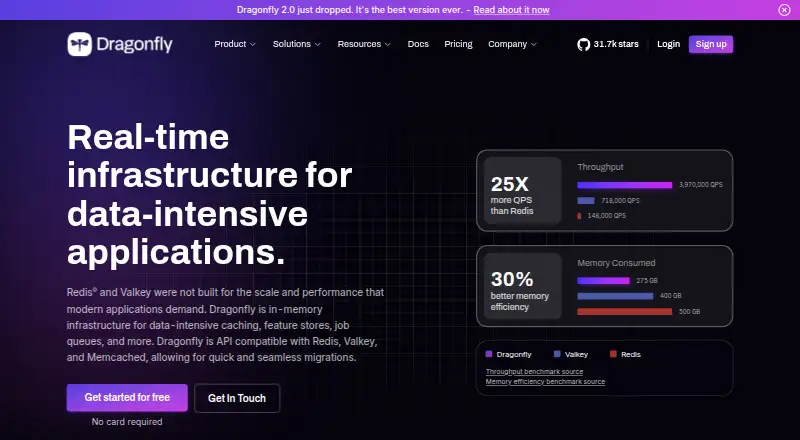
Dragonfly is an in-memory data store for real-time workloads such as caching, feature serving, message queues, and sorted-set leaderboards. Dragonfly works with Redis and Memcached APIs, and its maker says adoption requires no code changes. Its multi-threaded, shared-nothing architecture processes work across CPU cores and automatically shards data between them. The maker states that it can deliver millions of queries per second per instance with sub-1ms P99 latency, while data structures and compression are described as improving memory utilization by 30–60%. Prometheus monitoring works without an agent, and snapshots can be read from or written to S3-compatible storage. Deployment options include local Docker, Docker, Kubernetes, other environments, and managed cloud.
Who it suits
Dragonfly suits teams building real-time systems that need an in-memory store for caching, feature serving, queues, or leaderboards. It supports API-compatible migration paths for Redis and Memcached users.
What it does well
- Compatible with Redis and Memcached APIs
- Automatically shards data between CPU cores
- Supports persistence and high availability
- Prometheus monitoring needs no agent
- Managed cloud supports AWS, GCP, Azure, and on-premises
What to know first
- No free plan
- Cloud Business starts at $2,000/month
- Self-Managed pricing requires contacting the maker
Limits
Dragonfly has no free plan. Flex starts at $36 per month, Business starts at $2,000 per month, and Self-Managed pricing requires contacting the maker.
Plans
| Plan | Billed and limits | Price |
|---|---|---|
| Business | Starting at $2,000/month · Bring your own cloud · Auto-scaling · SSO and MFA · Custom SLA · Dedicated support | $2,000 a month |
| Flex | Starting at $36/month · Fully managed on AWS, GCP, or Azure · One-click provisioning · Horizontal and vertical scaling · Monitoring dashboard · Dragonfly team support | $36 a month |
| Self-Managed | Contact us for pricing · Deploy in your own cloud or on-premises · Runs on hardware you provision · LDAP authentication · RBAC · Enterprise support and SLA | On request |
As dragonflydb.io lists them, read 3 Oct 2026. The maker's own page has the final word.
Getting started
- Open the Dragonfly website
- Choose Docker, Kubernetes, another deployment environment, or a Dragonfly Cloud plan
- Run the single binary locally with Docker or deploy it in your environment
- Select Flex, Business, or Self-Managed based on hosting needs
- Use Redis or Memcached APIs to connect applications
Verdict
Dragonfly provides an API-compatible in-memory store with automatic sharding, multiple data models, and deployment choices from Docker to managed cloud. Paid options start at $36/month, with higher tiers adding cloud management and enterprise controls.
Questions
Is Dragonfly free?
No. Dragonfly is paid, with pricing starting at $36 per month, and a free trial is available.
Which platforms support Dragonfly?
It supports an API, Linux, and self-hosted deployments. Dragonfly Cloud runs on AWS, GCP, Azure, or on-premises.
Does Dragonfly support Redis?
Yes. It is compatible with Redis and Memcached APIs, and the maker says adoption requires no code changes.
Does Dragonfly support SQL?
No. SQL support is not provided.
What does the Flex plan include?
Flex costs $36 a month and includes fully managed AWS, GCP, or Azure hosting, one-click provisioning, horizontal and vertical scaling, a monitoring dashboard, and Dragonfly team support.
What security controls are listed for Dragonfly Cloud?
Dragonfly Cloud lists RBAC, ACL, user access management, and administrative audit logs.
Facts from Dragonfly's own pages
- API compatibility
- Dragonfly is compatible with Redis and Memcached APIs, and the maker says adoption requires no code changes. · dragonflydb.io, 3 Oct 2026
- Architecture
- Dragonfly uses a multi-threaded, shared-nothing architecture that processes work across CPU cores. · dragonflydb.io, 3 Oct 2026
- Cloud hosting
- Dragonfly Cloud is managed on AWS, GCP, Azure, or on-premises, with a bring-your-own-cloud option that keeps data in the customer’s account. · dragonflydb.io, 3 Oct 2026
- Company headquarters
- LinkedIn lists Dragonfly’s headquarters as Tel Aviv. · linkedin.com, 3 Oct 2026
- Company history
- DragonflyDB says the company was founded in 2022. · dragonflydb.io, 3 Oct 2026
- Deployment
- Dragonfly can be run locally via Docker, and its single binary can be deployed via Docker, Kubernetes, or elsewhere. · dragonflydb.io, 3 Oct 2026
- Integrations
- Dragonfly supports Prometheus monitoring without an agent and can read and write snapshots to S3-compatible storage. · dragonflydb.io, 3 Oct 2026
- Memory efficiency
- The maker says Dragonfly offers 30–60% better memory utilization through its data structures and compression. · dragonflydb.io, 3 Oct 2026
- Operations
- Dragonfly automatically shards data between CPUs, eliminating the need to reshard. · dragonflydb.io, 3 Oct 2026
- Performance
- The features page states Dragonfly can deliver millions of queries per second per instance and sub-1ms P99 latency. · dragonflydb.io, 3 Oct 2026
- Product
- Dragonfly is a modern in-memory data store for real-time workloads, caching, feature stores, and job queues. · dragonflydb.io, 3 Oct 2026
- Security
- Dragonfly Cloud lists RBAC, ACL, user access management, and administrative audit logs as security controls. · dragonflydb.io, 3 Oct 2026
- Support
- Dragonfly Cloud offers support from its engineering team backed by contractual SLAs; its pricing page also lists dedicated support for Business. · dragonflydb.io, 3 Oct 2026
- Use cases
- The maker highlights caching, real-time feature serving, message queues, and sorted-set leaderboards as use cases. · dragonflydb.io, 3 Oct 2026
Where Dragonfly stands on Freedom251
- In-Memory Databases#17 of 25