Freedom251 › AI Research Assistants

GPT Researcher
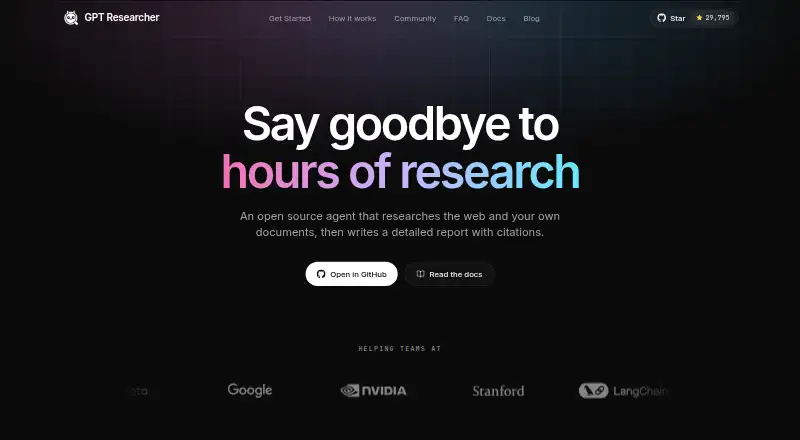
What GPT Researcher is
GPT Researcher is an open-source agent that investigates web sources and user documents, then produces detailed reports with citations. It turns a research request into sub-questions, searches sources in parallel, filters relevant passages, and assembles a cited report. The homepage lists more than 20 retrievers, including Tavily, Google, Bing, Exa, arXiv, and PubMed. It supports a range of language models, including OpenAI, Anthropic, Google, Mistral, DeepSeek, and local models through Ollama. Document research can cover PDFs, Word files, spreadsheets, and Markdown, either on their own or alongside web sources. Reports can be exported as Markdown, PDF, Word, JSON, or CSV. Its official gptr-mcp server makes research tools available to Claude, Cursor, ChatGPT custom GPTs, n8n, and other MCP clients. Developers can use a self-hosted FastAPI server with REST endpoints for deep research, quick search, and report writing. The software can run on a personal machine, server, or container, including through a Docker image. The maker says data leaves the user’s machine only through configured LLM and retriever providers; local models with SearXNG can keep it on the user’s infrastructure. GPT Researcher has no usage limits of its own, though provider limits and costs apply.
Who it suits
GPT Researcher suits people who need cited reports built from web research, their own files, or both. Its self-hosted deployment options, API, and MCP server also suit developers who want to use research tools in applications or MCP clients.
What it does well
- Research combines web sources and user documents.
- The homepage lists more than 20 retrievers.
- It supports hosted and local language models.
- Reports export to Markdown, PDF, Word, JSON, or CSV.
- A self-hosted FastAPI server provides REST endpoints.
- The software has no usage limits of its own.
What to know first
- Users provide keys for an LLM and a retriever.
- Underlying provider costs and limits still apply.
- The homepage FAQ requires Python 3.11 or later.
- Self-hosted deployment requires setup on a machine, server, or container.
Limits
The Open Source plan has no GPT Researcher usage limits. Usage limits and costs depend on configured providers; a deep research run with the default OpenAI and Tavily settings is estimated at a few cents to a few dollars in provider spend.
Plans
| Plan | Billed and limits | Price |
|---|---|---|
| Open Source | No GPT Researcher usage limits · Pay underlying LLM and search provider costs directly · Self-hosted | Free |
As gptr.dev lists them, read 4 Oct 2026. The maker's own page has the final word.
Getting started
- Visit the GPT Researcher website.
- Use Python 3.11 or later for the documented setup.
- Configure keys for an LLM and a retriever, or use local models through Ollama.
- Run it on a personal machine, server, or container; a Docker image is available.
- Choose web research, document research, or both, then select an output format.
Verdict
Choose GPT Researcher if you want an open-source research agent that can cite findings from the web and your own files, with self-hosting and export options. It does not impose its own usage limits, but you need configured providers and may incur their costs. People seeking a managed plan should consider that the listed offering is self-hosted open source.
Questions
Is GPT Researcher free?
The Open Source plan is free. Users pay underlying LLM and search provider costs directly.
Is GPT Researcher open source?
Yes. The listed Open Source plan is self-hosted.
What platforms does it support?
It is listed for web, API, and self-hosted use. It can run on a personal machine, server, or container.
Can it research my files as well as the web?
Yes. It can research PDFs, Word files, spreadsheets, and Markdown alone or alongside web sources.
Which models and retrievers can I use?
The product says it supports any LLM, including local models through Ollama. Its homepage lists more than 20 retrievers, including Tavily, Google, Bing, Exa, arXiv, and PubMed.
What are the setup requirements?
The homepage FAQ says Python 3.11 or later and keys for an LLM and retriever are required. Local models through Ollama are supported.
Facts from GPT Researcher's own pages
- API
- A self-hosted FastAPI server provides REST endpoints for deep research, quick search, and report writing. · gptr.dev, 4 Oct 2026
- Costs
- A deep research run using default OpenAI and Tavily settings is estimated at a few cents to a few dollars in provider spend. · gptr.dev, 4 Oct 2026
- Deployment
- The maker describes running it on a personal machine, server, or container, including with a Docker image. · gptr.dev, 4 Oct 2026
- Document research
- It can research PDFs, Word files, spreadsheets, and Markdown documents alone or alongside web sources. · docs.gptr.dev, 4 Oct 2026
- Integrations
- The official gptr-mcp server exposes research tools to Claude, Cursor, ChatGPT custom GPTs, n8n, and other MCP clients. · gptr.dev, 4 Oct 2026
- LLMs
- The product says it supports any LLM, including OpenAI, Anthropic, Google, Mistral, DeepSeek, and local models via Ollama. · gptr.dev, 4 Oct 2026
- Purpose
- GPT Researcher is an open source agent that researches the web and users’ documents, then writes detailed reports with citations. · gptr.dev, 4 Oct 2026
- Reports
- Reports can be produced in Markdown, PDF, or Word, and the homepage also lists JSON and CSV export formats. · docs.gptr.dev, 4 Oct 2026
- Requirements
- The homepage FAQ says it requires Python 3.11 or later and keys for an LLM and retriever, with local models supported via Ollama. · gptr.dev, 4 Oct 2026
- Research workflow
- It plans sub-questions, searches sources in parallel, filters relevant passages, and writes a cited report. · docs.gptr.dev, 4 Oct 2026
- Security and data
- The maker says data leaves the user’s machine only through configured LLM and retriever providers, and local models with SearXNG can keep it on the user’s infrastructure. · gptr.dev, 4 Oct 2026
- Sources
- The homepage lists 20+ retrievers, including Tavily, Google, Bing, Exa, arXiv, and PubMed. · gptr.dev, 4 Oct 2026
- Support
- The maker directs users to its Discord community for questions and support. · gptr.dev, 4 Oct 2026
- Usage limits
- GPT Researcher imposes no usage limits; limits depend on the configured providers. · gptr.dev, 4 Oct 2026
Where GPT Researcher stands on Freedom251
- AI Research Assistants#12 of 28