Freedom251 › AI transcription tools
Google Cloud Speech-to-Text
What Google Cloud Speech-to-Text is
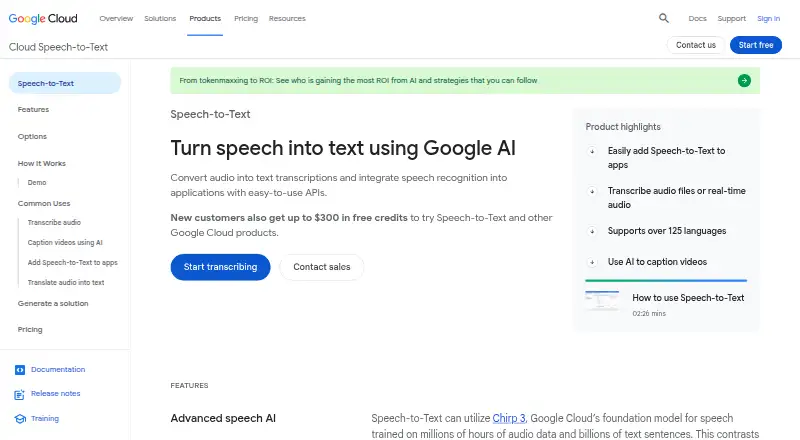
Google Cloud Speech-to-Text converts audio into text and provides APIs for adding speech recognition to applications. Recognition can run synchronously, asynchronously, or as a stream for post-processing, periodic updates, or real-time results. The product page lists support for more than 85 languages and variants. Users can provide model-adaptation hints for specialized terminology, uncommon words, and phrases; speaker diarization can attribute utterances to speakers. The service also supports multichannel audio and says it can process noisy audio without extra noise cancellation. Specialized models target voice control, phone calls, and video transcription. API v2 includes data residency, audit logging, and customer-managed encryption keys. An on-premises edition runs in customers’ private data centers and is offered through a sales contact. Developer access includes REST and RPC APIs, client libraries, and command-line quickstarts. Costs depend on audio duration, channel count, model, batch method, and API version, with each channel billed separately. Some plans include 60 free minutes per month; listed plan rates vary by recognition mode and version.
Who it suits
It suits developers adding speech recognition or transcription to applications, and teams handling live or batch audio. The on-premises option is aimed at customers seeking to run it in a private data center.
What it does well
- Synchronous, asynchronous, and streaming recognition
- Lists support for 85+ languages and variants
- Speaker diarization and multichannel recognition
- API v2 includes customer-managed encryption keys
- REST and RPC developer access
What to know first
- Each audio channel is billed separately
- Pricing varies by model and API version
- On-premises option requires a sales contact
Limits
The V1 standard plans with and without data logging each include 60 free minutes per month; usage above that is billed per minute. The V2 standard recognition plan lists $0.016 per minute for 0–500,000 minutes, with lower rates at higher monthly volumes. Dynamic batch plans are listed at $0.00 per month, while another V2 dynamic batch API listing bills $0.003 per minute.
Plans
| Plan | Billed and limits | Price |
|---|---|---|
| Speech-to-Text V2 Standard recognition | per 1 month / account · Standard speech recognition | $0.02 a month |
| Speech-to-Text V2 Dynamic Batch Recognition | per 1 month / account · Dynamic batch processing | Free |
| Speech-to-Text V1 Standard with data logging | 60 free minutes, then per 1 month / account · 60 free minutes per month | $0.02 a month |
| Speech-to-Text V1 Standard without data logging | 60 free minutes, then per 1 month / account · 60 free minutes per month | $0.02 a month |
| Medical Dictation | 60 free minutes, then per 1 month / account · 60 free minutes per month | $0.08 a month |
| Medical Conversation | 60 free minutes, then per 1 month / account · 60 free minutes per month | $0.08 a month |
| Speech-to-Text V2 API — Standard dynamic batch recognition | $0.003 / 1 minute, per 1 month / account · Dynamic batch · standard models · lower-urgency processing | Free |
| Speech-to-Text V1 API — Standard without data logging | 0–60 minutes: $0.00 (Free) / 1 minute, per 1 month / account; 60 minutes and above: $0.024 / 1 minute, per 1 month / account · 60 free minutes per month · standard recognition models | Free |
The first 8 of 10 plans, as cloud.google.com lists them, read 20 Sept 2026. The maker's own page has the final word. Every plan
Getting started
- Open the Google Cloud Speech-to-Text website.
- Choose an API workflow using the REST or RPC APIs, client libraries, or command-line quickstarts.
- Select synchronous, asynchronous, or streaming recognition for your processing needs.
- Consider a listed V1 plan with 60 free minutes per month, or a dynamic batch option listed at $0.00.
- Contact sales for the Speech-to-Text On-Prem option.
Verdict
Speech-to-Text offers multiple recognition modes, language support, and developer interfaces for application integration. Check the billing dimensions and applicable version or model before estimating usage.
Questions
Is Google Cloud Speech-to-Text free?
A free plan is listed, and some V1 plans include 60 free minutes per month. The V2 dynamic batch recognition plan is listed at $0.00 per month; other usage can be billed per minute.
How much does it cost?
The pricing note says from $0.00. Listed examples include $0.016 per minute for V2 standard recognition for 0–500,000 minutes, and $0.003 per minute for V2 standard dynamic batch recognition. Charges depend on usage and each channel is billed separately.
Which platforms are listed?
The listed platforms are API, self-hosted, and web.
Can it identify speakers and export subtitles?
Yes. Speaker identification and speaker labels are listed, and export formats include VTT and SRT.
Is there an on-premises option?
Yes. Speech-to-Text On-Prem runs in private data centers and is offered through a sales contact.
What developer access is available?
The documentation lists REST and RPC APIs, client libraries, and command-line quickstarts.
Facts from Google Cloud Speech-to-Text's own pages
- API access
- Yes · cloud.google.com, 20 Sept 2026
- Audio handling
- The service supports multichannel recognition and says it can handle noisy audio without additional noise cancellation. · cloud.google.com, 3 Oct 2026
- Billing limits
- Pricing depends on audio duration, number of channels, recognition model, batch method, and API version; each channel is billed separately. · cloud.google.com, 3 Oct 2026
- Company
- Google Inc. was officially born in August 1998, and Google’s current headquarters is in Mountain View, California. · about.google, 3 Oct 2026
- Connected service example
- A Google Cloud tutorial describes using Speech-to-Text with Translation API to create localized video subtitles. · cloud.google.com, 3 Oct 2026
- Export formats
- VTT,SRT · cloud.google.com, 20 Sept 2026
- Free plan
- No · cloud.google.com, 20 Sept 2026
- Integration and developer access
- The documentation lists REST and RPC APIs, client libraries, and command-line quickstarts. · docs.cloud.google.com, 3 Oct 2026
- Languages
- The product page states support for 85+ languages and variants. · cloud.google.com, 3 Oct 2026
- Model adaptation
- Model adaptation lets users give hints to improve recognition of domain-specific terms, rare words, and phrases. · cloud.google.com, 3 Oct 2026
- On-premises option
- Speech-to-Text On-Prem runs in customers’ private data centers and is offered through a sales contact. · cloud.google.com, 3 Oct 2026
- Purpose
- Speech-to-Text converts audio into text transcriptions and provides APIs for integrating speech recognition into applications. · cloud.google.com, 3 Oct 2026
- Real-time and batch modes
- The service supports synchronous, asynchronous, and streaming speech recognition for post-processing, periodic, or real-time results. · cloud.google.com, 3 Oct 2026
- Security controls
- Speech-to-Text API v2 supports data residency, audit logging, and customer-managed encryption keys. · cloud.google.com, 3 Oct 2026
- Speaker diarization
- The service can predict which speaker produced each utterance in a conversation. · cloud.google.com, 3 Oct 2026
- Speaker identification
- Yes · cloud.google.com, 20 Sept 2026
- Specialized models
- Google offers models tuned for uses including voice control, phone calls, and video transcription. · cloud.google.com, 3 Oct 2026
- Timestamp support
- Yes · cloud.google.com, 20 Sept 2026
Where Google Cloud Speech-to-Text stands on Freedom251
- AI transcription tools#6 of 46
- Transcription tools#4 of 28
- Speech-to-Text Software#9 of 35
- Speech Recognition Software#9 of 32
- Transcription Software#13 of 46
- Audio Transcription Software#14 of 35