Freedom251 › Game Networking Middleware
GGPO
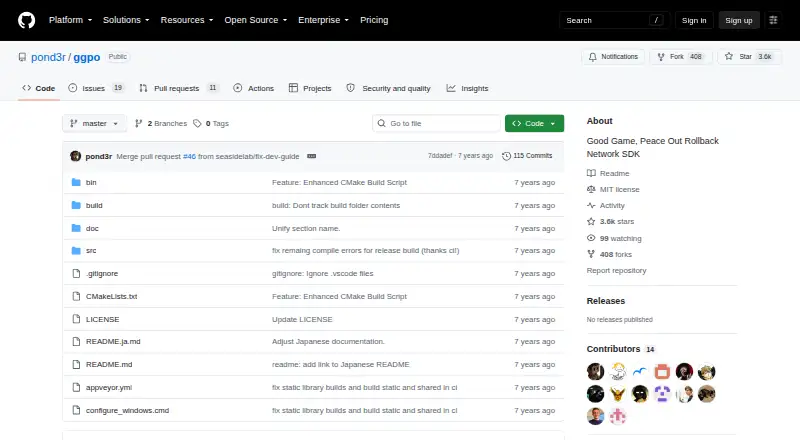
What GGPO is
GGPO is a free, open-source networking library for peer-to-peer games that need precise, responsive inputs. Its rollback approach predicts player inputs and lets the game advance while inputs from other players are in transit. When those inputs arrive and do not match the predictions, the game can replay its state from the point where they diverged. This is aimed at fast-paced games where execution depends on exact timing and individual frames.
Using the SDK requires a game to save and restore its state, and to run a frame without rendering its result. GGPO is designed to work with a fully deterministic peer-to-peer engine. Its repository includes SDK code, documentation and sample applications. The Vector War sample illustrates synchronizing two clients and includes examples for two, three and four players. GGPO uses UDP and is available under the MIT License for commercial and non-commercial use; attribution is appreciated but not required. The project was created in 2009. Building is currently supported only on Windows, using Visual Studio 2019 and CMake.
Who it suits
GGPO suits developers building fast-paced peer-to-peer games where responsive, frame-accurate input matters. It is a fit for teams whose engine can save and restore game state, run frames without rendering, and operate deterministically.
What it does well
- Free MIT-licensed SDK for commercial and non-commercial use.
- Predicts inputs to keep play progressing during network transit.
- Supports rollback resimulation when actual inputs differ.
- Includes SDK documentation and sample applications.
- Vector War demonstrates two-, three- and four-player examples.
What to know first
- Builds are currently available only on Windows.
- Integration requires deterministic peer-to-peer engine behavior.
- Games must support state saving, loading and non-rendered frame execution.
Limits
The SDK is free under the MIT License, with commercial and non-commercial use allowed. Builds are currently available only on Windows, and integration requires a deterministic peer-to-peer engine that can save and load state and execute frames without rendering.
Plans
| Plan | Billed and limits | Price |
|---|---|---|
| GGPO SDK (MIT License) | Free for commercial and non-commercial use · Attribution appreciated but not required | Free |
As github.com lists them, read 9 Oct 2026. The maker's own page has the final word.
Getting started
- Open the GGPO project repository on GitHub.
- Use a Windows environment to build the project.
- Install Visual Studio 2019 and CMake for Windows builds.
- Review the included SDK documentation and sample applications.
- Integrate state saving, loading and non-rendered frame execution into a deterministic peer-to-peer engine.
Verdict
Choose GGPO for a peer-to-peer game that needs rollback networking and can meet its deterministic engine and state-management requirements. Look elsewhere if you need a build platform beyond Windows today or cannot run frames without rendering.
Questions
How much does GGPO cost?
The GGPO SDK plan is free. It is free for commercial and non-commercial use under the MIT License.
What platforms can I build it on?
The project says builds are currently available only on Windows. Windows builds require Visual Studio 2019 and CMake.
What kind of games is GGPO designed for?
It is intended for fast-paced peer-to-peer games that need precise inputs and frame-perfect execution.
What does integration require?
The game must save and load state and execute a frame without rendering its outcome. GGPO is designed for a fully deterministic peer-to-peer engine.
What is included in the repository?
It contains SDK code, documentation and sample applications, including Vector War examples for two-, three- and four-player games.
What license does GGPO use?
GGPO is available under the MIT License for commercial and non-commercial use. Attribution is appreciated but not required.
Facts from GGPO's own pages
- Build platform
- The project README says building is currently available only on Windows, with efforts underway to port it to other platforms. · github.com, 9 Oct 2026
- Build tools
- Windows builds require Visual Studio 2019 and CMake. · github.com, 9 Oct 2026
- Contact
- The official site offers a contact form for licensing inquiries on terms other than the MIT license and other messages. · ggpo.net, 9 Oct 2026
- Engine requirement
- Rollback networking is designed to integrate with a fully deterministic peer-to-peer engine. · ggpo.net, 9 Oct 2026
- History
- The official site says GGPO was created in 2009 and pioneered rollback networking in peer-to-peer games. · ggpo.net, 9 Oct 2026
- Integration
- Integration requires the game to save and load state and execute a frame of game state without rendering its outcome. · ggpo.net, 9 Oct 2026
- Intended games
- The SDK is designed to hide network latency in fast-paced games that require precise inputs and frame-perfect execution. · ggpo.net, 9 Oct 2026
- License
- GGPO is available under the MIT License for commercial and non-commercial use; attribution is appreciated but not required. · github.com, 9 Oct 2026
- Purpose
- GGPO is a zero-input-latency networking library for peer-to-peer games. · ggpo.net, 9 Oct 2026
- Resimulation
- When received inputs differ from predictions, the game can be resimulated from the point of divergence. · ggpo.net, 9 Oct 2026
- Rollback
- It uses input prediction and speculative execution so gameplay can proceed while remote inputs are in transit. · ggpo.net, 9 Oct 2026
- Sample
- The Vector War sample application demonstrates synchronizing two clients and includes examples for two-, three-, and four-player games. · github.com, 9 Oct 2026
- SDK contents
- The repository contains the SDK code, documentation, and sample applications. · github.com, 9 Oct 2026
Where GGPO stands on Freedom251
- Game Networking Middleware#16 of 29