Freedom251 › Task Queue Software
Gearman
What Gearman is
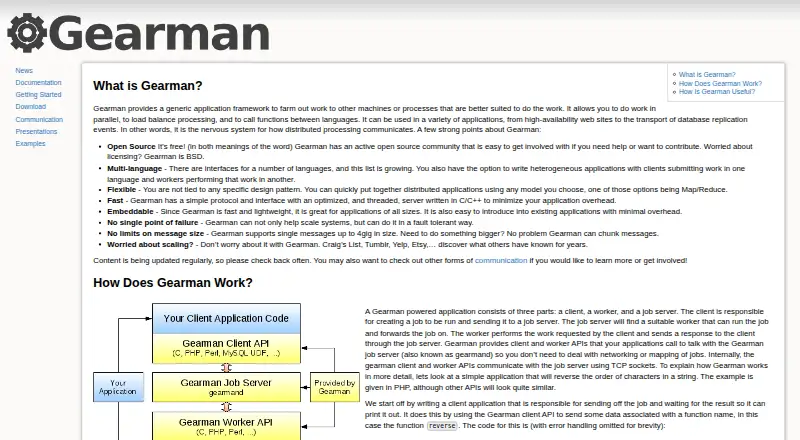
Gearman is a free application framework for distributing work across machines or processes. It supports parallel processing and load balancing through three parts: a client submits a job, a job server routes it, and a worker carries it out. Background asynchronous jobs and prioritized jobs are available. Clients and workers can use different language interfaces when both sides understand the workload. Supported interfaces include C, C#/.NET, Go, Java, Node.js, PHP, Perl, Python, Ruby, and Rust. Gearman handles messages up to 4096 MB and can chunk larger messages. Clients and workers can connect to multiple job servers and fail over to another if one goes down. The C job server supports persistent queues. MySQL and PostgreSQL functions let SQL queries, triggers, and stored procedures call Gearman clients; the pure Perl client and worker API supports SSL. Gearman is self-hosted, with Linux and Windows installation options, and is available under the BSD license. The project lists a 2.1.0 gearmand release with reliability improvements and a client ping option. Support is available through a mailing list and Matrix chat. GearmanSharp is incomplete and does not implement the full protocol.
Who it suits
Gearman suits developers and teams that need to distribute jobs across processes or machines, including work that benefits from parallel processing, load balancing, background execution, or job priorities. Its language interfaces and database functions can fit systems built with several programming languages or MySQL and PostgreSQL.
What it does well
- Free under the BSD license.
- Supports asynchronous background and prioritized jobs.
- Clients and workers can use different language interfaces.
- Handles payloads up to 4096 MB and can chunk larger messages.
- Supports failover across multiple job servers.
- MySQL and PostgreSQL functions can expose Gearman calls to SQL.
What to know first
- Self-hosted deployment requires users to run Gearman themselves.
- GearmanSharp is incomplete and does not implement the full protocol.
Plans
| Plan | Billed and limits | Price |
|---|---|---|
| Gearman | Open source · BSD license | Free |
| Gearman open-source software | self-hosted job server · client and worker APIs · BSD-licensed components | Free |
As gearman.org lists them, read 7 Oct 2026. The maker's own page has the final word.
Getting started
- Visit the Gearman website.
- Choose a Linux or Windows installation route, or use the API platform option.
- Set up a client to submit jobs, a job server to route them, and a worker to perform them.
- Choose client and worker language interfaces that can handle the same workload.
- Use the project's mailing list or Matrix chat for support.
Overview
Gearman is an open-source framework for distributing work across machines or processes, including parallel processing and load balancing. It suits teams building their own job-processing infrastructure across multiple languages. Its flexible client–server–worker design and failover support are compelling, though protocol coverage varies by client.
An application sends jobs from a client to a job server, which routes them to a worker for execution. That separation lets applications use different languages on each side of the queue, provided the client and worker agree on the workload.
Key features
Flexible job routing
Gearman supports background asynchronous and prioritized jobs, making it useful for work that should run outside a request or that needs relative urgency. The framework is designed for distributing work and balancing load, but it does not provide scheduled jobs.
Language interoperability
Client and worker interfaces cover C, C#/.NET, Go, Java, Node.js, PHP, Perl, Python, Ruby and Rust, among others. Different-language clients and workers can cooperate, which is useful when a team needs to connect services built with different stacks. That flexibility depends on both applications agreeing on the job format.
Payloads and resilience
The project supports messages up to 4 GB and can chunk larger messages. Clients and workers can connect to multiple job servers and fail over if one goes down, helping avoid a single-server dependency. The C job server supports persistent queues. The latest listed gearmand release, 2.1.0, adds reliability improvements and a client ping option.
Integration and security
MySQL and PostgreSQL user-defined functions expose Gearman client calls to SQL queries, triggers and stored procedures. The pure Perl client and worker API supports SSL. These integrations are useful for database-driven workflows and Perl deployments, but the stated SSL support is specific to that Perl API.
Pricing
Gearman is free: its plan costs nothing under an open-source BSD license. There is no free trial because the software is free, and there are no paid tiers or seat charges described. Self-hosting means teams provide and operate their own deployment; the framework does not include scheduled jobs.
Platforms
Gearman is available as an API and for Linux, Windows and self-hosted deployment. The Getting Started page includes a Windows installation link. Its multiple language interfaces broaden where teams can integrate it, while self-hosting makes infrastructure ownership part of the decision.
Who it's for
Gearman is a strong fit for engineering teams that want a free framework to route asynchronous or prioritized work among clients, job servers and workers, especially across language boundaries. Its failover options and persistent queues can suit teams building for resilience. It is less suitable for buyers seeking managed hosting, scheduled jobs, or a consistent implementation across every client: GearmanSharp is incomplete and does not implement the full protocol.
Pros and cons
- Pros: Free, BSD-licensed software avoids per-job pricing and supports self-hosted operation.
- Pros: Clients and workers can use different languages, giving mixed-stack teams room to integrate existing applications.
- Pros: Multiple job-server connections with failover, plus persistent queues in the C job server, support resilient designs.
- Cons: GearmanSharp does not implement the full protocol, so C#/.NET users should verify their required operations before adopting it.
- Cons: Scheduled jobs are not supported, ruling it out for workloads that depend on built-in scheduling.
- Cons: Self-hosted deployment leaves infrastructure operations to the team.
Alternatives
Task Queue Software is a useful starting point for comparing options across the category. Consider IronWorker if its free Basic plan's public cluster, one concurrency, five hours per month and 50 scheduled tasks match your needs. Django Q2 is another free, MIT-licensed option for teams working on Linux, macOS or self-hosted deployments. Choose Faktory if you want a free AGPL open-source edition or its enterprise packs, which start at $99 a month.
Google Tasks is a free choice for task lists, subtasks, due dates and notifications on Android, iOS or the web. Graphile Worker offers free MIT-licensed software, with a Worker Pro Launch Offer starting at $25 a month. Hangfire may suit teams seeking a free, commercially usable Open plan with SQL Server or in-memory storage. Inngest has a free tier with 5 seats, 50k executions, 500k events ingested and 24-hour trace history, or a Pro plan starting at $99 a month. pg-boss is a free MIT-licensed option that runs in your own database with no per-job charges.
Verdict
Choose Gearman if you need a free, self-hosted way to route jobs across clients and workers, particularly when those components use different languages or need job-server failover. Look elsewhere if you require scheduled jobs, managed deployment, or complete GearmanSharp protocol coverage.
Verdict
Choose Gearman if you need a free, self-hosted framework for routing jobs among clients, job servers, and workers, with support for multiple languages and job server failover. Check the protocol coverage before choosing GearmanSharp, which is incomplete.
Questions
How much does Gearman cost?
Gearman is free: its plan is free under the BSD license.
Does Gearman have a free trial?
No. Gearman has a free plan and no free trial.
Which platforms does Gearman support?
The listed platforms are API, Linux, self-hosted, and Windows.
Which languages have Gearman interfaces?
Listed interfaces include C, C#/.NET, Go, Java, Node.js, PHP, Perl, Python, Ruby, and Rust.
Can Gearman handle large messages and server failures?
It supports messages up to 4096 MB and can chunk larger messages. Clients and workers can connect to multiple job servers and fail over if one goes down.
Does Gearman integrate with databases?
The download page lists MySQL and PostgreSQL functions that expose Gearman client calls to SQL queries, triggers, and stored procedures.
Facts from Gearman's own pages
- Architecture
- A Gearman deployment has clients that submit jobs, a job server that routes them, and workers that execute them and return results. · gearman.org, 15 Oct 2026
- Build requirements
- The Ubuntu build guide lists GCC, autoconf, bison, flex, libtool, make, Boost, libcurl, libevent, memcached, UUID, SQLite, and MySQL development packages. · gearman.org, 15 Oct 2026
- Command-line interface
- The Ubuntu manpage documents command-line client and worker modes, background and priority options, multiple servers, timeouts, and worker counts. · manpages.ubuntu.com, 15 Oct 2026
- Cross-language execution
- Clients and workers can use different language APIs while communicating through the same Gearman protocol. · gearman.org, 15 Oct 2026
- Cross-language work
- Clients and workers can use different language interfaces as long as their applications understand the workload being sent. · gearman.org, 7 Oct 2026
- Database integration
- MySQL and PostgreSQL UDF packages expose Gearman client calls to SQL queries, triggers, and stored procedures. · gearman.org, 15 Oct 2026
- Database integrations
- The download page lists MySQL and PostgreSQL user-defined functions that expose Gearman client calls to SQL queries, triggers, and stored procedures. · gearman.org, 7 Oct 2026
- Documentation depth
- The documentation site includes getting started material, a manual, protocol specifications, generated gearmand documentation, libgearman references, install guides, SSL instructions, and changelogs. · gearman.org, 15 Oct 2026
- Fault tolerance
- Multiple job servers can be configured so clients and workers fail over when one server becomes unavailable. · gearman.org, 15 Oct 2026
- Founded
- 2005 · gearman.org, 28 Sept 2026
- Homebrew packaging
- Homebrew identifies gearman as the gearmand application, labels it BSD-3-Clause licensed, and provides bottles for macOS and Linux architectures. · formulae.brew.sh, 15 Oct 2026
- HTTP integration
- An HTTP protocol plugin maps GET and POST requests to Gearman jobs, but the documentation marks it experimental. · gearman.org, 15 Oct 2026
- Installation methods
- The getting-started guide covers RHEL/Fedora and Debian/Ubuntu packages, Windows installation, source tarballs, and Git checkout builds. · gearman.org, 15 Oct 2026
- Job modes
- Gearman supports background asynchronous jobs and prioritized jobs. · gearman.org, 7 Oct 2026
- Language APIs
- Official downloads list C, C#/.NET, Go, Java, Lisp, Node.js, PHP, Perl, Python, Ruby, Rust, database UDFs, and shell tooling. · gearman.org, 15 Oct 2026
- Language support
- The project lists client and worker interfaces for languages including C, C#/.NET, Go, Java, Node.js, PHP, Perl, Python, Ruby, and Rust. · gearman.org, 7 Oct 2026
- Latest release
- GitHub lists gearmand 2.1.0 as an August 2026 feature and bug-fix release improving thread safety, connection lifecycle reliability, OpenSSL diagnostics, health checks, and persistent-storage plugins. · github.com, 15 Oct 2026
- Licence
- The project describes itself as open source and BSD licensed; the C server and libgearman are specifically identified as BSD licensed. · gearman.org, 15 Oct 2026
- Limit: configuration guidance
- A project maintainer on the mailing list said Gearman had suffered prolonged silence and advised listing all job servers in every client and worker configuration for failover and distribution. · groups.google.com, 15 Oct 2026
- Limit: documentation
- The independent deployment report calls job-server documentation insufficient and says some socket keep-alive behavior was undocumented. · eastvisionsystems.com, 15 Oct 2026
- Limit: duplicate work after failure
- The independent report warns that a job can repeat database writes if it crashes after partially completing its database operations. · eastvisionsystems.com, 15 Oct 2026
- Limit: network security configuration
- A 2014 independent report said Gearman then lacked built-in access security and recommended firewall protection; current official documentation separately describes optional SSL configuration. · eastvisionsystems.com, 15 Oct 2026
- Limit: operational complexity
- A Gearman mailing-list user reported uneven worker utilization, queued jobs, stalled status reporting, high CPU use, and inconsistent multi-server statistics. · groups.google.com, 15 Oct 2026
- Limit: PHP operations
- A Reddit PHP discussion reports recurring queue errors, historical high-CPU extension bugs, and the operational burden of restarting large numbers of workers during updates. · reddit.com, 15 Oct 2026
Where Gearman stands on Freedom251
- Task Queue Software#1 of 37