Freedom251 › Fashion Design Software

garment.dev
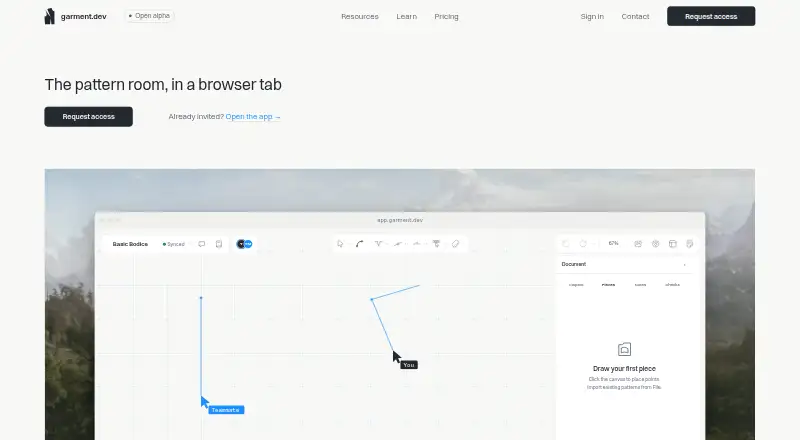
What garment.dev is
Garment.dev is browser-based software for drafting and grading patterns, nesting markers and producing production DXF files. Its workspace brings together patterns, construction specifications, people, moodboards, tech packs and bills of materials. Editing tools cover pen and trace work, linked edits, darts, pleats, fullness, seam walking, seam allowance and photo digitization. Users can create X/Y grading rules, check validation reports and build fabric markers with orientation, selvedge and nap constraints. The software imports and exports DXF-AAMA/ASTM, an interchange format also used by Gerber AccuMark, CLO3D, Optitex and StyleCAD. Team features include roles, shared boards, live editing, follow mode, comments and read-only mobile review. Garment.dev is in open alpha and access is by invitation. The free Hobby plan allows two patterns, one tech pack and one marker. Individual is listed at $16.20 a month, billed for 12 months. The service states it has no SOC 2, ISO 27001 or other audit report.
Who it suits
Garment.dev suits apparel pattern and production teams that want browser-based pattern drafting, grading, marker work and team collaboration. Access is currently by invitation, so it may not suit someone seeking open self-service access.
What it does well
- Imports and exports DXF-AAMA/ASTM
- Includes grading rules and validation reports
- Team features include live editing and shared boards
- Free Hobby plan available
What to know first
- Open alpha access is by invitation
- Hobby plan allows two patterns and one marker
- No public API yet
- No SOC 2, ISO 27001 or other audit report
Limits
The free Hobby plan allows two patterns, one tech pack, one moodboard, 720p export, one marker, 14 days of history, 50 checkpoints, and one editor. Individual, listed at $16.20 a month billed for 12 months, includes eight patterns, eight tech packs, three moodboards, and three markers.
Plans
| Plan | Billed and limits | Price |
|---|---|---|
| Hobby | 2 patterns · 1 tech pack · 1 moodboard · 720p export · 1 marker · 14 days history · 50 checkpoints · 1 editor · unlimited viewers and commenters | Free |
| Individual | Billed for 12 months · 8 patterns · 8 tech packs · 3 moodboards · full-resolution export · private patterns · 3 markers · Arch 36×48 printing · 30 days history · 100 checkpoints | $16.20 a month |
| Production | Billed for 12 months · Unlimited library · unlimited moodboards · unlimited markers · approved snapshots · auto-nest · every plotter size · unlimited history · 500 checkpoints · up to 4 editors | $24.30 a month |
| Studio | Billed yearly · Two people min. · Studio-owned library · named roles and approvals · per-pattern permissions · team audit · sold by conversation | $45 a month |
As garment.dev lists them, read 1 Oct 2026. The maker's own page has the final word.
Getting started
- Request an invitation to the open alpha.
- Open Garment.dev in a browser.
- Start with the free Hobby plan or select a paid plan.
- Create patterns and related workspace materials, then use the available editing, grading, and marker tools.
- Use DXF-AAMA/ASTM import or export when exchanging files.
Garment.dev is a browser-based patternmaking workspace for apparel professionals who want drafting, grading and production documentation together. It is most compelling for patternmakers and small teams coordinating those tasks; invitation-only alpha access and the lack of an audit report make it a cautious choice for production-critical operations.
Overview
The workspace brings patterns together with construction specifications, people, moodboards, tech packs and bills of materials. That breadth can keep design and production work connected instead of scattered across separate tools. The trade-off is maturity: Garment.dev is in open alpha, access is by invitation, and it has no public API yet.
Key features
Pattern tools cover pen and trace editing, linked edits, darts, pleats, fullness, seam walking, seam allowance and photo digitization. X/Y grading rules and validation reports support size development, while marker layouts can account for orientation, selvedge and nap. Together, these tools address more of the pattern-to-production workflow than drafting alone.
Garment.dev imports and exports DXF-AAMA/ASTM, an interchange format used by Gerber AccuMark, CLO3D, Optitex and StyleCAD. The company says it checks releases against 34 production files from major CAD systems, a useful compatibility signal for teams moving work between systems. Collaboration includes roles, shared boards, live editing, follow mode, comments and read-only mobile review.
Accounts use passkeys, and imported files are parsed in sandboxed WebAssembly workers with published resource limits. Data moves over TLS, storage is encrypted at rest, and backups are encrypted before leaving Garment Development and are write-once. These protections do not substitute for independent assurance: Garment.dev says it has no SOC 2, ISO 27001 or other audit report.
Pricing
The free Hobby plan costs nothing and is a narrow way to try the workflow: it allows 2 patterns, 1 tech pack, 1 moodboard, 1 marker, 720p export, 14 days of history, 50 checkpoints and 1 editor, with unlimited viewers and commenters. It suits an individual exploring the product, but the small library and single-editor cap constrain ongoing work.
Individual costs $16.20 a month, billed for 12 months. It raises the caps to 8 patterns, 8 tech packs, 3 moodboards and 3 markers, and adds full-resolution export, private patterns and Arch 36×48 printing; history is 30 days with 100 checkpoints. It fits a solo professional who needs those capabilities, but still has fixed library and marker limits.
Production costs $24.30 a month, billed for 12 months. It removes library, moodboard and marker caps, adds approved snapshots and auto-nest, supports every plotter size, and includes unlimited history, 500 checkpoints and up to 4 editors. This is the clearest fit for a small production team, though the editor ceiling matters as collaboration grows.
Studio is sold by conversation at $45 a month, billed yearly, with a two-person minimum. It adds a Studio-owned library, named roles and approvals, per-pattern permissions and team audit. Its minimum makes it a poor fit for a solo user, but the ownership and governance features target teams that need more structured control.
Platforms
Garment.dev runs in a browser, which avoids a desktop-platform requirement. Read-only mobile review is available for collaborators, but the core product is described as browser-based.
Who it's for
Choose Garment.dev if patternmaking, grading, markers and tech packs need to live in a shared workspace, particularly for a solo patternmaker or a small team. Look elsewhere if access must be immediate, an API is essential, or procurement requires an independent security audit.
Pros and cons
- Pro: Pattern editing, grading, marker constraints and production DXF work sit alongside tech packs and bills of materials, reducing workflow fragmentation.
- Pro: DXF-AAMA/ASTM import and export plus the stated checks against 34 production files give teams a concrete interoperability basis.
- Pro: Live collaboration, role controls and mobile read-only review support shared work without making every participant an editor.
- Con: Invitation-only alpha access makes adoption less predictable, and the product has no public API.
- Con: No SOC 2, ISO 27001 or other audit report may disqualify it for organizations with formal assurance requirements.
- Con: Hobby and Individual caps limit patterns, markers or editor capacity; Production allows at most 4 editors.
Alternatives
Seamly2D is a free, open-source option for users who want a desktop tool on Linux, macOS or Windows rather than an invitation-only browser workspace.
Valentina is worth considering for users who prefer a free desktop option with source code access and community support, while accepting that its free plan has no current binaries, manual or developer support.
PatternMaker suits Windows users who want a free viewer for pre-made patterns, or a one-time Deluxe Editor purchase rather than Garment.dev's recurring plans.
Browzwear VStitcher is an alternative for readers comparing paid apparel software with freelancer plans and desktop support across macOS and Windows.
Style3D Studio is another option for readers seeking desktop software, with a free non-commercial plan that allows 30 downloadable assets per week.
Futura Next is a paid Windows alternative for readers evaluating production software from Caledonia Group.
Gerber AccuMark is a paid Windows alternative for readers considering a standalone CAD system named as using DXF-AAMA/ASTM interchange.
Marvelous Designer is a paid alternative for users who need Linux, macOS or Windows support and prefer a personal monthly subscription.
Browse Fashion Design Software for more options.
Verdict
Garment.dev is a strong candidate for patternmakers and small apparel teams that want pattern development, production documentation and collaboration in one browser workspace. Its combined workflow is the main reason to choose it; invitation-only alpha access and the absence of independent audit reports are the main reasons to wait or look elsewhere when reliability and formal assurance are prerequisites.
Verdict
Garment.dev combines pattern work, production documentation and collaboration in a browser workspace. Its invitation-only alpha and stated audit-report gap are important considerations before adopting it.
Questions
How much does Garment.dev cost?
The Hobby plan is free. Individual is listed at $16.20 a month, billed for 12 months.
Is there a free trial?
No. Garment.dev offers a free Hobby plan.
What platforms does it support?
It is browser-based, and the listed supported platform is browser.
What file format does it use for CAD exchange?
Garment.dev imports and exports DXF-AAMA/ASTM. The site names Gerber AccuMark, CLO3D, Optitex, and StyleCAD as systems using that interchange format.
Can a team collaborate in Garment.dev?
Teams have roles, shared boards, live editing, follow mode, comments, and read-only mobile review.
Who runs Garment.dev?
The service is run by Garment Development in Toronto, Canada.
Facts from garment.dev's own pages
- Access and status
- The product is in open alpha and access is by invitation. · garment.dev, 1 Oct 2026
- API availability
- There is no public API yet. · garment.dev, 1 Oct 2026
- CAD interoperability
- Garment.dev imports and exports DXF-AAMA/ASTM and states that releases are checked against 34 production files from major CAD systems. · garment.dev, 1 Oct 2026
- Collaboration
- Teams support roles, shared boards, live editing, follow mode, comments, and read-only mobile review. · garment.dev, 1 Oct 2026
- Compliance status
- Garment.dev states that it does not hold SOC 2, ISO 27001, or another audit report. · garment.dev, 1 Oct 2026
- Core workspace
- The workspace combines patterns, construction specifications, people, moodboards, tech packs, and bills of materials. · garment.dev, 1 Oct 2026
- Data protection
- Data moves over TLS, storage is encrypted at rest, and backups are encrypted before leaving Garment Development and are write-once. · garment.dev, 1 Oct 2026
- Grading and markers
- Users can author X/Y grading rules, review validation reports, and build fabric markers with orientation, selvedge, and nap constraints. · garment.dev, 1 Oct 2026
- Headquarters
- Toronto, Canada · garment.dev, 28 Sept 2026
- Maker location
- The service is run by Garment Development in Toronto, Canada. · garment.dev, 1 Oct 2026
- Pattern tools
- Features include pen and trace editing, linked edits, darts, pleats, fullness, seam walking, seam allowance, and photo digitization. · garment.dev, 1 Oct 2026
- Security
- Accounts use passkeys without passwords, and imported files are parsed in sandboxed WebAssembly workers with published resource limits. · garment.dev, 1 Oct 2026
- Supported CAD systems
- The site names Gerber AccuMark, CLO3D, Optitex, and StyleCAD as systems using the DXF-AAMA/ASTM interchange format. · garment.dev, 1 Oct 2026
- What it does
- Garment.dev is browser-based pattern-making software for drafting, grading, marker nesting, and production DXF. · garment.dev, 1 Oct 2026
Where garment.dev stands on Freedom251
- Fashion Design Software#2 of 30