Freedom251 › Container Build Tools

Garden
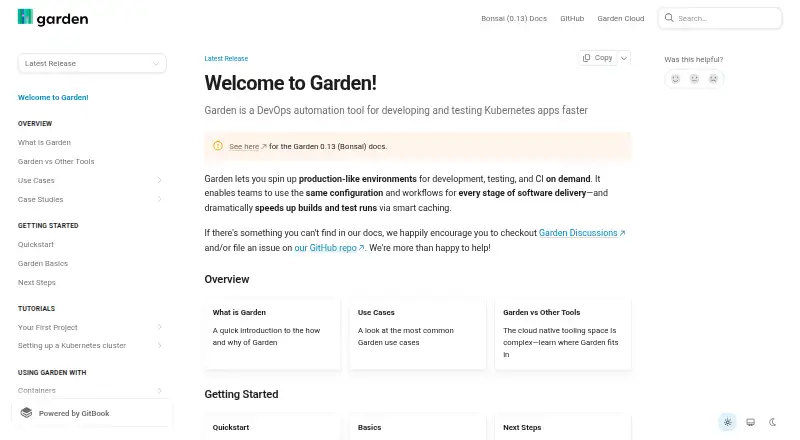
What Garden is
Garden is a DevOps automation tool for developing and testing applications that run on Kubernetes. It creates production-like environments for development, testing, and continuous integration on demand. Garden represents infrastructure, builds, services, and tests in a dependency-aware action graph, and its graph-aware caching skips images and tests that have not changed. Garden Core uses YAML declarations to make workflows reproducible across developer machines and CI systems. A sync mode sends changes to running deployments to speed up development feedback. Plugins are available for Kubernetes, Helm, Terraform, Pulumi, and local scripts. Garden's Terraform provider can validate and provision infrastructure and make stack outputs available to Garden actions; its Pulumi plugin is experimental and deploys stacks in dependency order. Garden Cloud's Remote Container Builder uses managed remote compute and shared Docker layer caches. It supports Linux, macOS, Windows, and self-hosted use. Garden requires Git 2.14 or newer, and local service builds require a local Kubernetes installation. Garden's free tier has limits on build minutes, cache hits, and cache retention. Team offers higher cache limits, more build minutes, and more layer caching. Garden Enterprise is a self-hosted Garden Cloud distribution installed in a customer's Kubernetes infrastructure. The company directs users to Garden Discussions and its GitHub repository for help and issue reporting.
Who it suits
Garden is intended for platform engineers, DevOps engineers, and application developers running workloads on Kubernetes. It suits teams that want repeatable development, testing, and CI environments, with local or managed remote build options.
What it does well
- Creates production-like development, testing, and CI environments on demand.
- Graph-aware caching skips unchanged images and tests.
- YAML workflows are designed to work across developer machines and CI.
- Plugins cover Kubernetes, Helm, Terraform, Pulumi, and local scripts.
- Supports Linux, macOS, Windows, and self-hosted use.
What to know first
- Free tier limits build minutes, cache hits, and cache retention.
- Local service builds require a local Kubernetes installation.
- The Pulumi plugin is experimental.
- Git 2.14 or newer is required.
Limits
The free tier limits build minutes, cache hits, and cache retention. Team provides higher cache limits, more build minutes, and more layer caching; Enterprise adds a self-hosted distribution, secrets management, and RBAC.
Plans
| Plan | Billed and limits | Price |
|---|---|---|
| Free tier | limited build minutes · cache hits · cache retention | Free |
| Free | Garden Core CLI · limited monthly remote-cache hits via Garden Cloud | Free |
| Team | per user · 1,000 remote build minutes per user monthly, pooled organization-wide · extra compute available à la carte | $50 a month |
| Enterprise | higher cache-hit limits · self-hosted or single-tenant cloud · enhanced security features | On request |
As garden.io lists them, read 1 Oct 2026. The maker's own page has the final word.
Getting started
- Install Garden on macOS, Windows, or Linux, or use a self-hosted setup.
- Make sure Git 2.14 or newer is available.
- Install local Kubernetes if you plan to build local services.
- Use Garden Core YAML declarations to define workflows.
- Choose plugins for the tools and services in your workflow.
- Consult Garden Discussions or the GitHub repository for help.
Garden is a DevOps tool for coordinating development and testing workflows around Kubernetes applications. It is aimed at platform and DevOps engineers, as well as developers working on Kubernetes-based services. Its dependency-aware workflow can make repeated builds and tests more efficient, though local service builds require Kubernetes on the developer’s machine.
Overview
Garden brings infrastructure, builds, services and tests together as actions in a dependency-aware graph. That gives teams a way to coordinate development, testing and CI in production-like environments they can create on demand. The approach suits projects with interconnected services and repeatable workflows; teams without Kubernetes workloads have less reason to adopt it.
Key features
Garden’s graph-aware cache avoids rerunning unchanged image builds and tests. This can reduce repeated work across development and CI runs, especially in projects where changes affect only part of a larger workflow. Garden Core uses YAML declarations to make workflows reproducible across developer machines and CI, while sync mode live-syncs changes to running deployments for quicker development feedback.
Plugins cover Kubernetes, Helm, Terraform, Pulumi and local scripts. The Terraform provider validates and provisions infrastructure and makes stack outputs available to Garden actions. Garden’s Pulumi plugin deploys stacks in dependency order, but it is experimental, so teams that depend on Pulumi should weigh that maturity limitation.
Garden Cloud’s Remote Container Builder uses managed remote compute and shared Docker layer caches. That offers another way to run container builds, while Garden’s local service builds require a local Kubernetes installation. Garden also supports Compose workflows and resource controls.
Pricing
Garden uses a freemium model. The Free tier costs nothing and has limited build minutes, cache hits and cache retention. It gives teams a no-cost starting point, but those caps may constrain sustained or larger workloads.
The Team plan has custom pricing and offers higher cache limits, more build minutes and more layer caching. It is the relevant step up for teams whose usage outgrows the Free tier. Enterprise also has custom pricing and includes secrets management, RBAC and a self-hosted distribution, making it the plan for organizations that need those controls and deployment model.
Platforms
Garden supports Linux, macOS, Windows, web and self-hosted use. Its desktop platforms are macOS, Windows and Linux. Garden requires Git 2.14 or newer, and local service builds need a local Kubernetes installation.
Who it's for
Garden is a strong fit for platform engineers, DevOps engineers and application developers running Kubernetes workloads who want repeatable development, testing and CI workflows. Dependency-aware caching and live sync are most useful where teams repeatedly build and test connected services. Teams that cannot provide local Kubernetes for service builds should look elsewhere.
Pros and cons
- Dependency-aware caching: Unchanged images and tests can be skipped, reducing repeated work in development and CI.
- Reproducible workflows: YAML declarations help carry the same workflow across developer machines and CI.
- Multiple infrastructure integrations: Plugins span Kubernetes, Helm, Terraform, Pulumi and local scripts, though the Pulumi plugin is experimental.
- Free tier caps: Limited build minutes, cache hits and cache retention may be restrictive as usage grows.
- Kubernetes requirement: Local service builds need a local Kubernetes installation, which limits fit for teams without one.
Alternatives
DevSpace is a free, open-source Kubernetes developer tool with a client-only CLI, for teams looking for a narrower developer tool. KubeVela offers a free, self-hosted Kubernetes control plane under the Apache-2.0 license. Argo CD is a free, self-managed Kubernetes option for teams focused on continuous delivery; its non-HA installation is not recommended for production.
Flux CD is a free open-source Kubernetes delivery project that requires a Kubernetes cluster. Argo Rollouts is a free, self-hosted Kubernetes controller and CRDs. Cyclops is free, self-hosted software that works with existing Helm charts.
Octopus Deploy has a free plan and a free trial, with a Machines add-on priced at $770 a year for a default of 10 machines and options up to 1,000. Plural offers a free Sandbox with a 14-day platform trial and a paid Pro plan.
For more options, browse Kubernetes Deployment Tools, Container Development Environments and Container Build Tools.
Verdict
Choose Garden if your team runs Kubernetes workloads and wants reproducible development and testing workflows that can skip unchanged builds and tests. The free tier provides a way to start, while Team adds capacity for higher usage and Enterprise adds secrets management, RBAC and self-hosting. Look elsewhere if local service builds cannot use a local Kubernetes installation.
Verdict
Pick Garden if your team runs Kubernetes workloads and needs reproducible development and testing workflows with dependency-aware caching. Its free tier provides a way to start, but teams needing higher cache limits, more build minutes, or more layer caching may need the Team plan. Look elsewhere if local service builds cannot use a local Kubernetes installation.
Questions
Does Garden have a free plan?
Yes. Its Free tier costs nothing, with limits on build minutes, cache hits, and cache retention.
What platforms does Garden support?
Garden lists Linux, macOS, Windows, and self-hosted use.
Does Garden require Kubernetes?
Garden is intended for Kubernetes workloads, and local service builds require a local Kubernetes installation.
Which integrations does Garden offer?
It provides plugins for Kubernetes, Helm, Terraform, Pulumi, and local scripts.
What are Team and Enterprise plans?
Team offers higher cache limits, more build minutes, and more layer caching. Enterprise is a self-hosted Garden Cloud distribution with secrets management and RBAC.
Where can users get Garden support?
Garden directs users to Garden Discussions and its GitHub repository for help and issue reporting.
Facts from Garden's own pages
- Action graph
- Its dependency-aware action graph tracks infrastructure, builds, deployments and tests to avoid unnecessary reruns. · github.com, 14 Oct 2026
- Audience
- Garden is intended for platform engineers, DevOps engineers and application developers running workloads on Kubernetes. · docs.garden.io, 1 Oct 2026
- Caching
- Garden uses graph-aware caching so unchanged images and tests do not run again. · docs.garden.io, 1 Oct 2026
- Changelog
- Release 0.14.18 dated February 25, 2026 added custom-command improvements and bundled Traefik ingress support. · github.com, 14 Oct 2026
- CI portability
- The same workflows can run on developer machines, CI servers and cloud environments. · docs.garden.io, 14 Oct 2026
- Company profile
- LinkedIn lists Garden.io as a privately held software-development company founded in 2018, headquartered in Berlin, with 11–50 employees. · linkedin.com, 14 Oct 2026
- Configuration
- Garden Core uses YAML declarations to make workflows reproducible and portable across developer machines and CI. · docs.garden.io, 1 Oct 2026
- Dashboard
- Garden Cloud's dashboard visualizes CI/CD flows, logs and command history. · docs.garden.io, 14 Oct 2026
- Docker requirement
- The quickstart requires Docker running, while local Kubernetes is optional for the introductory deployment. · docs.garden.io, 14 Oct 2026
- Documentation
- Documentation includes quickstarts, conceptual guides, workflow guides, provider references and a large CLI command reference. · docs.garden.io, 14 Oct 2026
- Enterprise deployment
- Garden Enterprise is a self-hosted Garden Cloud distribution installed into a customer's Kubernetes infrastructure. · enterprise-v1.docs.garden.io, 1 Oct 2026
- Environments
- Garden creates production-like environments for development, testing and CI on demand. · docs.garden.io, 1 Oct 2026
- Extensibility
- Garden is plugin-based and its repository includes an SDK area for building provider and action integrations. · github.com, 14 Oct 2026
- Infrastructure integrations
- The project identifies Kubernetes, Terraform and Pulumi as its principal plugins. · github.com, 14 Oct 2026
- Integrations
- Garden provides plugins for Kubernetes, Helm, Terraform, Pulumi and local scripts. · docs.garden.io, 1 Oct 2026
- Kubernetes integration
- Garden uses the Kubernetes API and kubectl, supports Helm and Kubernetes actions, and isolates work with namespaces. · docs.garden.io, 14 Oct 2026
- License
- The Garden repository is open source under the Mozilla Public License 2.0. · github.com, 14 Oct 2026
- Limit: documentation
- Reviewers say the documentation can be overwhelming or difficult to read, especially during initial setup. · g2.com, 14 Oct 2026
- Limit: learning curve
- G2 reviewers describe a steep learning curve for people new to Kubernetes, microservices or DevOps. · g2.com, 14 Oct 2026
- Limit: multi-project complexity
- A G2 reviewer reports difficulty managing dependencies across complex multi-project configurations. · g2.com, 14 Oct 2026
- Limit: shared files
- A G2 reviewer reports no convenient deployment mechanism for sharing files or libraries, leading to duplicated code or external resources. · g2.com, 14 Oct 2026
- Live synchronization
- Sync mode live-syncs code changes into running services for faster development feedback. · github.com, 14 Oct 2026
- Ownership news
- Incredibuild announced its acquisition of Garden on November 4, 2024, combining Garden's cloud-native CI capabilities with Incredibuild's acceleration platform. · incredibuild.com, 14 Oct 2026
- Praise: automation and integration
- Reviewers praise automated testing and deployment plus integration with existing CI pipelines and version-control systems. · g2.com, 14 Oct 2026
Where Garden stands on Freedom251
- Container Build Tools#1 of 34
- Kubernetes Deployment Tools#1 of 28
- Container Development Environments#2 of 40