Freedom251 › Breach and Attack Simulation Software

FourCore ATTACK
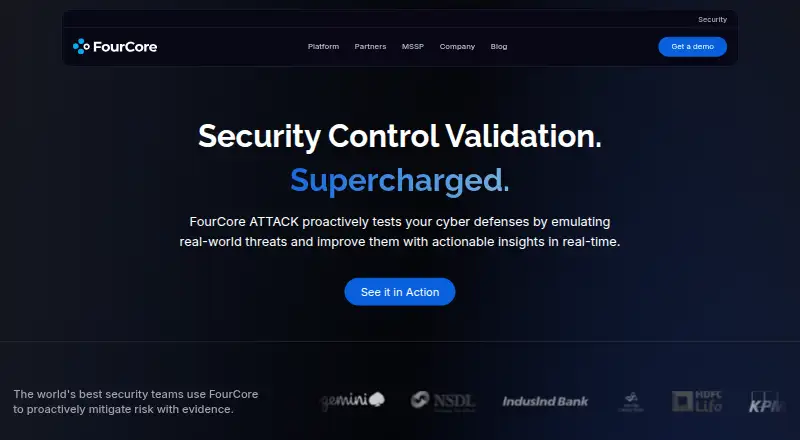
What FourCore ATTACK is
FourCore ATTACK is an adversarial exposure validation platform for checking how security controls respond to simulated cyberattacks. It uses threat intelligence connected to an organization’s environment to help security teams prioritize tests, then runs controlled campaigns that emulate adversary tactics, techniques, procedures, indicators, and artifacts. Simulations can cover endpoints, email, web application firewalls, network segmentation, SIEM, EDR, XDR, firewalls, DLP, and exfiltration controls. Results map activity to MITRE ATT&CK techniques and classify outcomes as detected, partially detected, blocked, or missed. Campaign evidence links simulated actions with telemetry, alerts, control responses, alert timing, and recommended next steps. Teams can use the results to generate or refine Sigma, YARA, Snort, and configuration changes, then retest after updates. FourCore describes integrations with security products including CrowdStrike, SentinelOne, Microsoft Sentinel, QRadar, Trend Micro Vision One, Proofpoint, Cisco Secure Email, Cortex XDR, and ServiceNow; findings can also enter Jira workflows. The platform is available as AWS-hosted SaaS, with on-premises options discussed by request. Lightweight Windows and Linux agents connect to the SaaS service. Pricing is on request.
Who it suits
FourCore ATTACK suits SecOps and detection engineering teams responsible for detection, response, and security control assurance. It is relevant to organizations that want recurring, mapped simulations across multiple security layers and workflows for acting on the results.
What it does well
- Maps simulation results to MITRE ATT&CK techniques.
- Supports continuous scheduling of attack simulations.
- Links campaign activity with telemetry, alerts, and outcomes.
- Can refine Sigma, YARA, Snort, and configuration changes.
- Lists integrations across endpoint, SIEM, email, and service workflows.
What to know first
- Pricing is available on request.
- On-premises deployment requires contacting FourCore.
- Windows and Linux agents connect to the SaaS platform.
Getting started
- Visit the FourCore website.
- Book a demo to discuss the platform and pricing.
- Choose the AWS-hosted SaaS platform or contact FourCore about on-premises solutions.
- Connect lightweight Windows or Linux agents to the SaaS platform as needed.
- Run controlled campaigns and review mapped results and recommended actions.
FourCore ATTACK is an adversarial exposure validation platform for security teams that need recurring, controlled simulations rather than occasional point-in-time assessments. It suits SecOps and detection engineering teams responsible for proving that endpoint, email, network and analytics controls respond to realistic behavior. Its strongest case is the closed loop from attack emulation to ATT&CK-mapped evidence, remediation changes and retesting; teams wanting transparent package pricing should look elsewhere.
Overview
FourCore ATTACK continuously models real-world cyberattacks to validate security controls. Its agentic threat intelligence connects current threats with an organization’s environment, helping teams prioritize which tests to run. Campaigns emulate adversary tactics, techniques, procedures, indicators and artifacts in controlled conditions, while lightweight Windows and Linux agents connect to the SaaS platform.
Results correlate simulation steps with telemetry, alert timing, control responses and outcomes across security tools. Each behavior maps to MITRE ATT&CK and is classified as detected, partially detected, blocked or missed. That makes the product more useful for measuring defensive coverage than a simple pass/fail scanner. FourCore says simulations are designed not to disrupt or destroy target systems, an important safeguard when testing production-connected controls.
Key features
- Broad control coverage: campaigns address endpoints, email, WAFs, network segmentation, SIEM, EDR, XDR, firewalls, DLP and exfiltration controls, allowing one program to examine several defensive layers.
- Actionable evidence: linking behavior to telemetry, alert timing and ATT&CK techniques helps detection engineers identify where a control failed and what to change next.
- Detection refinement: FourCore can generate or refine Sigma, YARA and Snort rules, plus configuration changes, then retest the behavior. This shortens the path from finding to verification, although teams still need ownership of rule review and deployment.
- Continuous scheduling: recurring simulations support ongoing assurance as threats and configurations change, rather than a single annual snapshot.
- Workflow and tool integrations: findings can move into Jira and ServiceNow. Named integrations include CrowdStrike, SentinelOne, Microsoft Sentinel, QRadar, Trend Micro Vision One, Proofpoint, Cisco Secure Email, Cortex XDR, ServiceNow, Microsoft Defender for Endpoint, Harfanglab, Qualys Cloud EDR, LimaCharlie and ZScaler NSS.
- Security safeguards: FourCore states that UI and API traffic uses HTTPS/TLS 1.2 or higher, with customer-selectable two-factor enforcement or SSO. It reports ISO 27001:2022 certification, CSA STAR Level 1 and detailed third-party penetration tests at least annually.
Pricing
FourCore ATTACK uses paid, custom pricing. Maker pages direct prospective customers to book a demo, so there are no published plans, seat counts, quotas, trial duration or renewal terms to compare. This fits organizations prepared for a security-platform buying process, but makes budget qualification harder for smaller teams and prevents a clear price-to-coverage comparison before contacting FourCore.
Platforms
The deployment model is hybrid. FourCore describes an AWS-hosted SaaS platform and invites customers to discuss on-premises solutions. Lightweight agents support Windows and Linux; the Windows agent is supplied as a preconfigured MSI and installed as a service. The listed platform coverage is Linux, Windows, web and self-hosted, with agent-based attack simulation.
Who it's for
Choose it for SecOps, detection engineering and control-assurance teams that need scheduled adversary emulation across multiple security products, defensible ATT&CK coverage metrics and a remediation-to-retest workflow. It is particularly suitable where Jira or ServiceNow processes and existing endpoint, SIEM, email and network tooling can consume correlated findings.
It is a weaker fit for a team seeking a free, self-directed test library, a simple open-source lab, or an immediately purchasable package with public limits. Organizations requiring on-premises deployment should confirm that arrangement directly with FourCore.
Pros and cons
Pros
- Closed-loop validation: generated rules and configuration changes can be retested, tying remediation to measurable behavior.
- Useful evidence model: ATT&CK mapping and detected/partially detected/blocked/missed outcomes give security leaders a consistent language for control gaps.
- Wide integration footprint: support for major EDR, XDR, SIEM, email and workflow products can reduce manual evidence collection.
- Safety and assurance controls: non-destructive simulations, TLS, 2FA or SSO options, ISO 27001:2022 and annual external penetration testing address operational and governance concerns.
Cons
- Custom pricing only: buyers cannot assess cost, seats or usage limits without entering a sales process.
- SaaS is the stated default: teams needing an on-premises installation must establish availability and terms with FourCore.
- Operational ownership remains with the customer: generated detections and configuration changes still require review, rollout and monitoring in the organization’s tools.
Alternatives
Atomic Red Team is the better choice for a free, community-developed option with tests designed to run in five minutes or less on Linux, macOS and Windows.
AttackIQ Platform suits buyers who want free testing packages and adversary research, with a published pay-as-you-go option at $300, paid once credit purchase.
Infection Monkey is a free, open-source BAS tool for Linux, Windows, web and self-hosted deployments.
MITRE Caldera fits teams wanting an Apache-licensed, open-source cybersecurity framework with API, Linux, macOS, self-hosted and web support.
OpenAEV offers a free-forever on-premise Community Edition with core attack simulation and tabletop exercises, plus community support.
Pentera Platform is another paid platform for API, Linux, self-hosted, web and Windows environments, with commercial details handled through a personalized demo.
Stratus Red Team is a free option covering API, Linux, macOS, self-hosted and Windows environments.
BlackNoise BAS is a paid alternative for self-hosted and web deployments.
Verdict
FourCore ATTACK is a strong choice for security teams that need recurring adversary simulations tied to control responses, ATT&CK coverage and retestable detection improvements. Its breadth, integrations and evidence model support mature SecOps programs. Look elsewhere if you require public pricing, a free starting tier or a clearly defined on-premises package before engaging a vendor.
Verdict
Choose FourCore ATTACK if your security team needs recurring adversary simulations with results tied to control responses and MITRE ATT&CK. Its remediation suggestions and retesting can support detection improvement; teams seeking stated plan prices or an on-premises setup should contact FourCore for details.
Questions
How much does FourCore ATTACK cost?
FourCore ATTACK is paid, with pricing on request.
Where can FourCore ATTACK be deployed?
FourCore describes an AWS-hosted SaaS platform and invites customers to contact it about on-premises solutions. The listed platforms include Linux, self-hosted, web, and Windows.
Which security tools does it integrate with?
Named integrations include CrowdStrike, SentinelOne, Microsoft Sentinel, QRadar, Trend Micro Vision One, Proofpoint, Cisco Secure Email, Cortex XDR, and ServiceNow.
Does FourCore ATTACK map to MITRE ATT&CK?
Yes. Simulation results map to MITRE ATT&CK techniques, with outcomes classified as detected, partially detected, blocked, or missed.
Who founded FourCore?
FourCore identifies Aarush Ahuja, Hardik Manocha, and Swapnil as its CEO, COO, and CTO co-founders, respectively.
How does FourCore describe simulation safety?
FourCore says its simulations are designed not to disrupt or destroy target systems.
Facts from FourCore ATTACK's own pages
- Attack emulation
- It emulates adversary tactics, techniques, procedures, indicators, and artifacts in controlled campaigns. · fourcore.io, 8 Oct 2026
- ATT&CK coverage
- Simulation results map to MITRE ATT&CK techniques and classify outcomes as detected, partially detected, blocked, or missed. · fourcore.io, 8 Oct 2026
- Company
- The About page identifies Aarush Ahuja, Hardik Manocha, and Swapnil as FourCore’s CEO, COO, and CTO co-founders, respectively. · fourcore.io, 8 Oct 2026
- Coverage
- The platform describes testing endpoint, email, network segmentation, WAF, SIEM, XDR, DLP, and exfiltration controls. · fourcore.io, 8 Oct 2026
- Deployment
- The FAQ says FourCore ATTACK is available as an AWS-hosted SaaS platform and invites customers to contact FourCore about on-premises solutions. · fourcore.io, 8 Oct 2026
- Detection improvement
- It can generate or refine Sigma, YARA, Snort, and configuration changes, then retest the behavior. · fourcore.io, 8 Oct 2026
- Endpoint agents
- FourCore describes lightweight Windows and Linux agents that connect to its SaaS platform; the Windows agent is provided as a preconfigured MSI and installed as a service. · fourcore.io, 8 Oct 2026
- Evidence
- Campaign results can link simulated behavior to control responses, telemetry, alert timing, ATT&CK techniques, and recommended next actions. · fourcore.io, 8 Oct 2026
- Integrations
- Listed integrations include CrowdStrike, SentinelOne, Microsoft Sentinel, QRadar, Trend Micro Vision One, Proofpoint, Cisco Secure Email, Cortex XDR, and ServiceNow. · fourcore.io, 8 Oct 2026
- Intended users
- The platform is presented for security teams responsible for detection, response, and control assurance, including SecOps and detection engineering teams. · fourcore.io, 8 Oct 2026
- Named integrations
- Its integrations page lists Trend Micro Vision One, Microsoft Defender for Endpoint, Harfanglab, Qualys Cloud EDR, LimaCharlie, CrowdStrike, SentinelOne, Microsoft Sentinel, QRadar, ZScaler NSS, Proofpoint, Cisco Secure Email, Cortex XDR, and ServiceNow. · fourcore.io, 8 Oct 2026
- Penetration testing
- FourCore says third-party security experts conduct detailed product penetration tests at least annually. · fourcore.io, 8 Oct 2026
- Pricing
- The maker pages reviewed direct visitors to book a demo and do not state plan prices. · fourcore.io, 8 Oct 2026
- Product
- FourCore ATTACK is an adversarial exposure validation platform that simulates cyberattacks to test security controls. · fourcore.io, 8 Oct 2026
- Purpose
- FourCore ATTACK continuously simulates real-world cyberattacks to validate whether security controls work. · fourcore.io, 8 Oct 2026
- Remediation
- The platform can generate or refine Sigma, YARA, Snort, and configuration changes, then retest behavior after updates. · fourcore.io, 8 Oct 2026
- Safety
- The FAQ says its attack simulations are designed not to disrupt or destroy target systems. · fourcore.io, 8 Oct 2026
- Security certification
- FourCore says it maintains ISO 27001:2022 certification and lists CSA STAR Level 1. · fourcore.io, 8 Oct 2026
- Security controls
- FourCore states that UI and API communications use HTTPS/TLS 1.2 or higher and that customers can choose 2FA enforcement or SSO. · fourcore.io, 8 Oct 2026
- Security testing
- FourCore says third-party security experts perform detailed product penetration tests at least annually. · fourcore.io, 8 Oct 2026
- Simulation safety
- FourCore says its simulations are safe and do not disrupt or destroy target systems. · fourcore.io, 8 Oct 2026
- Threat assessment
- Its agentic threat intelligence connects current threats with an organization’s environment to help prioritize tests. · fourcore.io, 8 Oct 2026
- Validation
- The platform correlates simulation steps with telemetry, alerts, and outcomes across security tools. · fourcore.io, 8 Oct 2026
- Workflow integrations
- The platform describes carrying findings into Jira and ServiceNow workflows. · fourcore.io, 8 Oct 2026