Freedom251 › Status Page Software
Flashduty Status Page
What Flashduty Status Page is
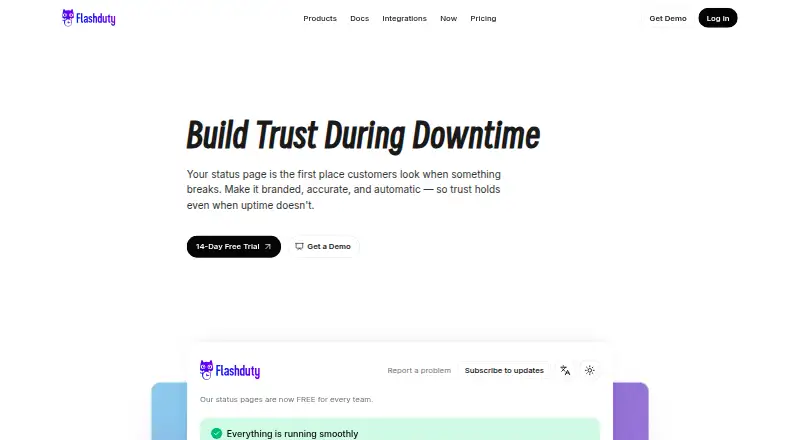
Flashduty Status Page publishes branded service status and incident updates for customers, partners, and internal teams. It can present a public page or a gated page for internal audiences, with subscriptions and access suited to each group. Its status information follows the incident record maintained in Flashduty, avoiding a separate customer-facing incident write-up. Teams can connect component availability to incident history to share uptime records, and schedule maintenance. Pages support custom domains, HTTPS, logos, and branded headers and footers. Public visitors can subscribe by email or RSS; internal teams can receive notifications through Feishu, DingTalk, WeCom, and Slack. Public pages are free to use, with publishing, custom domains, and RSS included; email beyond the allowance is billed on demand. The Free plan includes five users and one public page. Standard costs $14/user/mo, while Professional costs $29/user/mo and includes five public and 20 internal pages. Flashduty also documents an Open API and webhooks. Its stated data location is mainland China.
Who it suits
It suits organizations that need to publish customer-facing incident updates as well as gated status information for internal teams. Teams already maintaining incidents in Flashduty can use those records to inform status pages.
What it does well
- Supports public and gated internal status pages
- Incident updates sync from Flashduty records
- Offers custom domains, HTTPS, and branding
- Public pages include RSS subscriptions
- Open API and webhooks are documented
What to know first
- Customer data is stored on servers in mainland China
- Email beyond the included allowance is billed on demand
- Free and Standard include one public page each
Limits
The Free plan includes five users and one public status page. Public pages include publishing, custom domains, and RSS, while email beyond the included allowance is billed on demand. Internal pages are limited to Professional and Private Deployment, with a stated limit of 20.
Plans
| Plan | Billed and limits | Price |
|---|---|---|
| Standard | $14/user/mo · 1 public status page · unlimited users, schedules, and alerts | $14 a month |
| Professional | $29/user/mo · 5 public status pages · 20 internal status pages · unlimited users, schedules, and alerts | $29 a month |
| Free | $0/user/mo · 5 users · 1 public status page · 100 alerts/day | Free |
| Private Deployment | Contact us · 5 public status pages · 20 internal status pages · network-isolated deployment | On request |
As flashduty.com lists them, read 5 Oct 2026. The maker's own page has the final word.
Getting started
- Visit https://www.flashduty.com/en/products/status-page.
- Choose the Free plan or a paid plan; a 14-day trial is available.
- Configure a public page or, on an eligible plan, an internal page.
- Set up branding such as a custom domain, logo, and branded headers or footers.
- Connect incident updates through Flashduty or use its Open API and webhooks.
Flashduty Status Page is a branded status communication layer for service operators that need public incident updates alongside restricted internal notices. It suits teams already managing incidents in Flashduty, especially those serving audiences in China, while organizations needing broader hosting choices should weigh its mainland-China data residency carefully.
Overview
The service publishes customer- and partner-facing status pages and can also provide access-controlled pages for employees or other private audiences. Its most useful distinction is synchronization with Flashduty incident records: the public narrative can follow the incident maintained in the monitoring platform instead of being rewritten separately. That reduces conflicting updates when incidents evolve quickly.
Public pages are free to use and include publishing, custom domains, and RSS. Email notifications are included only up to an allowance, with additional messages billed on demand, so high-subscriber services need to budget for variable communication costs.
Key features
Incident updates and maintenance scheduling cover the routine communication work around outages and planned changes. Component-level availability is tied to incident history, allowing a team to show an auditable uptime record rather than only a current green or red indicator.
Branding options include a custom domain, HTTPS, logo, and branded header and footer. Public subscribers can use email and RSS. Internal pages add Feishu, DingTalk, WeCom, and Slack notifications, making the product better suited to organizations that must separate customer communication from operational-team alerts.
Developers can connect through an Open API and webhooks. Flashduty's wider integrations directory lists 283 alert sources for monitoring and observability connections, useful for routing and escalation but not all exclusive to the status-page product.
Security controls described for the platform include encryption in transit and at rest where applicable, access controls, audits, vulnerability remediation, physical safeguards, and disaster recovery. Flashduty reports ISO/IEC 27001:2022 and ISO 9001:2015 certifications for stated cloud-native monitoring development scopes. All customer data is stored on servers in mainland China, a decisive constraint for some regulated or geographically distributed organizations.
Pricing
Free — free, billed monthly: five users, one public status page, collaboration, and status-page functions. It is a practical starting point for a small service, but the single-page cap and five-user limit leave little room for multiple products or larger teams.
Standard — $14 a month, billed at $14/user/mo: one public page with unlimited users, schedules, and alerts. This removes the Free plan's user ceiling without adding more public properties or internal pages, so it fits a single-service organization with a broad operations group.
Professional — $29 a month, billed at $29/user/mo: five public pages, 20 internal pages, and unlimited users, schedules, and alerts. It is the appropriate tier for portfolios of services or teams needing audience-gated internal communications. Dedicated support is listed for this plan.
Private Deployment — custom pricing: network-isolated deployment, local data retention, LDAP, and internal integrations. Choose it when isolation or directory integration outweighs the convenience of the hosted tiers; dedicated support is included in the plan description.
A 14-day trial is offered. Public pages remain free, while email beyond the included allowance is charged on demand, so subscriber volume matters even when the page itself costs nothing.
Platforms
Flashduty Status Page is offered through the web, API, and self-hosted deployment options. Private Deployment adds a network-isolated operating model rather than simply extending the hosted plans.
Who it's for
Choose it if your organization already uses Flashduty for incident management, needs both public and internal audiences, or wants component-level historical availability attached to incident records. It is also a logical fit for teams whose notification workflows center on Feishu, DingTalk, WeCom, or Slack.
Look elsewhere if data must remain outside mainland China, if you need several public pages on the entry tiers, or if pay-as-you-go email could complicate communications budgeting.
Pros and cons
- Pro: Incident synchronization avoids maintaining a second customer-facing incident narrative.
- Pro: Custom domains, HTTPS, logos, and branded headers and footers support a consistent service identity.
- Pro: Internal pages and audience-specific channels cover operational teams as well as customers.
- Pro: Component availability linked to incident history creates a shareable uptime record.
- Con: Free and Standard each allow only one public page.
- Con: Internal pages are restricted to Professional and Private Deployment, with a 20-page limit.
- Con: Email over the included allowance incurs on-demand charges.
- Con: Mainland-China-only hosting may conflict with residency or transfer requirements.
Alternatives
Browse the Status Page Software list when you want to compare a wider field. AppStatus is worth considering for a free page bundled with monitoring limits, heartbeats, team members, and a workspace. Pick openstatus when self-hosting and a free Hobby plan with one monitor and one page are priorities. StatusIQ fits teams wanting a free page with 10 components and 100 subscribers across web and mobile access.
cState is the free, open-source choice for static, self-hosted, Markdown-based status pages. Spectate suits users seeking monitor or server limits with mobile apps. Instatus is an alternative for a free public page with monitoring, email alerts, and small-team on-call allowances. StatusEntry targets a single-user setup with unlimited updates, two services, an uptime graph, and customization. StatusOwl is a fit for a free-forever page with 25 monitors, three-minute checks, two team members, and 30 days of history.
Verdict
Flashduty Status Page is a strong choice for Flashduty customers that need synchronized incident publishing, branded public pages, and controlled internal communications in one workflow. Its main reasons to look elsewhere are the one-page entry tiers, metered excess email, and mainland-China data residency; organizations with those constraints should choose a platform whose hosting and quotas match them.
Verdict
Flashduty Status Page combines public updates, internal notifications, and incident-linked availability history. Check the page limits, email allowance, and mainland China data location against your organization’s needs.
Questions
Is there a free plan?
Yes. Free includes five users and one public status page. Public status pages include publishing, custom domains, and RSS; email beyond the included allowance is billed on demand.
What do the listed plans cost?
Free costs nothing. Standard is $14/user/mo, and Professional is $29/user/mo. Private Deployment has no listed price.
How many status pages do the plans include?
Free and Standard include one public page. Professional and Private Deployment include five public pages and up to 20 internal pages.
Can I make an internal status page?
Yes. Internal pages are available on Professional and Private Deployment, with audience-specific access and subscriptions.
Which notification channels are supported?
Public pages support email and RSS subscriptions. Internal pages can notify teams through Feishu, DingTalk, WeCom, and Slack.
Where is customer data stored?
Flashduty states that it operates as a single service hosted in mainland China and stores all customer data on servers there.
Facts from Flashduty Status Page's own pages
- API
- Flashduty documentation says developers can integrate through its Open API and webhooks. · docs.flashduty.com, 5 Oct 2026
- Availability history
- Component-level availability is mapped to incident history so teams can share auditable uptime records. · flashduty.com, 5 Oct 2026
- Branding
- Pages can use a custom domain, HTTPS, logo, and branded headers and footers. · flashduty.com, 5 Oct 2026
- Custom domain
- Yes · flashduty.com, 19 Sept 2026
- Data location
- Flashduty states that it operates as a single service hosted in mainland China and stores all customer data on servers there. · flashduty.com, 5 Oct 2026
- Data safeguards
- The maker lists encryption in transit and at rest where applicable, access controls, security audits, vulnerability remediation, physical security, and disaster recovery measures. · flashduty.com, 5 Oct 2026
- Free plan
- Yes · flashduty.com, 19 Sept 2026
- Incident sync
- The status page reflects the incident story maintained in Flashduty, avoiding duplicate customer-facing write-ups. · flashduty.com, 5 Oct 2026
- Incident updates
- Yes · flashduty.com, 19 Sept 2026
- Integrations
- Flashduty's integrations directory lists 283 alert sources and describes connecting monitoring and observability tools for noise reduction, routing, and escalation. · flashduty.com, 5 Oct 2026
- Maintenance scheduling
- Yes · flashduty.com, 19 Sept 2026
- Plan limits
- The pricing page lists 1 public status page on Free and Standard, 5 on Professional and Private Deployment, and internal pages only on the latter two plans, with a limit of 20. · flashduty.com, 5 Oct 2026
- Private status page
- Yes · flashduty.com, 19 Sept 2026
- Public and internal pages
- It supports public pages and gated internal pages with audience-specific subscriptions and access. · flashduty.com, 5 Oct 2026
- Purpose
- Flashduty Status Pages publish branded service status and incident updates for customers, partners, and internal teams. · flashduty.com, 5 Oct 2026
- Security certifications
- The maker reports ISO/IEC 27001:2022 and ISO 9001:2015 certifications for the stated cloud-native monitoring platform development scopes. · flashduty.com, 5 Oct 2026
- Status page pricing
- Public status pages are free to use, with publishing, custom domains, and RSS included; email beyond the included allowance is billed on demand. · flashduty.com, 5 Oct 2026
- Subscriber channels
- multi-channel · flashduty.com, 19 Sept 2026
- Subscriptions
- Public pages support email and RSS subscriptions; internal pages can notify teams through Feishu, DingTalk, WeCom, and Slack. · flashduty.com, 5 Oct 2026
- Support
- Flashduty offers contact by email, phone, demo booking, and business or technical support chat; its pricing page lists dedicated support on Professional and Private Deployment. · flashduty.com, 5 Oct 2026
Where Flashduty Status Page stands on Freedom251
- Status Page Software#4 of 31
- Status page services#10 of 31