FHEM
What FHEM is
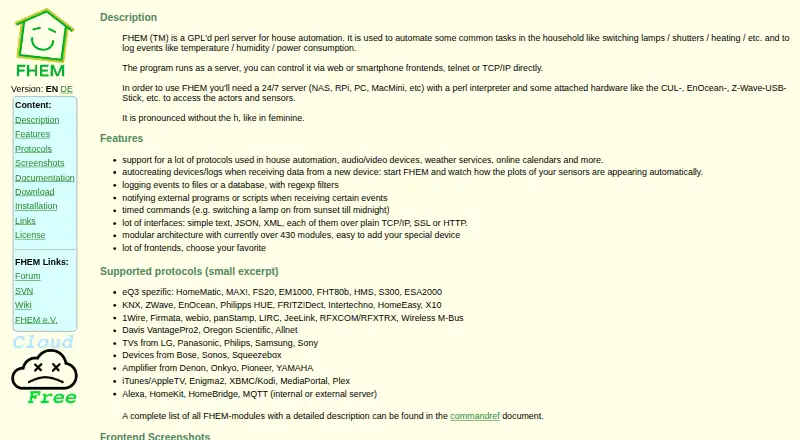
FHEM is a free, GPL version 2 Perl server for automating household devices and recording events such as temperature, humidity, and power use. It can control lamps, shutters, and heating, and users can operate it through web or smartphone frontends, telnet, or TCP/IP. FHEM can create device entries and logs when new devices send data, save events to files or a database with regular-expression filters, notify external programs or scripts, and run commands on a schedule.
The system is modular, with over 430 modules and options to add device support. Examples of supported devices and services include HomeMatic, Z-Wave, EnOcean, Philips Hue, FRITZ!Dect, Alexa, HomeKit, HomeBridge, and MQTT. Listed media examples include televisions from LG, Panasonic, Philips, Samsung, and Sony, plus Bose and Sonos devices, Kodi, Plex, and Apple TV. Text, JSON, and XML interfaces can use TCP/IP, SSL, or HTTP.
FHEM runs locally, but requires a server that stays on continuously, Perl, and compatible hardware connected to the server. Installation coverage includes Debian, Ubuntu, Raspbian, Unix, macOS, and Windows. Downloads include packages, nightly versions, and a container image for Docker, Kubernetes, and Podman. Documentation includes a command reference and wiki, with a forum for questions and support.
Who it suits
FHEM suits people who can maintain a continuously running Perl server and connect compatible household devices or sensors. Its modular design and broad list of device and service examples may fit setups that need local automation and event logging.
What it does well
- Runs locally and is GPL version 2 software.
- Supports web and smartphone frontends, telnet, and TCP/IP control.
- Can log events to files or a database with filters.
- Timed commands and notifications to scripts support automation.
- More than 430 modules support a range of devices and services.
- Text, JSON, and XML interfaces are available.
What to know first
- Requires a 24/7 server, Perl, and compatible attached hardware.
- The privacy notice says complete protection from third-party access cannot be guaranteed.
- Most forum entries are in German.
Limits
FHEM is free, but requires a continuously running server with Perl and compatible hardware. The site advises against deploying it on Fritz!Box under the stated Fritz!OS conditions.
Plans
| Plan | Billed and limits | Price |
|---|---|---|
| FHEM | GPL v2 software · requires a continuously running server with Perl and compatible hardware | Free |
As fhem.de lists them, read 8 Oct 2026. The maker's own page has the final word.
Getting started
- Visit https://fhem.de/ and choose an installation route for a supported system.
- Provide a server that can stay on continuously, such as a NAS, Raspberry Pi, PC, or Mac Mini.
- Install Perl and connect compatible hardware for devices and sensors.
- Install FHEM using the applicable package or container option.
- Use the command reference, wiki, or forum for help.
Verdict
Choose FHEM if you want free local home automation and can provide a continuously available Perl server with compatible hardware. Look elsewhere if you need a setup that does not depend on maintaining that server and its device connections.
Questions
How much does FHEM cost?
FHEM is free software, listed as free.
Is FHEM open source?
Yes. The site identifies it as GPL-licensed software under version 2.
What does FHEM run on?
Installation coverage includes Debian, Ubuntu, Raspbian, Unix, macOS, and Windows. It requires a server that stays on continuously, Perl, and compatible attached hardware.
Can FHEM work locally?
Yes. FHEM is described as running locally, with control through web or smartphone frontends, telnet, or TCP/IP.
Which devices and services are supported?
Examples include HomeMatic, Z-Wave, EnOcean, Philips Hue, FRITZ!Dect, Alexa, HomeKit, HomeBridge, and MQTT. The site also lists television, audio, and media integrations.
Where can users get support?
FHEM provides a command reference, wiki, and forum, and directs support requests to the forum rather than private email. Questions may be asked in English, though most forum entries are in German.
Facts from FHEM's own pages
- Automation features
- FHEM can automatically create devices and logs when it receives data from a new device, log events to files or a database with regular-expression filters, notify external programs or scripts, and run timed commands. · fhem.de, 8 Oct 2026
- Device and service support
- The listed protocol and integration examples include HomeMatic, Z-Wave, EnOcean, Philips Hue, FRITZ!Dect, Alexa, HomeKit, HomeBridge, and MQTT. · fhem.de, 8 Oct 2026
- Documentation and support
- FHEM provides a command reference, wiki, and forum; the site says users may ask questions in English, though most forum entries are in German, and directs support requests to the forum rather than private email. · fhem.de, 8 Oct 2026
- Downloads and containers
- The download section lists version 6.4 packages dated 2025-03-29, nightly versions, and a container image for Docker, Kubernetes, and Podman. · fhem.de, 8 Oct 2026
- Energy monitoring
- Yes · fhem.de, 24 Sept 2026
- Free plan
- Yes · fhem.de, 24 Sept 2026
- Home automation
- FHEM is a Perl server for automating household devices such as lamps, shutters, and heating, and logging events such as temperature, humidity, and power use. · fhem.de, 8 Oct 2026
- How it is controlled
- The server can be controlled through web or smartphone frontends, telnet, or TCP/IP directly. · fhem.de, 8 Oct 2026
- Interfaces
- Its text, JSON, and XML interfaces are available over plain TCP/IP, SSL, or HTTP. · fhem.de, 8 Oct 2026
- License
- The site identifies FHEM as GPL-licensed and specifies GPL version 2. · fhem.de, 8 Oct 2026
- Local control
- Yes · fhem.de, 24 Sept 2026
- Media integrations
- The site lists support examples including TVs from LG, Panasonic, Philips, Samsung, and Sony; Bose and Sonos devices; and Kodi, Plex, and Apple TV. · fhem.de, 8 Oct 2026
- Modules
- The site describes FHEM as modular, with over 430 modules and the ability to add device support. · fhem.de, 8 Oct 2026
- Security and privacy statement
- The privacy notice says internet data transmission may have security gaps and that complete protection from third-party access cannot be guaranteed. · fhem.de, 8 Oct 2026
- Self-hosting requirement
- FHEM requires a 24/7 server such as a NAS, Raspberry Pi, PC, or Mac Mini, with Perl and attached hardware to access devices and sensors. · fhem.de, 8 Oct 2026
- Supported installation systems
- The installation section covers Debian, Ubuntu, Raspbian, Unix, macOS, and Windows, and advises against deploying FHEM on Fritz!Box under the stated Fritz!OS conditions. · fhem.de, 8 Oct 2026
- Voice assistant support
- Yes · fhem.de, 24 Sept 2026
- Who it is for
- FHEM is intended for people who can run a continuously available Perl server and connect compatible hardware for household automation. · fhem.de, 8 Oct 2026
- Z-Wave support
- Yes · fhem.de, 24 Sept 2026
Where FHEM stands on Freedom251
- Home Automation#4 of 25
- Home automation platforms#16 of 25