Freedom251 › DevOps analytics software

FeatureFactory
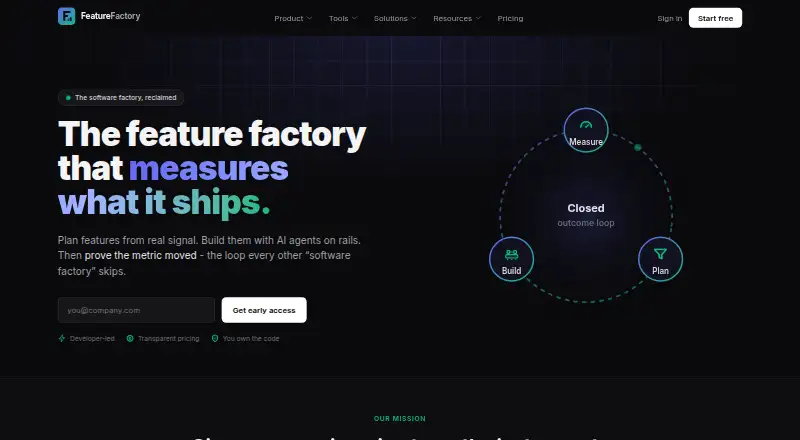
What FeatureFactory is
FeatureFactory brings product signals, AI-assisted work planning, and delivery measurement into one workflow for software teams. It gathers inputs from tools such as Jira, Slack, support systems, and calls, groups them into themes, and turns them into plans for agents. Teams can approve a plan as a scoped work order, choose the AI agents that carry it out, and keep human approval and review gates in the process. Once changes are merged and released, FeatureFactory evaluates linked work against a baseline and its intended product or customer outcome.
For measurement, it scores pull requests and commits for quality and effort, tracks team velocity, and distinguishes AI-authored work from human work. It also supports DORA, delivery, and reliability metrics. The integration catalog includes GitHub, Jira, Linear, Slack, Intercom, Zendesk, HubSpot, Salesforce, and other tools; integrations are labeled early access, and other systems can connect through its API. GitHub measurement starts read-only, and existing tests, branch protection, review, and merge controls remain in place. Pull request diffs and code content go to Anthropic for scoring and recommendations; signal text and pull request descriptions go to OpenAI for embeddings, not raw code diffs. Application data is hosted on AWS and stored in the EU or US region according to account configuration.
Who it suits
Solo is described for one developer, while Team is aimed at engineering teams that want to plan and measure together. It may suit teams that want to connect product signals to AI agent work and track outcomes after release.
What it does well
- Scores pull requests and commits for quality and effort.
- Tracks team velocity and separates AI-authored work from human work.
- Supports DORA, delivery, and reliability metrics.
- Approved work orders retain human approval and review gates.
- Other systems can connect through the API.
What to know first
- Solo is limited to one developer and one connected repository.
- Solo includes 30 days of measurement history.
- Integrations are labeled early access and require an access request.
- SSO is unavailable.
Limits
Solo is free forever for one developer and one connected repository, with 30 days of measurement history and five representative AI quality previews. Team is $49 per developer per month, billed annually, and includes 12 months of AI scoring history; Business is $99 per developer per month, billed annually, and includes unlimited scoring and measurement history.
Plans
| Plan | Billed and limits | Price |
|---|---|---|
| Solo | free forever · 1 developer · 1 connected repo · 30 days of measurement history · 5 representative AI quality previews | Free |
| Team | per developer / month; billed annually · Unlimited repositories · 12 months of AI scoring history · managed AI included | $49 a month |
| Business | per developer / month; billed annually · Unlimited scoring & measurement history · customer outcome integrations · work orders and agent pipeline · priority support | $99 a month |
| Enterprise | custom · SSO / SAML and SCIM provisioning (on the roadmap) · self-hosted or on-prem model routing (on the roadmap) · custom DPA · dedicated success + SLAs | On request |
As featurefactory.com lists them, read 8 Oct 2026. The maker's own page has the final word.
Getting started
- Visit the FeatureFactory website.
- Choose Solo, Team, Business, or Enterprise.
- Use the Solo plan for one developer and one connected repository, or choose a paid plan for its listed provisions.
- Connect tools from the integration catalog; integrations are labeled early access and users can request access.
- Use the API to connect other systems.
Verdict
Choose FeatureFactory if you want to connect product signals with agent work orders and measure changes against intended outcomes. Solo suits one developer exploring the workflow, while Team and Business offer broader measurement and planning provisions. Look elsewhere if you need available SSO or integrations that are not in early access.
Questions
Is there a free plan?
Yes. Solo is free forever for one developer and one connected repository.
What do paid plans cost?
Team costs $49 per developer per month, billed annually. Business costs $99 per developer per month, billed annually; Enterprise has custom pricing.
Which platforms does FeatureFactory support?
The listed platforms are API and web.
Which integrations are available?
The catalog lists GitHub, Jira, Linear, Slack, Intercom, Zendesk, HubSpot, Salesforce, and other tools. Integrations are labeled early access; other systems can connect through the API.
Where does code go for AI processing?
Pull request diffs and code content go to Anthropic for AI scoring and recommendations. Signal text and pull request descriptions go to OpenAI for embeddings, while raw code diffs are not sent to OpenAI.
Does FeatureFactory support SSO?
SSO is listed as unavailable. Enterprise lists SSO/SAML and SCIM provisioning as roadmap items.
Facts from FeatureFactory's own pages
- Build
- Approved plans can become scoped work orders that execute with AI agents selected by the team, with human approval and review gates. · featurefactory.com, 8 Oct 2026
- Code sent to AI providers
- FeatureFactory sends pull request diffs and code content to Anthropic for AI scoring and recommendations; it sends signal text and PR descriptions to OpenAI for embeddings, not raw code diffs. · featurefactory.com, 8 Oct 2026
- DPA
- Enterprise customers may request a signed DPA, and FeatureFactory says it will respond within two business days. · featurefactory.com, 8 Oct 2026
- Hosting and data region
- AWS hosts application data, which is stored at rest in the EU or US region according to account configuration. · featurefactory.com, 8 Oct 2026
- Integrations
- The integration catalog lists GitHub, Jira, Linear, Slack, Intercom, Zendesk, HubSpot, Salesforce, and other tools, and says other systems can connect through its API. · featurefactory.com, 8 Oct 2026
- Integration status
- The catalog labels integrations as early access and invites users to request access. · featurefactory.com, 8 Oct 2026
- Intended users
- The pricing page describes Solo for one developer and Team for engineering teams measuring and planning together. · featurefactory.com, 8 Oct 2026
- Measure
- It scores pull requests and commits for quality and effort, tracks team velocity, and distinguishes AI-authored work from human work. · featurefactory.com, 8 Oct 2026
- Outcome measurement
- After merge and release, linked changes are evaluated against the baseline and intended product or customer outcome. · featurefactory.com, 8 Oct 2026
- Plan
- It ingests signals from tools such as Jira, Slack, support systems, and calls, groups them into themes, and generates plans for agents to build from. · featurefactory.com, 8 Oct 2026
- Product purpose
- FeatureFactory connects product signals, AI agent workflows, and outcome measurement so teams can plan features, build them, and measure results. · featurefactory.com, 8 Oct 2026
- User controls
- GitHub measurement starts read-only, generated plans and work orders require owner approval, and existing tests, branch protection, review, and merge controls remain in place. · featurefactory.com, 8 Oct 2026
Where FeatureFactory stands on Freedom251
- DevOps analytics software#17 of 48