fast.ai
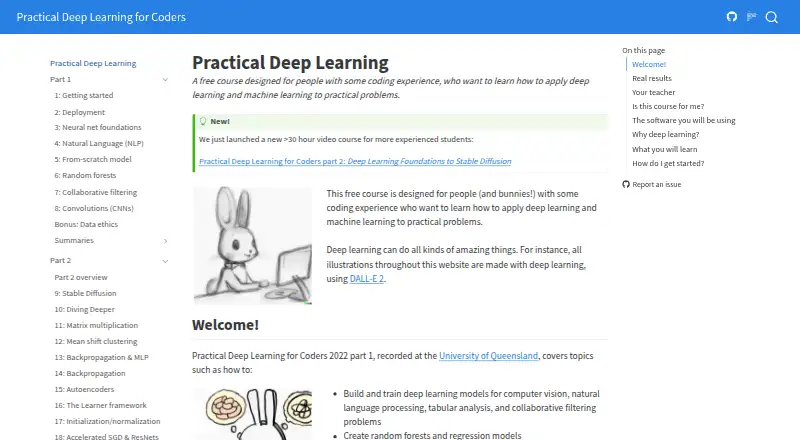
What fast.ai is
fast.ai offers free deep learning courses, a software library, research, and a community focused on making deep learning easier to use. Its Practical Deep Learning for Coders course covers computer vision, natural language processing, tabular analysis, collaborative filtering, random forests, regression, and model deployment. Part 1 has nine lessons of around 90 minutes each, and a linked Part 2 video course is described as over 30 hours. Learners should know how to code, preferably in Python, and have followed a high school math course. The course uses PyTorch, fastai, Hugging Face Transformers, and Gradio, and recommends Kaggle Notebooks and Paperspace Gradient; some work happens on the learner’s laptop. The fastai library combines high-level components for practical deep learning with lower-level parts researchers can assemble into new approaches. It can run in Google Colab without installation or be installed locally with `pip install fastai`. Documentation lists a GPU-optimized computer vision library, an optimizer, callbacks, and a data block API. On Windows, Jupyter resets DataLoader `num_workers` to 0 to avoid hangs, which can slow some computer vision tasks compared with Linux. Learners who need help are directed to the online community forum.
Who it suits
The course suits learners who can code, preferably in Python, and have studied high school mathematics. The library may also suit researchers who want components to combine into deep learning approaches.
What it does well
- Free course covers a range of practical deep learning topics.
- Part 1 provides nine lessons of around 90 minutes each.
- Library can be used in Google Colab without installation.
- Documentation includes computer vision, optimizer, callback, and data-block components.
What to know first
- Coding experience and high school math are expected.
- Some Windows computer vision tasks can be slower than on Linux.
- The course does not provide completion certificates.
Limits
The course is free and has no completion certificate. Learners are expected to know how to code and have followed a high school math course; on Windows, some computer vision work may be slower because Jupyter resets DataLoader `num_workers` to 0.
Plans
| Plan | Billed and limits | Price |
|---|---|---|
| Practical Deep Learning for Coders | Free online course; coding experience is the only prerequisite stated | Free |
As course.fast.ai lists them, read 11 Oct 2026. The maker's own page has the final word.
Getting started
- Open the fast.ai course website.
- Choose Practical Deep Learning for Coders; course access is per course.
- Use Kaggle Notebooks or Paperspace Gradient as recommended, or do some work on your own laptop.
- Use fastai in Google Colab without installation, or install it locally with `pip install fastai`.
- Ask for help in the fast.ai online community forum.
Verdict
fast.ai pairs a broad practical course with a library that can be used in Colab or installed locally. Learners should be ready to code, and Windows Jupyter has a documented performance caveat for some computer vision work.
Questions
How much does Practical Deep Learning for Coders cost?
The course is listed as free. There is no free trial.
What does the course cover?
Topics include computer vision, natural language processing, tabular analysis, collaborative filtering, random forests, regression, and model deployment.
What are the prerequisites?
Learners should know how to code, preferably in Python, and have followed a high school math course.
Can I use fastai without installing it?
Yes. The documentation says it can be used in Google Colab without installation, or installed locally with `pip install fastai`.
What platforms and tools does the course use?
The listed platforms are Linux, macOS, web, and Windows. The course uses PyTorch, fastai, Hugging Face Transformers, and Gradio, and recommends Kaggle Notebooks and Paperspace Gradient.
Does the course provide a completion certificate?
No, completion certificates are not offered.
Facts from fast.ai's own pages
- Course format
- Part 1 has nine lessons of around 90 minutes each, and the course page also links a Part 2 video course described as over 30 hours. · course.fast.ai, 11 Oct 2026
- Course platforms
- The course recommends Kaggle Notebooks and Paperspace Gradient, and says some parts are done on the learner’s own laptop. · course.fast.ai, 11 Oct 2026
- Course software
- The course uses PyTorch, fastai, Hugging Face Transformers, and Gradio. · course.fast.ai, 11 Oct 2026
- Course topics
- Practical Deep Learning for Coders covers computer vision, natural language processing, tabular analysis, collaborative filtering, random forests, regression, and model deployment. · course.fast.ai, 11 Oct 2026
- Founded
- 2016 · course.fast.ai, 28 Sept 2026
- Integrations
- The fastai documentation includes guides for using it with plain PyTorch, Ignite, Lightning, and Catalyst. · docs.fast.ai, 11 Oct 2026
- Library features
- The library documentation lists a GPU-optimized computer vision library, an optimizer, a callback system, and a data block API among its components. · docs.fast.ai, 11 Oct 2026
- Library installation
- The documentation says fastai can be used without installation in Google Colab or installed locally with `pip install fastai`. · docs.fast.ai, 11 Oct 2026
- Library purpose
- The fastai library provides high-level components for practical deep learning and low-level components researchers can combine to build new approaches. · docs.fast.ai, 11 Oct 2026
- Organization
- The about page describes fast.ai as a research institute dedicated to making deep learning more accessible and identifies Jeremy Howard and Rachel Thomas as co-founders. · fast.ai, 11 Oct 2026
- Prerequisites
- The course says learners should know how to code, preferably in Python, and have followed a high school math course. · course.fast.ai, 11 Oct 2026
- Security and compliance
- The opened official pages do not state security certifications or compliance claims. · fast.ai, 11 Oct 2026
- Support
- The course directs learners who need help to the fast.ai online community forum. · course.fast.ai, 11 Oct 2026
- What it is
- fast.ai offers free courses, a software library, research, and a community to make deep learning easier to use and more accessible. · fast.ai, 11 Oct 2026
- Windows support
- The documentation says Jupyter on Windows resets DataLoader `num_workers` to 0 to avoid hangs, which can make some computer vision tasks slower than on Linux. · docs.fast.ai, 11 Oct 2026
Where fast.ai stands on Freedom251
- MOOC Platforms#9 of 67