Freedom251 › Text-to-speech tools
F5-TTS
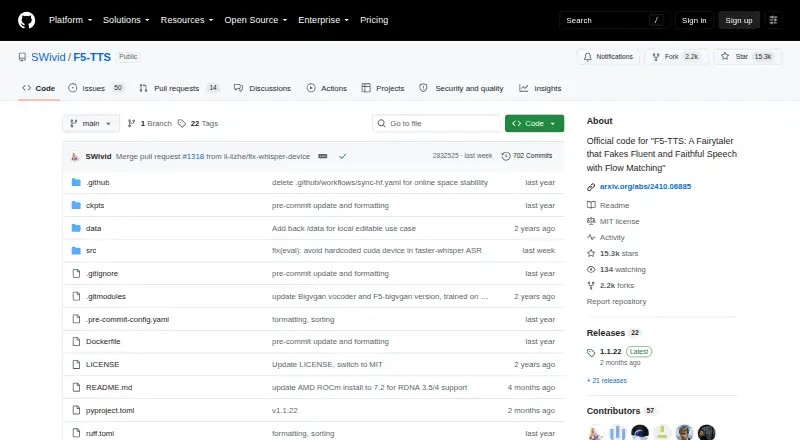
What F5-TTS is
F5-TTS is an open-source text-to-speech project for turning written text into speech. It offers command-line inference and a Gradio web interface, with voice cloning and API access. The Gradio app supports chunked inference, generation with multiple styles and speakers, and voice chat powered by Qwen2.5-3B-Instruct. Custom inference guidance explains how to add language support.
The project’s model design uses flow matching in a Diffusion Transformer with ConvNeXt V2, and includes E2 TTS, a Flat-UNet Transformer. You can install F5-TTS as a Python package, use an editable local clone, or build and run it with Docker. Training and fine-tuning are supported through Hugging Face Accelerate or a Gradio app. Installation instructions cover NVIDIA, AMD and Intel GPUs, plus Apple Silicon; AMD ROCm setup is for Linux. The README also describes deployment with Triton and TensorRT-LLM and links to base models on Hugging Face, Model Scope and Wisemodel. Requirements include Python 3.10 or newer and FFmpeg. The code is MIT-licensed, while pre-trained models use CC-BY-NC, and commercial use is unavailable.
Who it suits
F5-TTS suits developers and researchers who want an open-source speech-generation project with command-line, web, and API access, or who need voice cloning, training, or fine-tuning. Its hardware guidance covers several GPU makers and Apple Silicon, but commercial users should note that commercial use is unavailable.
What it does well
- Open-source code is released under the MIT License.
- Offers command-line inference and a Gradio web interface.
- Supports voice cloning and API access.
- Training and fine-tuning are supported.
- Instructions cover NVIDIA, AMD, Intel, and Apple Silicon setups.
What to know first
- Commercial use is unavailable.
- Pre-trained models use the CC-BY-NC license.
- Installation requires Python 3.10 or newer and FFmpeg.
Getting started
- Visit the F5-TTS GitHub project.
- Choose Python package installation, an editable local clone, or Docker.
- Install Python 3.10 or newer and FFmpeg.
- Follow the installation guidance for your hardware setup.
- Run command-line inference or launch the Gradio web interface.
Verdict
Choose F5-TTS if you want an open-source text-to-speech project with voice cloning, API access, and several ways to run it. Look elsewhere if commercial use is required, since it is unavailable.
Questions
Is F5-TTS free?
Yes. It is listed as free and open source.
Can F5-TTS be used commercially?
No. Commercial use is listed as unavailable.
What platforms does it support?
Its listed platforms are API, Linux, macOS, self-hosted, and web.
Does F5-TTS offer a web interface?
Yes. The project provides a Gradio interface, as well as command-line inference.
What are the license terms?
The code is under the MIT License, while pre-trained models are licensed under CC-BY-NC.
What is needed to install it?
The installation instructions call for Python 3.10 or newer and FFmpeg.
Facts from F5-TTS's own pages
- API access
- Yes · github.com, 20 Sept 2026
- Commercial use
- No · github.com, 20 Sept 2026
- Custom languages
- The README links to custom inference instructions for adding language support. · github.com, 8 Oct 2026
- Deployment
- The README describes a deployment solution using Triton and TensorRT-LLM. · github.com, 8 Oct 2026
- Hardware and operating systems
- The installation instructions cover NVIDIA, AMD, and Intel GPUs and Apple Silicon; the AMD ROCm instructions specify Linux. · github.com, 8 Oct 2026
- Hardware requirements
- The installation instructions cover NVIDIA, AMD, Intel, and Apple Silicon setups; the AMD ROCm instructions specify Linux. · github.com, 8 Oct 2026
- Inference features
- The Gradio app supports basic text-to-speech with chunk inference, multi-style and multi-speaker generation, and voice chat powered by Qwen2.5-3B-Instruct. · github.com, 8 Oct 2026
- Interfaces
- The project provides a Gradio web interface and command-line inference. · github.com, 8 Oct 2026
- License
- The code is released under the MIT License, while the pre-trained models are licensed under CC-BY-NC. · github.com, 8 Oct 2026
- Model availability
- The README links F5-TTS and E2 TTS base models on Hugging Face, Model Scope, and Wisemodel. · github.com, 8 Oct 2026
- Model design
- The project describes F5-TTS as a Diffusion Transformer with ConvNeXt V2 and includes E2 TTS, a Flat-UNet Transformer. · github.com, 8 Oct 2026
- Platforms
- web,linux,macos,api,self_hosted · github.com, 20 Sept 2026
- Purpose
- F5-TTS is an open-source text-to-speech project that uses flow matching to generate fluent and faithful speech. · github.com, 8 Oct 2026
- Related tools
- The project acknowledges Vocos and BigVGAN as vocoders and FunASR and faster-whisper among its evaluation tools. · github.com, 8 Oct 2026
- Requirements
- The installation instructions call for Python 3.10 or newer and FFmpeg. · github.com, 8 Oct 2026
- Runtime benchmark
- The README reports a 253 ms average latency for F5-TTS Base with Vocos at concurrency 2 on a single L20 GPU in its stated benchmark setup. · github.com, 8 Oct 2026
- Support guidance
- The README recommends searching GitHub issues for help with problems encountered. · github.com, 8 Oct 2026
- Training
- Training and fine-tuning are supported through Hugging Face Accelerate or a Gradio app. · github.com, 8 Oct 2026
- Voice cloning
- Yes · github.com, 20 Sept 2026
- Ways to run
- The project can be installed as a Python package, run from a local editable clone, or built and run with Docker. · github.com, 8 Oct 2026
- Web interface
- The project provides Gradio commands for launching a web interface and a share link. · github.com, 8 Oct 2026
Where F5-TTS stands on Freedom251
- Text-to-speech tools#52 of 232
- Text-to-Speech Software#55 of 223
- Voice Cloning Software#8 of 25
- Game Voice Generators#17 of 45