Freedom251 › Email Verification Services

emailverifier.dev
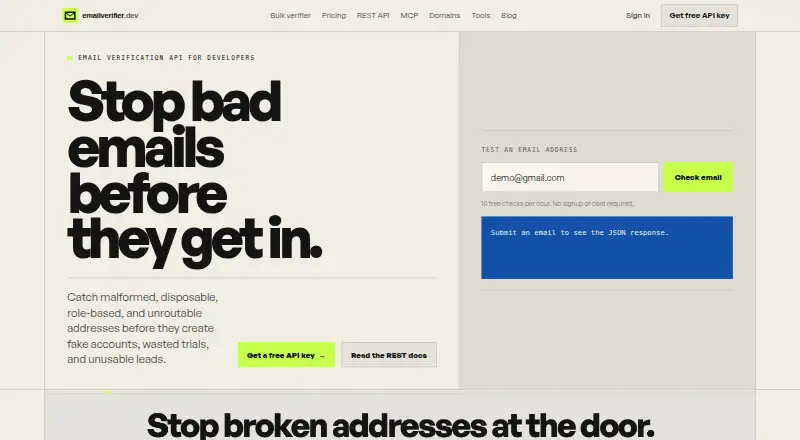
What emailverifier.dev is
emailverifier.dev checks addresses before they enter product workflows such as signups, lead forms and CRM imports. It examines address structure, likely typos, mail-routing DNS, provider type, disposable and role-based signals, and mailbox acceptance or catch-all behavior when available. Results distinguish deliverable, risky, undeliverable and unknown addresses so uncertain checks are not automatically treated as failures. Domain reports classify providers as disposable, known free mailbox services or neither, with risk and mail-routing information. Teams can use a REST API, a remote MCP server with verify_email and check_domain tools, or bulk verification. Bulk jobs accept CSV or TXT uploads or pasted addresses, support up to 100 CSV columns and 5,000 unique addresses per job, and preserve original rows with appended results. Completed files expire after seven days. Each verification and domain check uses one project credit; the public demo allows 10 checks per hour without project credits. The free plan has 1,000 starter credits, one API key per project and credits that do not expire. A one-time 10.00 USD pack provides 20,000 credits, with optional $10 auto top-up at 1,000 credits.
Who it suits
emailverifier.dev suits product teams adding email checks to signups, free trials, lead forms, CRM imports or other application workflows. Its API and bulk options cover both individual checks and list processing.
What it does well
- Results distinguish risky and unknown addresses.
- REST API and remote MCP tools are available.
- Free plan includes 1,000 non-expiring starter credits.
- Bulk jobs handle up to 5,000 unique addresses.
What to know first
- Each verification and domain check uses one project credit.
- Completed bulk files expire after seven days.
- Bulk lists and working results are temporarily stored.
Limits
The free plan includes 1,000 starter credits, and each email verification or domain check consumes one credit. The one-time $10.00 Credit pack adds 20,000 credits; completed bulk files expire after seven days.
Plans
| Plan | Billed and limits | Price |
|---|---|---|
| Start free | No card required · 1,000 starter credits · one API key per project · REST and MCP access · credits do not expire | Free |
| Credit pack | one-time · 20,000 credits per pack · buy 1–100 packs in one checkout · credits do not expire · optional $10 auto top-up at 1,000 credits | $10, paid once |
As emailverifier.dev lists them, read 4 Oct 2026. The maker's own page has the final word.
Getting started
- Open the emailverifier.dev website.
- Use the public demo for up to 10 checks per hour without a key, or create a project for credits and API access.
- Use the REST API or remote MCP tools for individual email or domain checks.
- For bulk verification, upload a CSV or TXT file or paste addresses.
- Review the results and download completed bulk output before it expires after seven days.
Overview
emailverifier.dev checks addresses and domains through a web interface, REST API and remote MCP tools. It suits product teams validating signups, lead forms and imports; its strongest fit is workflows that need distinct risky and uncertain outcomes rather than a simple pass-or-fail.
Its per-check credit model and bulk jobs make it useful for both application integrations and list cleanup, though teams handling sensitive lists should weigh the temporary storage required for bulk processing.
Key features
Address checks assess structure, likely typos, mail-routing DNS, provider type, disposable and role-based signals, and mailbox acceptance or catch-all behavior when available. Results are grouped as deliverable, risky, undeliverable or unknown. That distinction helps avoid treating uncertainty as failure, while the range of signals can inform signup and import decisions.
Domain checks identify whether a provider is disposable, a known free mailbox service or neither. The MCP domain tool also returns risk and mail-routing data. Each email verification or domain check costs one project credit; REST and MCP tool calls follow the same one-credit rate. A public demo allows 10 checks per hour without using project credits.
Bulk verification accepts CSV and TXT uploads or pasted addresses, with up to 100 CSV columns and 5,000 unique addresses per job. Output retains the original rows and adds status, recommended action, flagged state, signals and any typo suggestion. Completed files expire after seven days. This is a practical route for CRM imports, but lists and working results are temporarily stored so jobs can continue after the user leaves.
Single-address checks are not stored in the application usage database. The service says it stores passwords, API keys, verification links and password-reset links as one-way hashes, and uses secure HTTP-only cookies for sessions. Stripe handles payment and billing; emailverifier.dev says it does not store full card numbers. Support is by email for account, billing, API, privacy and security questions.
Pricing
The free Start free plan costs nothing, requires no card, and includes 1,000 starter credits, one API key per project, REST and MCP access, and credits that do not expire. It is a meaningful evaluation and light-use option, but the one-key limit may constrain teams that need separate project credentials.
The Credit pack costs $10, paid once and provides 20,000 credits per pack. Buyers can purchase 1–100 packs in one checkout; credits do not expire. An optional $10 auto top-up triggers at 1,000 credits. Since each email or domain check uses one credit, this makes costs straightforward to track, though heavier ongoing use means buying more packs or enabling top-up rather than subscribing to a monthly allowance. There is no free trial.
Platforms
Access is through web and API tools, including a REST API and remote MCP server. The web tools cover individual, domain and bulk checks; the API and MCP options are suited to adding verification to product workflows.
Who it's for
Product teams adding checks to signups, free trials, lead forms, CRM imports or other application flows are the clearest fit. The service also suits teams that need occasional batch cleanup without a recurring subscription, especially when non-expiring credits match their usage pattern. It is less suited to workflows that require bulk files not to be temporarily stored, or teams that need more than one API key per free project.
Pros and cons
- Pros: Separate risky and unknown outcomes preserve uncertainty instead of forcing every address into a binary decision.
- Pros: Non-expiring free and paid credits suit irregular verification needs, and the free plan includes REST and MCP access.
- Pros: Bulk jobs accept up to 5,000 unique addresses and preserve source rows alongside actionable signals and typo suggestions.
- Cons: Each check consumes one credit, including domain checks, so repeated use draws down the same project balance.
- Cons: Bulk lists and working results are temporarily stored, with completed files expiring after seven days.
- Cons: The free plan permits one API key per project, limiting credential separation for teams on that tier.
Alternatives
For a broader shortlist, see Email Verification Services.
- VerifyAnyEmail is worth considering if iOS access or monthly free credits matter: its free tier includes 1,000 credits per month, but limits batches to 10 and one concurrent batch, with no webhooks or priority support. Its 1,000-credit pay-as-you-go option costs 4.00 USD.
- Bounceless may suit users who prefer 1,000 free credits each month and do not want unknown results billed. Its 5,000-credit pack costs $19, paid once.
- Email Verifier API offers a smaller no-card starting point of 100 one-time credits that never expire; its 1,000-credit option costs $9.95, paid once.
- Emailable is an option for buyers who want a monthly subscription: it offers 250 free credits for new accounts and a 5,000-credit monthly subscription at $32.30 a month.
- EmailOversight is another service to compare for verification needs.
- Mailbeam may fit teams looking for monthly free credits plus webhooks and community support; its free tier includes 1,000 verifications per month and bulk CSV upload.
- MyEmailVerifier offers 100 free credits daily and an extension alongside API and web access, making it a candidate for users who value daily replenishment or browser access.
- QuickEmailVerification is an alternative with a daily-reset free tier of 100 credits.
Verdict
Choose emailverifier.dev if you need email and domain checks in product flows, want web-based bulk cleanup, and prefer credits that never expire. Its layered outcomes and REST/MCP access are the main reasons to choose it. Look elsewhere if temporary bulk-data storage is unacceptable, you need multiple free-tier API keys per project, or a monthly free allowance better matches your workload.
Verdict
emailverifier.dev offers single, domain and bulk checks through web and API tools. Consider credit use and temporary bulk-data storage when choosing how to process addresses.
Questions
Is emailverifier.dev free?
Yes. Start free includes 1,000 starter credits, one API key per project, REST and MCP access, and credits that do not expire.
How much does a credit pack cost?
A Credit pack costs 10.00 USD one-time and provides 20,000 credits. Users can buy 1–100 packs in one checkout.
How are credits used?
Each email verification and domain check uses one project credit. The public no-key demo allows 10 checks per hour without using project credits.
Can I verify a list of addresses?
Yes. Bulk verification accepts CSV or TXT uploads or pasted addresses, supports up to 100 CSV columns, and allows up to 5,000 unique addresses per job.
What happens to bulk results?
Results preserve original rows and append status, recommended action, flagged state, signals, and any typo suggestion. Completed files expire after seven days.
What platforms are available?
The service is available on the web and through an API. It also offers a remote MCP server.
Facts from emailverifier.dev's own pages
- API and AI tools
- The product offers a REST API and a remote MCP server with verify_email and check_domain tools; each tool call costs one project credit. · emailverifier.dev, 4 Oct 2026
- Bulk output and retention
- Bulk results preserve original rows and append status, recommended action, flagged state, signals, and any typo suggestion; completed files expire after seven days. · emailverifier.dev, 4 Oct 2026
- Bulk verification
- The bulk verifier accepts CSV or TXT uploads or pasted addresses, supports up to 100 CSV columns, and allows up to 5,000 unique addresses per job. · emailverifier.dev, 4 Oct 2026
- Credit usage
- Each email verification and domain check uses one project credit, while the public no-key demo allows 10 checks per hour without spending project credits. · emailverifier.dev, 4 Oct 2026
- Data handling
- Single-address checks are not stored in the application usage database, while bulk lists and working results are temporarily stored so jobs can finish after the user leaves. · emailverifier.dev, 4 Oct 2026
- Domain checks
- Domain reports classify a provider as disposable, a known free mailbox service, or neither, and the MCP domain tool returns classification, risk, and mail-routing data. · emailverifier.dev, 4 Oct 2026
- Intended users
- The product is designed for product teams adding checks to signups, free trials, lead forms, CRM imports, and other application workflows. · emailverifier.dev, 4 Oct 2026
- Payment processing
- Stripe processes payment and billing information, and emailverifier.dev says it does not store full card numbers. · emailverifier.dev, 4 Oct 2026
- Purpose
- The service checks email addresses for malformed, disposable, role-based, and unroutable addresses before they enter a product. · emailverifier.dev, 4 Oct 2026
- Results
- The verifier distinguishes deliverable, risky, undeliverable, and unknown outcomes so an uncertain result is not automatically treated as a failure. · emailverifier.dev, 4 Oct 2026
- Security practices
- The service says passwords, API keys, verification links, and password-reset links are stored as one-way hashes, and account sessions use secure HTTP-only cookies. · emailverifier.dev, 4 Oct 2026
- Support
- Support is provided by email at [email protected] for account, billing, API, privacy, and security questions. · emailverifier.dev, 4 Oct 2026
- Verification signals
- Checks include address structure, likely typos, mail-routing DNS, provider type, disposable and role signals, and mailbox acceptance or catch-all behavior when available. · emailverifier.dev, 4 Oct 2026
Where emailverifier.dev stands on Freedom251
- Email Verification Services#15 of 36
- Email Verification APIs#13 of 31