Freedom251 › Email Verification Services

VerifyAnyEmail
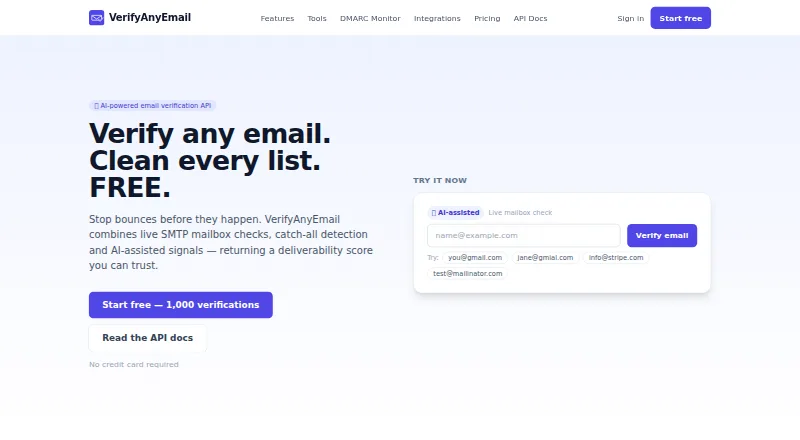
What VerifyAnyEmail is
VerifyAnyEmail checks whether an email address appears real, risky, or undeliverable before a message is sent. Its SMTP probes check mailboxes without sending a message, while a random-address probe can flag domains that accept every address. Other checks identify disposable and role accounts, tag free providers, suggest typo corrections, and score gibberish. Dozens of weighted signals contribute to a confidence score from 0 to 100. The API supports asynchronous batch verification for lists, with status polling or completion webhooks. Integrations include WordPress, WooCommerce, Shopify, Zapier, Make, n8n, MailWizz, Google Sheets, and Microsoft Excel. Official client libraries are listed for Node.js, Python, PHP, Go, Java, .NET, Ruby, and Swift. The site, API, and dashboard use HTTPS; API keys are hashed and can be rotated or revoked. Raw SMTP transcripts are not stored by default, and verification records can be purged or removed on a configured schedule. Each verification uses one credit, while batch size and request rates depend on the plan. A free plan is available; paid monthly plans start at $8.99/mo.
Who it suits
VerifyAnyEmail suits teams that check email addresses before sending campaigns or messages, whether they use its API, listed integrations, or client libraries. It supports individual and batch verification.
What it does well
- SMTP probes do not send a message.
- Scores confidence from 0 to 100.
- Batch checks support polling or completion webhooks.
- API keys can be rotated or revoked.
- Verification records can be purged or automatically removed.
What to know first
- Each verification uses one credit.
- Batch sizes and request rates depend on the plan.
- Free plan has no webhooks or priority support.
Limits
The free plan includes 1,000 credits per month, 10 requests per minute, batches of up to 10, and one concurrent batch; it has no webhooks or priority support. Each verification uses one credit. Monthly plan limits differ, with Starter providing 10,000 credits per month and batches up to 1,000.
Plans
| Plan | Billed and limits | Price |
|---|---|---|
| Free | 1,000 credits/month · 10 requests/min · batches up to 10 · 1 concurrent batch · no webhooks or priority support | Free |
| Pay-as-you-go credits — 250,000 | $150 · 250,000 credits · credits never expire | $150, paid once |
| Pay-as-you-go credits — 10,000 | $20 · 10,000 credits · credits never expire | $20, paid once |
| Pay-as-you-go credits — 500,000 | $225 · 500,000 credits · credits never expire | $225, paid once |
| Growth | $24.99/mo · 50,000 credits/month · 600 requests/min · batches up to 5,000 · 5 concurrent batches · webhooks · priority support | $24.99 a month |
| Pay-as-you-go credits — 1,000 | $4 · 1,000 credits · credits never expire | $4, paid once |
| Scale | $49.90/mo · 500,000 credits/month · 2000 requests/min · batches up to 10,000 · 10 concurrent batches · webhooks · priority support | $49.90 a month |
| Pay-as-you-go credits — 50,000 | $75 · 50,000 credits · credits never expire | $75, paid once |
The first 8 of 9 plans, as verifyany.email lists them, read 29 Sept 2026. The maker's own page has the final word. Every plan
Getting started
- Visit https://verifyany.email/.
- Choose the free plan, a monthly plan, or a one-time credit pack.
- Use the API for verification or connect a listed integration.
- For development, use an official client library for your language.
- Use the iOS app or web dashboard where applicable.
Overview
VerifyAnyEmail is an email-address verification service for teams and developers who need to screen sign-ups or work through contact lists. Its combination of SMTP probes, address-quality signals and API workflows makes it a practical fit for recurring validation, though the free tier is constrained for larger or automated jobs.
It checks whether addresses appear real, risky or undeliverable without sending a message. The strongest reason to choose it is the range of batch controls and integrations across its paid plans; the main trade-off is that useful throughput and batch capacity rise with the monthly price.
Key features
Mailbox and quality checks
SMTP probes check a mailbox without sending an email, while a random-address probe identifies domains that accept every address. VerifyAnyEmail also detects disposable and role accounts, tags free-provider addresses, suggests typo corrections and scores gibberish. Dozens of weighted signals feed a confidence score from 0 to 100, giving users more context than a single mailbox result, though the score still needs to be interpreted in light of the address and campaign.
Lists, API and integrations
The API supports asynchronous batch verification, with polling or completion webhooks. Bulk list upload and real-time form checks also suit both list-cleaning and sign-up workflows. Integrations include WordPress, WooCommerce, Shopify, Zapier, Make, n8n, MailWizz, Google Sheets and Microsoft Excel; official client libraries cover Node.js, Python, PHP, Go, Java, .NET, Ruby and Swift. The breadth is useful for connecting validation to existing systems, while the plan-dependent batch and request limits matter for high-volume pipelines.
Security and support
The site, API and dashboard use HTTPS, and API keys are stored hashed and can be rotated or revoked. Raw SMTP transcripts are not stored by default; verification records can be purged or removed automatically under a configurable retention window. Email support runs Monday–Friday with a target first response within one business day; priority plans receive faster handling.
Pricing
Each verification costs one credit. The Free plan costs nothing and includes 1,000 credits/month, 10 requests/min, batches up to 10 and one concurrent batch, but no webhooks or priority support. It is suitable for light checks, not larger automated lists.
Starter costs $8.99 a month for 10,000 credits/month, 120 requests/min, batches up to 1,000, one concurrent batch and webhooks. It is the entry point for regular API or list use that needs callbacks. Growth costs $24.99 a month and raises the allowance to 50,000 credits/month, 600 requests/min, batches up to 5,000 and five concurrent batches; it also includes webhooks and priority support. Scale costs $49.90 a month, with 500,000 credits/month, 2,000 requests/min, batches up to 10,000 and ten concurrent batches, plus webhooks and priority support. These tiers suit progressively heavier workloads; select by both monthly volume and the size and concurrency of jobs, not just credit count.
For occasional or uneven demand, one-time credit packs never expire: 1,000 credits for $4, paid once, 10,000 for $20, paid once, 50,000 for $75, paid once, 250,000 for $150, paid once, or 500,000 for $225, paid once. They avoid a monthly commitment, but do not replace plan-specific throughput and batch controls. Credit rollover is supported.
Platforms
VerifyAnyEmail lists API, iOS and web platforms. Its APIs, integrations and client libraries make it particularly relevant to developers and teams wiring verification into software or spreadsheets.
Who it's for
Choose VerifyAnyEmail if you need a mix of mailbox checks, risk signals and list processing, especially when webhooks, multiple integrations or growing batch capacity matter. It is less compelling for a very small workflow that needs no API automation, or a high-volume operation that cannot fit the stated plan limits.
Pros and cons
- Pros: Multiple address-quality signals and a confidence score add context beyond SMTP probing.
- Pros: Paid tiers scale request rates, batch sizes and concurrency, and include webhooks.
- Pros: One-time packs offer non-expiring credits for users with irregular verification needs.
- Cons: Free limits batches to 10 and 10 requests/min, with no webhooks, restricting automated list workflows.
- Cons: Monthly quotas and capacity are tiered, so sustained high volume calls for a more expensive plan.
Alternatives
Email Verification Services is a useful starting point for comparing the category. Choose Bouncer if you prefer a pay-as-you-go option with a free trial and non-expiring 1,000-credit purchase for $8, paid once. Clearout Email Verification is another freemium alternative with API, extension and web platforms. MillionVerifier offers a free trial and a one-time 10,000-credit pack for $39, paid once, with credits that never expire. QuickEmailVerification may suit daily low-volume use with a free tier that resets daily at 100 credits. ZeroBounce includes API, iOS and web platforms and 100 free monthly email verifications for a business account. Byteplant Email Validator is a paid alternative with a free plan and trial. DeBounce offers pay-as-you-go credit options with credits that never expire and all features included. MailTester Ninja is a freemium alternative for web, Windows and macOS.
Verdict
VerifyAnyEmail is a strong choice for teams that need address-quality signals plus scalable API batch workflows: its paid plans add meaningful capacity, webhooks and, at higher tiers, priority support. Choose it when those controls match your workload; look elsewhere if the free batch cap or monthly plan limits do not fit.
Verdict
VerifyAnyEmail combines mailbox probes and address-quality signals with batch API tools and integrations. Its free plan includes 1,000 credits per month, while paid monthly plans start at $8.99/mo; check plan limits if you need larger batches or higher request rates.
Questions
Is VerifyAnyEmail free?
Yes. Its free plan costs nothing and includes 1,000 credits per month.
What does the Starter plan cost?
Starter costs $8.99 a month, billed $8.99/mo.
Which platforms are listed?
The listed platforms are API, iOS, and web.
Can it check lists of addresses?
Yes. The API supports asynchronous batch verification, with polling or completion webhooks. Batch limits depend on the plan.
Which integrations are listed?
Integrations include WordPress, WooCommerce, Shopify, Zapier, Make, n8n, MailWizz, Google Sheets, and Microsoft Excel.
Do unused one-time credits expire?
No. The listed one-time credit packs say that credits never expire.
Facts from VerifyAnyEmail's own pages
- Batch verification
- The API supports asynchronous batch verification for lists, with polling or completion webhooks. · verifyany.email, 29 Sept 2026
- Catch-all detection
- A random-address probe detects domains that accept all addresses. · verifyany.email, 29 Sept 2026
- Data retention
- Raw SMTP transcripts are not stored by default, and verification records can be purged or automatically removed under a configurable retention window. · verifyany.email, 29 Sept 2026
- Integrations
- Listed integrations include WordPress, WooCommerce, Shopify, Zapier, Make, n8n, MailWizz, Google Sheets, and Microsoft Excel. · verifyany.email, 29 Sept 2026
- Limits
- One verification costs one credit, and batch size and request rate limits depend on the plan. · verifyany.email, 29 Sept 2026
- Quality signals
- Checks include disposable and role-account detection, free-provider tagging, typo suggestions, and gibberish scoring. · verifyany.email, 29 Sept 2026
- Scoring
- Dozens of weighted signals produce a confidence score from 0 to 100. · verifyany.email, 29 Sept 2026
- SDKs
- Official client libraries are listed for Node.js, Python, PHP, Go, Java, .NET, Ruby, and Swift. · verifyany.email, 29 Sept 2026
- Security
- The site, API, and dashboard use HTTPS; API keys are stored hashed and can be rotated or revoked. · verifyany.email, 29 Sept 2026
- SMTP checks
- It probes mailboxes through SMTP without sending a message. · verifyany.email, 29 Sept 2026
- Support
- Email support is available Monday–Friday with a target first response within one business day; priority-plan customers get faster handling. · verifyany.email, 29 Sept 2026
- What it does
- VerifyAnyEmail checks whether an address is real, risky, or undeliverable before sending email. · verifyany.email, 29 Sept 2026
Where VerifyAnyEmail stands on Freedom251
- Email Verification Services#26 of 36