Freedom251 › Community Building Platforms

Elgg
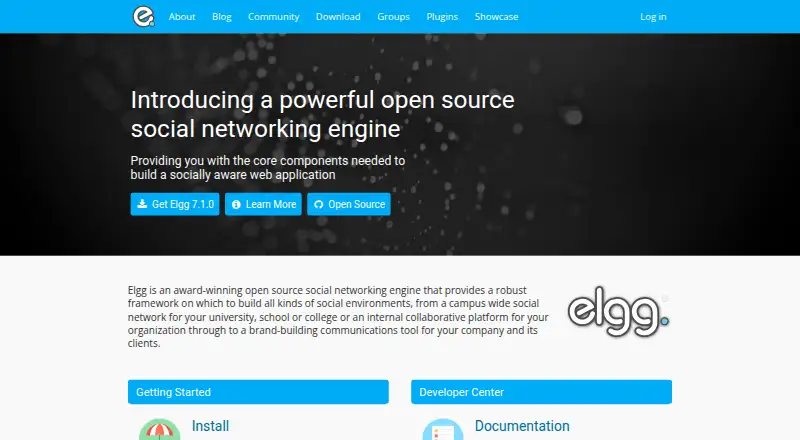
What Elgg is
Elgg is a free, open-source framework for building web applications where users log in and share information. It can support social environments such as campus networks, organizational collaboration spaces, and company communication tools. Plugins can extend application behavior through hooks and events, while the view system supports custom themes. Granular content access policies can be used for private networks and intranets; the framework also includes user groups and a file storage API for user-generated files. It supports on-site and email notifications, RPC web services for external applications and mobile clients, and notification integrations with third-party services. Listed security features include anti-CSRF validation, XSS filters, HMAC signatures, and password hashing. The project provides documentation, tutorials, an API reference, community discussions, forums, and a repository with more than 1,000 open-source plugins. Elgg can be installed on a user's own server using Composer or a ZIP package. An installation needs a database and configured cron job. The full package with core plugins is under GPLv2; the framework-only MIT release excludes the mod directory containing plugins.
Who it suits
Elgg suits universities, schools, organizations, and companies building social or collaborative web applications. It is for teams able to install and maintain a self-hosted project with a database and cron job.
What it does well
- Free to download, install, and use.
- Granular access policies can support private networks.
- Plugins can extend functionality and themes.
- Community repository includes over 1,000 open-source plugins.
- Offers documentation, tutorials, and an API reference.
What to know first
- Self-hosting requires a database and configured cron job.
- The MIT release excludes the mod directory of plugins.
- Installation and maintenance are the user's responsibility.
Limits
The MIT framework release excludes the mod directory, which contains Elgg's plugins. A self-hosted installation also requires a database and a configured cron job.
Plans
| Plan | Billed and limits | Price |
|---|---|---|
| Free | Free to download, install, and use | Free |
As elgg.org lists them, read 11 Oct 2026. The maker's own page has the final word.
Getting started
- Install Elgg on your own server using Composer or the pre-packaged ZIP file.
- Set up the required database.
- Configure a cron job for background tasks such as notifications and database cleanup.
- Use the documentation and API reference, or explore the community plugin repository.
Elgg is an open-source framework for building social and collaborative web applications, best suited to schools, universities, and organizations that can run and tailor their own software. Its strongest appeal is the control its plugins and access policies provide; choosing it also means taking responsibility for self-hosting.
Overview
Elgg is a foundation for communities such as campus networks, organizational collaboration spaces, and company communication tools—not a ready-made hosted service. Its granular content policies can support private networks and intranets, which makes it relevant when access boundaries matter. In return, teams need to install and maintain the application themselves, including a database and a configured cron job for background work such as notifications and database cleanup.
Key features
- Extensible behavior: Hooks and events let plugins alter or add to much of an application's functionality. More than 1,000 open-source plugins in the community repository offer a substantial starting point, though selecting and combining extensions requires technical judgment.
- Custom presentation: Elgg's view system lets plugins work together on themes. This gives teams latitude to shape the interface rather than accept a fixed presentation.
- Private spaces, groups, and files: Granular access policies support controlled content, while user groups and a file storage API give plugins ways to organize communities and handle user-generated files.
- Integrations and notifications: RPC web services support connections to external applications and mobile clients. On-site and email notifications are included, and the notification service can support third-party integrations.
- Security mechanisms: Elgg includes anti-CSRF validation, strict XSS filters, HMAC signatures, and password hashing using current cryptographic approaches. These are useful safeguards, but they do not remove the operator's responsibility for securing and maintaining a self-hosted deployment.
Pricing
Elgg is free to download, install, and use. The free option is the whole product model rather than a time-limited trial, so there is no software license charge to begin building a community.
There are two license choices with a meaningful difference: the full framework and core plugins are offered under GPLv2, while the framework without plugins is offered under MIT. The MIT release excludes the mod directory, which contains Elgg's plugins; teams choosing it should not assume they are also receiving the core plugins. Elgg does not list a paid plan, but self-hosting still entails operating the server and required database and cron job.
Platforms
Elgg is available for web applications, self-hosted installations, and API use. Its installation guide recommends Composer as the simplest way to install and maintain a project, with a pre-packaged ZIP file also available. Third-party hosting providers are listed, but the project does not officially endorse them.
Who it's for
Elgg is a strong fit for universities, schools, organizations, and companies that need a tailored social network or collaboration platform and have the technical capacity to operate it. Documentation, tutorials, an API reference, community discussions, technical support forums, and professional service providers give builders several routes to guidance. It is less suitable for teams that need a managed, turnkey community and do not want responsibility for installation and upkeep.
Pros and cons
- Pro: Broad customization. Plugins can change much of the application's behavior and presentation, with a large community repository to draw from.
- Pro: Fine-grained privacy. Granular content policies make private networks and intranets a plausible use case.
- Pro: No license fee. The software is free to install and use, with GPLv2 and framework-only MIT licensing options.
- Con: Self-hosting is part of the deal. A database and configured cron job are required, so teams must be prepared to manage the underlying installation.
- Con: The MIT option omits plugins. Teams wanting the core plugins need to account for the GPLv2 full package rather than treating the MIT release as equivalent.
Alternatives
For a different approach, consider these options:
- NodeBB is worth comparing if a freemium platform with a free plan and a Starter tier at $20 a month is a better fit.
- HumHub offers a self-hosted Community Edition under an AGPLv3 open-source license, with module marketplace access and community support.
- BuddyBoss Platform has a free WordPress community platform, with Platform Pro at $99 a year for updates and support.
- Geneva is a free option for readers seeking group chats and community features on web and mobile.
- BuddyPress is a free, open-source WordPress plugin for self-hosted installations.
- Discourse is another self-hosted open-source choice, with a free plan that includes unlimited members, 2 staff seats, and 500k monthly page views.
- ProfileGrid offers a free Core plan with 90+ core features and free extensions, plus a Premium plan at $79 a month.
- Oxwall is another free option for web and self-hosted communities, with mobile platforms also supported.
Verdict
Choose Elgg if your school, organization, or company wants a configurable social application with private-content controls and can take on self-hosting. Its main reason to choose is the freedom to shape behavior and presentation without a license fee; look elsewhere if you need a managed service or want a complete MIT-licensed package that includes the plugins.
Verdict
Elgg provides a customizable foundation for social and collaborative web applications, with access controls and a large plugin repository. The MIT framework-only option excludes plugins, and self-hosting requires a database and cron job.
Questions
How much does Elgg cost?
Elgg is free to download, install, and use. The listed Free plan costs nothing.
Is Elgg open source?
Yes. The full framework with core plugins is offered under GPLv2. The framework without plugins is also offered under MIT.
What is excluded from the MIT release?
The MIT release excludes the mod directory, which contains Elgg's plugins.
Which platforms are listed for Elgg?
The listed platforms are API, self-hosted, and web.
What does an Elgg installation require?
It needs a database and a configured cron job for background work such as notifications and database cleanup.
What support resources are available?
Elgg lists community discussions, technical support forums, documentation, tutorials, an API reference, and professional service providers.
Facts from Elgg's own pages
- Access control
- Elgg includes granular content access policies for private networks and intranets. · elgg.org, 11 Oct 2026
- Access controls
- Elgg provides granular content access policies that can support private networks and intranets. · learn.elgg.org, 11 Oct 2026
- Audience
- The site describes Elgg as suitable for universities, schools, colleges, organizations, and companies building communities or collaborative platforms. · elgg.org, 11 Oct 2026
- Community resources
- The project lists a community repository with more than 1,000 open source plugins and provides documentation, tutorials, and an API reference. · elgg.org, 11 Oct 2026
- Community support
- Elgg points users to its community, documentation, plugin repository, and professional service providers for help and services. · elgg.org, 11 Oct 2026
- Customization
- Plugins can extend Elgg's views to create custom themes. · elgg.org, 11 Oct 2026
- Extensibility
- Its hooks and events let plugins extend and modify most aspects of an application's functionality and behavior. · elgg.org, 11 Oct 2026
- Free plan
- Yes · elgg.org, 21 Sept 2026
- Groups and files
- Elgg includes user groups and a file storage API for plugins to store and serve user-generated files. · elgg.org, 11 Oct 2026
- Hosting
- Elgg lists third-party hosting providers and says the project does not officially endorse the listed companies. · elgg.org, 11 Oct 2026
- Installation
- The download page recommends Composer as the simplest way to install and maintain an Elgg project. · elgg.org, 11 Oct 2026
- Integrations
- Elgg provides RPC web services for integrations with external applications and mobile clients. · learn.elgg.org, 11 Oct 2026
- License
- The full package with core plugins is available under GPLv2, while the framework without those plugins is also available under MIT. · learn.elgg.org, 11 Oct 2026
- License and cost
- Elgg is free to download, install, and use; the full framework and core plugins are offered under GPLv2, while the framework without plugins is offered under MIT. · learn.elgg.org, 11 Oct 2026
- Notable limit
- The download page says the MIT release excludes the contents of the mod directory, which contains Elgg's plugins. · elgg.org, 11 Oct 2026
- Notifications
- Elgg supports on-site and email notifications and says its notification service can integrate with third-party services. · learn.elgg.org, 11 Oct 2026
- Private spaces
- Yes · elgg.org, 21 Sept 2026
- Purpose
- Elgg is an open source social networking engine for building social environments such as campus networks, organizational collaboration platforms, and company communications tools. · elgg.org, 11 Oct 2026
- Security
- The feature list says Elgg includes anti-CSRF validation, strict XSS filters, HMAC signatures, and password hashing using current cryptographic approaches. · elgg.org, 11 Oct 2026
- Security reporting
- The Elgg project asks that potential security vulnerabilities be reported to [email protected]. · learn.elgg.org, 11 Oct 2026
- Self-hosting
- Elgg's installation guide describes installing it on your own server using Composer or a pre-packaged ZIP file. · learn.elgg.org, 11 Oct 2026
- Support
- Elgg lists community discussions, technical support forums, and professional service providers as support resources. · elgg.org, 11 Oct 2026
- Technical requirement
- An Elgg installation needs a database and a configured cron job for background tasks such as notifications and database cleanup. · learn.elgg.org, 11 Oct 2026
- Themes
- Elgg's view system lets plugins collaborate on presentation and build custom themes. · elgg.org, 11 Oct 2026
Where Elgg stands on Freedom251
- Community Building Platforms#2 of 27
- Online Community Platforms#5 of 54
- Social Networking Software#3 of 24
- Community Platforms#48 of 126