Freedom251 › Community Building Platforms
BuddyPress
by BuddyPress
What BuddyPress is
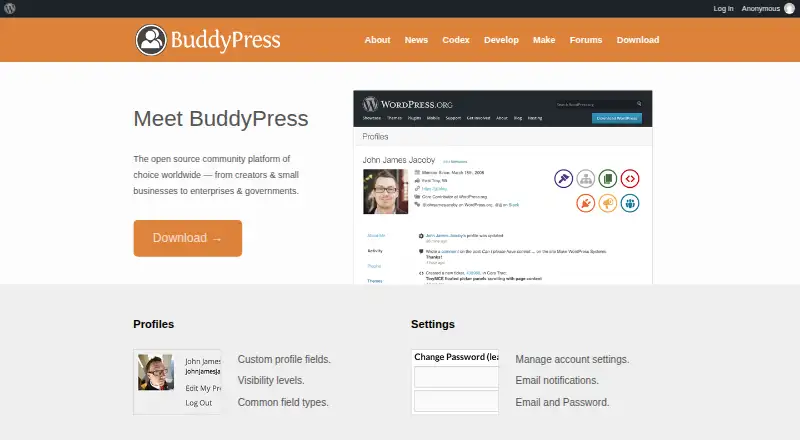
BuddyPress is a free, open-source plugin that adds social networking features to WordPress sites. It can support communities such as campus networks, company communication tools, niche social networks, and product networks. Administrators can enable only the components they want, and the site's theme adjusts menus, pages, and buttons to match. Member profiles offer configurable fields, avatars, account settings, and visibility options. Activity streams can collect activity from the site, members, and groups, with updates, comments, favorites, mentions, and RSS feeds. Members can create public, private, or hidden groups, send private messages to friends, and receive notifications about community activity. WordPress.org plugins can extend the system, while its REST API provides JSON endpoints for community data and actions. BuddyPress is self-hosted and requires WordPress, PHP 5.2.4 or greater, MySQL 5.0 or greater, and Apache mod_rewrite; HTTPS is recommended. The project began in 2008, with its first stable release in May 2009. A community support forum is available.
Who it suits
BuddyPress suits site owners who want to add configurable community features to a WordPress installation. Its groups and profiles can serve interest-based communities, campuses, companies, or product networks.
What it does well
- Administrators can disable unneeded features.
- Profiles include configurable fields and visibility controls.
- Groups can be public, private, or hidden.
- REST API exposes community data and actions.
- Free, open-source WordPress plugin.
What to know first
- Requires a WordPress installation.
- Requires PHP 5.2.4 or greater and MySQL 5.0 or greater.
- Requires Apache mod_rewrite.
- No mobile apps are listed.
Limits
The free plan is an open-source, self-hosted WordPress plugin. It requires WordPress, PHP 5.2.4 or greater, MySQL 5.0 or greater, and Apache mod_rewrite; HTTPS is recommended.
Plans
| Plan | Billed and limits | Price |
|---|---|---|
| BuddyPress | Open source WordPress plugin · self-hosted installation | Free |
As buddypress.org lists them, read 11 Oct 2026. The maker's own page has the final word.
Getting started
- Visit the BuddyPress website.
- Prepare a WordPress installation with PHP 5.2.4 or greater, MySQL 5.0 or greater, and Apache mod_rewrite.
- Install BuddyPress as a self-hosted WordPress plugin.
- Enable the components you want and configure profile fields and visibility.
- Use WordPress.org plugins to extend the site if needed.
BuddyPress is a free, open-source WordPress plugin for building member communities on infrastructure you control. It best suits organizations already comfortable running WordPress, from campus and company networks to focused interest or product communities. Its configurable social toolkit is broad, but the self-hosted setup and absence of mobile apps make it a poor fit for teams seeking a turnkey, mobile-first service.
Overview
Conceived in 2008 and first released as a stable project in May 2009, BuddyPress adds social networking functions to a WordPress site. Administrators can disable components they do not need, while the active theme adjusts its menus, pages, and buttons accordingly. That lets a site owner keep a small community focused instead of exposing an oversized feature set.
The trade-off is operational responsibility. BuddyPress requires WordPress, PHP 5.2.4 or newer, MySQL 5.0 or newer, and Apache mod_rewrite; HTTPS is recommended. It is self-hosted rather than a hosted community service, so the owner handles the installation and server environment. A community support forum is provided for questions and troubleshooting.
Key features
Profiles and activity
Extended Profiles lets administrators create configurable fields and field groups, with avatars, account settings, and visibility choices of Everyone, Only Me, All Members, or My Friends. This is useful when a directory needs structured member information without making every detail public.
Activity streams combine site, member, and group activity. Members can post updates, comment, favorite items, use mentions, and follow RSS feeds. The combination supports ongoing conversation and discoverability, although communities wanting a narrowly focused feed may need to switch off components they do not use.
Groups and private communication
Members can create public, private, or hidden groups. Group administrators control membership and invitations, giving organizers a practical way to separate open discussion from restricted projects or cohorts.
Private messaging works between people on a member's friends list and provides individual inbox and sent-message folders. Notifications cover activity, messages, friendships, and groups, and members can turn notification emails on or off in settings. These controls suit communities that need direct contact without making every exchange public, but messaging is tied to the site's friendship model.
Extensions and API
WordPress.org plugins and supported add-ons can extend BuddyPress, with developer documentation for building integrations. The BP REST API exposes public data and authenticated community actions through JSON endpoints, including members, activity, groups, messages, and notifications. That makes BuddyPress a more adaptable foundation for custom interfaces or connected services than a closed community product.
Security maintenance matters on a self-hosted system. The July 7, 2026 release announcement includes fixes for Messages REST API user-ID validation and component-management permissions, so owners should keep the plugin and WordPress environment maintained.
Pricing
| Plan | Price | What you get |
|---|---|---|
| BuddyPress | free | Open-source WordPress plugin for self-hosted installation |
There is no paid tier or free trial because the plugin itself is free. The zero software price is most attractive to organizations that already budget for WordPress hosting and administration; it does not remove those infrastructure responsibilities.
Platforms
BuddyPress runs as an API-enabled, self-hosted web solution. It requires a WordPress site and the stated PHP, MySQL, and Apache mod_rewrite environment. There is no Android or iOS app, so members use the web experience or a custom interface built against the REST API.
Who it's for
Choose BuddyPress for a campus network, internal company community, niche social network, or product-focused member space when you want ownership of the WordPress installation and the ability to tailor components. It is especially suitable for teams with WordPress skills, plugin expertise, or a developer who can connect the REST API.
Look elsewhere if you need managed hosting, a ready-made mobile app, or an event-hosting system: event hosting is not part of BuddyPress's stated capabilities, and the site owner must operate the platform.
Pros and cons
Pros
- No plugin fee: the open-source plan costs 0.00 USD, making a broad community foundation accessible to organizations that can cover hosting.
- Configurable scope: administrators can disable unused components and let the theme adapt, reducing clutter for focused communities.
- Strong social core: profiles, visibility controls, activity streams, groups, messaging, and notifications cover the main patterns of member interaction.
- Extensible architecture: WordPress plugins, add-ons, and a REST API support custom features and connected applications.
Cons
- Self-hosting required: WordPress, server software, and ongoing maintenance are the owner's responsibility.
- No mobile apps: there is no native Android or iOS client for members who expect app-based access.
- No event hosting: organizations centered on events will need another tool or an additional WordPress solution.
- Messaging is relationship-bound: private messages are sent to people on a member's friends list rather than to any site member.
Alternatives
NodeBB is the better choice when you want a freemium forum platform with a hosted Starter plan at $20 a month, including 50,000 pageviews, 5 GB storage, unlimited staff users, and weekly backups.
HumHub fits teams seeking an AGPLv3 self-hosted network with a Community Edition, module marketplace access, and community support.
BuddyBoss Platform is worth considering if Android and iOS apps matter; its free platform is complemented by Platform Pro at $99 a year with updates and support.
Elgg is another free-to-download, self-hosted social networking foundation.
Geneva suits readers who prefer a free web, Android, and iOS service centered on group chats and community features.
Discourse is a self-hosted, open-source discussion platform whose free plan includes unlimited members, two staff seats, and 500,000 monthly page views.
ProfileGrid is a WordPress-oriented alternative with a free Core plan and a Premium plan at $79 a month.
Oxwall is a free platform option offering a Silver plan with white-label website and source-code components.
Browse Social Networking Software and Community Platforms for more choices.
Verdict
BuddyPress is a strong recommendation for WordPress owners who want a free, extensible member community with profiles, groups, activity, and messaging under their control. Choose it for configurability and the WordPress ecosystem; look elsewhere if managed operations, native mobile apps, or built-in event hosting are central requirements.
Verdict
BuddyPress provides a set of configurable social features for self-hosted WordPress sites, including groups, profiles, messaging, and activity streams. Check the server requirements and lack of mobile apps before choosing it.
Questions
How much does BuddyPress cost?
The listed BuddyPress plan costs nothing.
Is BuddyPress open source?
Yes. The project describes itself as open source and community-built.
What platforms does BuddyPress support?
The listed platforms are API, self-hosted, and web. No mobile apps are listed.
What does BuddyPress require?
It requires WordPress, PHP 5.2.4 or greater, MySQL 5.0 or greater, and Apache mod_rewrite. HTTPS is recommended.
Can BuddyPress be extended?
Yes. It can be extended with WordPress.org plugins, and it provides a REST API for community data and actions.
Is there a free trial?
No free trial is listed; the plan is free.
Facts from BuddyPress's own pages
- Activity streams
- Activity streams can aggregate site, member, and group activity, with features including updates, comments, favorites, mentions, and RSS feeds. · buddypress.org, 11 Oct 2026
- Event hosting
- No · buddypress.org, 20 Sept 2026
- Founded
- 2008 · buddypress.org, 28 Sept 2026
- Free plan
- Yes · buddypress.org, 20 Sept 2026
- Groups
- Members can form groups with public, private, or hidden access, and group administrators can manage membership and invitations. · buddypress.org, 11 Oct 2026
- Integrations
- BuddyPress can be extended with WordPress.org plugins, and the project points developers to its plugin developer documentation and supported add-ons. · buddypress.org, 11 Oct 2026
- Member profiles
- Extended Profiles supports configurable profile fields, field groups, avatars, account settings, and visibility choices such as Everyone, Only Me, All Members, and My Friends. · buddypress.org, 11 Oct 2026
- Mobile apps
- none · buddypress.org, 20 Sept 2026
- Moderation tools
- Yes · buddypress.org, 20 Sept 2026
- Notifications
- Members can receive notifications about activity, messages, friendships, and groups, and can enable or disable notification emails in settings. · buddypress.org, 11 Oct 2026
- Private messaging
- Members can send messages to people on their friends list and use individual inbox and sent-message folders. · buddypress.org, 11 Oct 2026
- Private spaces
- Yes · buddypress.org, 20 Sept 2026
- Project history
- BuddyPress was conceived in 2008 and had its first official stable release in May 2009; the project describes itself as open source and community-built. · buddypress.org, 11 Oct 2026
- Purpose
- BuddyPress adds social networking features to WordPress sites so people with shared interests can connect and communicate. · buddypress.org, 11 Oct 2026
- Requirements
- BuddyPress requires WordPress, PHP 5.2.4 or greater, MySQL 5.0 or greater, and Apache mod_rewrite; HTTPS is listed as recommended. · buddypress.org, 11 Oct 2026
- REST API
- The BP REST API exposes public data and authenticated community actions through JSON endpoints, including members, activity, groups, messages, and notifications. · developer.buddypress.org, 11 Oct 2026
- Security updates
- The July 7, 2026 release announcement describes security fixes for Messages REST API user ID validation and component management permissions. · buddypress.org, 11 Oct 2026
- Selectable features
- Administrators can turn off features they do not need, and the site theme adjusts its menus, pages, and buttons to the enabled features. · buddypress.org, 11 Oct 2026
- Support
- The project provides a community support forum for questions and troubleshooting. · buddypress.org, 11 Oct 2026
- Use cases
- The project describes uses including campus networks, company communication tools, niche social networks, and networks for products. · buddypress.org, 11 Oct 2026
Where BuddyPress stands on Freedom251
- Community Building Platforms#1 of 27
- Social Networking Software#2 of 24
- Community Platforms#36 of 126