Freedom251 › Wide-Column Databases
Elassandra
What Elassandra is
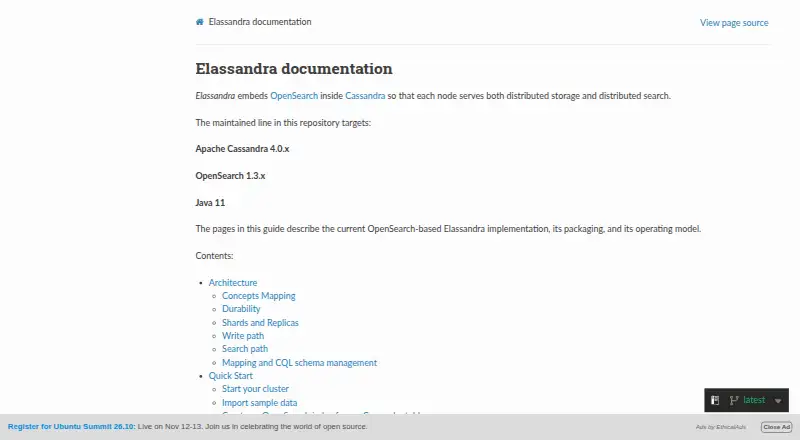
Elassandra combines distributed storage from Apache Cassandra with search powered by embedded OpenSearch. Its maintained line targets Apache Cassandra 4.0.x, OpenSearch 1.3.x, and Java 11. OpenSearch indices map to Cassandra keyspaces, documents to rows, and indexed fields to columns or cells. Cassandra stores durable data; after a restart, Elassandra can replay that state and rebuild the local search view. Search requests can use the OpenSearch HTTP API or CQL, and HTTP searches return standard OpenSearch-style responses. Data placement follows Cassandra token ownership, while replicas follow the keyspace’s replication settings. Teams can create Cassandra schema from an OpenSearch index or discover existing schema through OpenSearch mappings. Listed integrations include OpenSearch plugins, OpenSearch Dashboards, and Spark. Installation options include tarball, Debian package, RPM, Docker image, and Helm chart. Elassandra is free and open source, with a 30-day trial noted. It requires the Murmur3 partitioner, and search indexing adds work to Cassandra writes. Refresh timing also affects write latency and search freshness.
Who it suits
Elassandra suits teams that want Cassandra-backed storage with OpenSearch-compatible search interfaces. It is aimed at self-hosted deployments that can meet its partitioner and stack requirements.
What it does well
- Cassandra provides durable storage
- Search through OpenSearch HTTP API or CQL
- Supports multiple deployment package formats
- Data placement and replicas follow Cassandra settings
What to know first
- Requires the Murmur3 partitioner
- Search indexing adds work to Cassandra writes
- Immediate search visibility can increase write latency
- Maintained line targets specific Cassandra, OpenSearch, and Java versions
Limits
The 30-day trial is listed. The maintained line targets Apache Cassandra 4.0.x, OpenSearch 1.3.x, and Java 11; Elassandra requires the Murmur3 partitioner. Search indexing adds work to writes, while immediate visibility and synchronous refresh can increase write latency and cost.
Getting started
- Visit https://elassandra.org/.
- Choose a tarball, Debian package, RPM, Docker image, or Helm chart installation route.
- Set up the documented maintained stack: Apache Cassandra 4.0.x, OpenSearch 1.3.x, and Java 11.
- Configure Cassandra to use the Murmur3 partitioner.
- Create Cassandra schema from an OpenSearch index, or discover existing schema through OpenSearch mappings.
- Search through the OpenSearch HTTP API or CQL.
Verdict
Elassandra offers an integrated Cassandra storage and OpenSearch search model, with familiar interfaces and several installation formats. Its partitioner requirement and write-versus-freshness trade-off are important operational constraints.
Questions
Is Elassandra free and open source?
It is listed as free, and the pricing note describes it as open source. The same note lists a 30-day trial.
Which versions does the maintained line target?
Apache Cassandra 4.0.x, OpenSearch 1.3.x, and Java 11.
How can applications search?
Search requests can use the OpenSearch HTTP API or CQL. HTTP searches return standard OpenSearch-style responses.
Can I run Elassandra myself?
Yes. It is self-hosted, with installation options including a tarball, Debian package, RPM, Docker image, and Helm chart.
Which integrations are listed?
The documentation lists OpenSearch plugins, OpenSearch Dashboards, and Spark.
What should I know about deleting an index?
Deleting an index removes its search metadata and files, but does not delete its backing Cassandra keyspace or table by default.
Facts from Elassandra's own pages
- APIs
- Elassandra exposes Cassandra-backed documents through OpenSearch-compatible HTTP APIs and also supports searching through CQL. · elassandra.org, 3 Oct 2026
- Consistency limit
- Document version fields such as _version, _seq_no, and _primary_term are not globally authoritative conflict controls. · elassandra.org, 3 Oct 2026
- Current stack
- The maintained line targets Apache Cassandra 4.0.x, OpenSearch 1.3.x, and Java 11. · elassandra.org, 3 Oct 2026
- Data durability
- Cassandra is the durable storage layer, and Elassandra rebuilds the local search view from Cassandra state when needed. · elassandra.org, 3 Oct 2026
- Data model
- Elassandra maps OpenSearch indices to Cassandra keyspaces, documents to rows, and indexed fields to columns or cells. · elassandra.org, 3 Oct 2026
- Deployment
- The documentation lists tarball, Debian package, RPM, Docker image, and Helm chart installation options. · elassandra.org, 3 Oct 2026
- Deployment options
- The documentation lists tarball, Debian package, RPM, Docker image, and Helm chart installation options. · elassandra.org, 3 Oct 2026
- Durability
- Cassandra is the durable storage layer, and restart recovery replays Cassandra state and can rebuild the local search view. · elassandra.org, 3 Oct 2026
- Feature scope
- The current line focuses on embedded OpenSearch, and the documentation advises validating advanced upstream features before relying on them in production. · elassandra.org, 3 Oct 2026
- Index deletion limit
- Deleting an index removes search metadata and files but does not delete its backing Cassandra keyspace or table by default. · elassandra.org, 3 Oct 2026
- Integrations
- The documentation lists integration with OpenSearch plugins, OpenSearch Dashboards, and Spark. · elassandra.org, 3 Oct 2026
- Local resource guidance
- The quick start says each node usually needs around 1.5 GB to 2 GB of RAM for local demos. · elassandra.org, 3 Oct 2026
- Maintained stack
- The documented maintained line targets Apache Cassandra 4.0.x, OpenSearch 1.3.x, and Java 11. · elassandra.org, 3 Oct 2026
- Operational limit
- Elassandra requires the Murmur3 partitioner, and search indexing adds work to Cassandra writes, especially for complex documents. · elassandra.org, 3 Oct 2026
- Operational requirement
- Elassandra requires the Murmur3 partitioner. · elassandra.org, 3 Oct 2026
- Purpose
- Elassandra embeds OpenSearch inside Apache Cassandra so each node provides distributed storage and distributed search. · elassandra.org, 3 Oct 2026
- Refresh trade-off
- Immediate search visibility after a write trades off against write latency, and synchronous refresh adds cost. · elassandra.org, 3 Oct 2026
- Scaling
- Data placement follows Cassandra token ownership, and replica behavior follows Cassandra keyspace replication. · elassandra.org, 3 Oct 2026
- Schema workflows
- Elassandra supports creating Cassandra schema from an OpenSearch index or discovering an existing Cassandra schema through OpenSearch mappings. · elassandra.org, 3 Oct 2026
- Search and storage mapping
- An OpenSearch index maps to a Cassandra keyspace, and the current `_doc` model maps to a Cassandra table. · elassandra.org, 3 Oct 2026
- Search freshness
- Refresh scheduling is separate from Cassandra replication, so immediate search visibility trades off against write latency. · elassandra.org, 3 Oct 2026
- Search interfaces
- Search requests can use the OpenSearch HTTP API or CQL, and Elassandra returns standard OpenSearch-style search responses. · elassandra.org, 3 Oct 2026
- What it does
- Elassandra embeds OpenSearch inside Apache Cassandra so each node serves distributed storage and distributed search. · elassandra.org, 3 Oct 2026
Where Elassandra stands on Freedom251
- Wide-Column Databases#13 of 22