Freedom251 › Risk Management Software
EasyRisk
What EasyRisk is
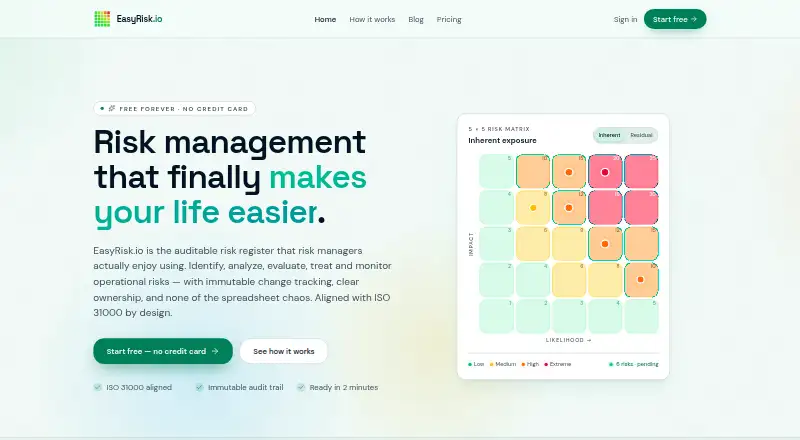
EasyRisk is an operational risk register for identifying, analyzing, evaluating, treating, and monitoring risks. Its qualitative 5×5 matrix shows inherent and residual risk and calculates severity bands. The workflow is described as aligned with ISO 31000, though EasyRisk explicitly says it is not certified to that standard. Risk and treatment changes record who made them, when, and the old and new values; entries cannot be edited or deleted through the application. Dashboards surface overdue reviews and high-severity risks, and each risk has a next-review date. Teams can assign owners and roles, set treatment actions and due dates, and discuss risks in comment threads. A REST API and MCP server are listed, and Enterprise supports SAML and OIDC single sign-on. EasyRisk can run on an organization's own infrastructure. The Free plan includes unlimited risks but only one board, one editor, and one attachment per risk. Team costs €14 per user per month billed annually; Business costs €29 per user per month billed annually.
Who it suits
EasyRisk may suit organizations that need a structured operational risk register with review monitoring and change history. Business is described for multi-team organizations and board reporting; Enterprise is presented for regulated organizations with formal defenses.
What it does well
- Tracks inherent and residual risk in a 5×5 matrix
- Records old and new values in audit history
- Dashboards surface overdue reviews and high-severity risks
- Can run on an organization's own infrastructure
- Free plan includes unlimited risks
What to know first
- Workflow is not certified to ISO 31000
- Free plan includes only one risk board
- Free plan includes only one editor
- ISO 27001, SOC 2, and penetration-test reports require confirmation
Limits
The Free plan has one risk board, one editor, and one attachment per risk. Team provides five boards and five attachments per risk; Business provides ten boards and 25 attachments per risk.
Plans
| Plan | Billed and limits | Price |
|---|---|---|
| Free | free forever · Unlimited risks · 1 risk board · 1 editor · 1 attachment per risk · Standard email support | Free |
| Team | $168.00 per editor per year (= $14.00 per editor/month, billed annually) · 5 risk boards · Unlimited editors · 5 attachments per risk · Priority support | $168 a year |
| Business | per editor / month, billed yearly · 10 risk boards · 25 attachments per risk · Custom risk categories and scales · Quarterly PDF reports · AI risk copilot · REST API · TOTP · Time-boxed access delegation · Priority support | $29 |
| Enterprise | tailored to your organization · Unlimited risk boards, editors, viewers, and attachments · SAML/OIDC SSO · SCIM provisioning · Dedicated tenant and EU/CH data residency · Custom scoring frameworks · Dedicated customer success · Onboarding and training | On request |
As easyrisk.io lists them, read 30 Sept 2026. The maker's own page has the final word.
Getting started
- Open the EasyRisk website.
- Choose the web, API, or self-hosted route that fits your deployment.
- Select the Free, Team, Business, or Enterprise plan.
- Create a risk board and record risks for identification, analysis, evaluation, treatment, and monitoring.
- Assign owners, roles, treatment actions, due dates, and next-review dates.
Overview
EasyRisk is an operational risk register for teams that need to assess, treat, and monitor risks in one workspace. It suits organizations seeking structured risk scoring and accountable follow-up, from a single editor to multi-team deployments. Its strongest case is the combination of review monitoring and an in-app change history users cannot alter; it is not a substitute for ISO certification.
Key features
EasyRisk uses a qualitative 5×5 matrix to show inherent and residual risk, with computed severity bands. That gives teams a consistent way to compare exposure before and after treatment. Organizations that need a scoring model tailored to their own framework will need Enterprise, which includes custom scoring frameworks.
Risk owners and roles, treatment actions and due dates, comment threads, and next-review dates connect assessment to follow-up. Dashboards surface overdue reviews and high-severity risks, useful for teams that need to keep a register active rather than let it become a periodic reporting exercise.
Changes to risks and treatments capture who made them, when, and the old and new values. Application users cannot edit or delete these entries, which supports traceability. EasyRisk describes its workflow as aligned with ISO 31000, but explicitly says it is not certified to that standard.
The pricing comparison includes a REST API and MCP server for AI assistants. Enterprise adds SAML and OIDC single sign-on with MS Entra ID, Okta, and Google Workspace. The Trust Center says workspace isolation is enforced with database Row-Level Security and tested automatically before each release. Data and backups stay within the EU/EEA and Switzerland; daily database backups are retained as the latest 30 runs in encrypted form. Organizations requiring ISO 27001 certification, a SOC 2 report, or penetration-test reports should confirm directly whether EasyRisk can meet that requirement.
Pricing
EasyRisk has a free plan and paid tiers. The pricing note gives paid pricing from €14/user/mo (annual), while the plan comparison quotes prices in USD:
- Free: free, forever. It includes unlimited risks, one risk board, one editor, one attachment per risk, and standard email support. This is a useful way for an individual to maintain a register, but the single board and editor constrain shared use.
- Team: $168 a year, or $14.00 per editor per month billed annually. It provides five risk boards, unlimited editors, five attachments per risk, and priority support. It fits teams that need multiple contributors without the broader reporting and configuration tools of Business.
- Business: $29 a year, billed per editor per month and billed yearly. It includes ten boards, 25 attachments per risk, custom risk categories and scales, quarterly PDF reports, an AI risk copilot, REST API, TOTP, time-boxed access delegation, and priority support. Those additions make it the more capable option for multi-team organizations and board reporting. The listed annual amount differs from the monthly-equivalent figure for Team, so compare the plan terms directly before choosing.
- Enterprise: custom pricing tailored to the organization. It includes unlimited boards, editors, viewers, and attachments; SAML/OIDC SSO; SCIM provisioning; a dedicated tenant and EU/CH data residency; custom scoring frameworks; a dedicated customer success manager; and onboarding and training. It is aimed at regulated organizations with formal second- and third-line defenses.
There is no free trial. Free includes standard email support, while Team and Business include priority support; Enterprise adds dedicated customer success. EasyRisk can also run on an organization's own infrastructure or servers, giving organizations a self-hosting option.
Platforms
EasyRisk supports web access, an API, and self-hosting. Its hybrid deployment options suit organizations choosing between a hosted workspace and running the software on their own infrastructure.
Who it's for
EasyRisk is a good fit for teams that want comparable risk scores, visible review deadlines, and a traceable treatment history. Business is positioned for multi-team work and board reporting; Enterprise is the stronger fit for regulated organizations needing formal defense lines, expanded access controls, and custom scoring. It is less suitable for buyers who require a particular assurance report or certification without first confirming that EasyRisk can provide it.
Pros and cons
- Pros: Inherent and residual scoring, review dates, and dashboard alerts bring assessment and follow-up together.
- Pros: Risk and treatment changes retain actor, time, and before-and-after values, and users cannot edit or delete the entries in the app.
- Pros: Self-hosting, EU/EEA and Switzerland data and backup residency, and daily encrypted backups offer deployment and data-location options.
- Cons: The default matrix is qualitative; custom scoring frameworks are reserved for Enterprise.
- Cons: Free is limited to one editor and one board, while even Team permits only five attachments per risk.
- Cons: ISO 31000 alignment is not certification, and organizations needing ISO 27001, SOC 2, or penetration-test assurance must confirm whether their requirements can be met.
Alternatives
Consider Pirani if mobile access matters: it supports Android and iOS and offers a free tier with 200 records, five seats, one heat map report, and 2.5 GB of cloud storage. Eramba is worth comparing when an open, self-hosted community edition is the priority; its listed Enterprise On-Premise plan starts at €2,500 a year. Riskware may suit buyers seeking a paid option with a free trial and mobile apps.
Qualsys EQMS is another paid option with Android, iOS, and web platforms. For buyers considering broader risk and compliance offerings, Ncontracts uses contact-based pricing, while Protecht charges annual license fees based on named active users and prices some modules and templates extra. Quantivate Business Continuity Software is a paid alternative with contact-based pricing and a demo request. Riskonnect is another paid option whose pricing depends on project size, complexity, and customization. Browse Risk Management Software for more options.
Verdict
Choose EasyRisk if your organization wants a structured operational risk register with visible review follow-up and an application-protected audit history, and its qualitative matrix fits your process. Look elsewhere if a particular certification or assurance report is mandatory, or if your scoring model cannot fit the standard matrix and Enterprise custom frameworks are not practical.
Verdict
EasyRisk combines risk scoring, review monitoring, and uneditable in-app audit entries. Its ISO 31000 alignment is not certification, and organizations needing specific assurance reports are asked to confirm availability.
Questions
Is there a free plan?
Yes. Free is listed at 0.00 USD, billed free forever, and includes unlimited risks, one risk board, one editor, one attachment per risk, and standard email support.
What do the paid plans cost?
Team is listed at $168 a year per editor, equivalent to $14 per editor per month billed annually. Business is listed at $29 a year, billed per editor per month yearly. Enterprise pricing is tailored to the organization.
Which platforms and deployment options are available?
EasyRisk lists API, self-hosted, and web platforms. It can run on an organization's own infrastructure or servers.
Does it support integrations and single sign-on?
The pricing comparison lists a REST API and MCP server. Enterprise supports SAML and OIDC SSO with MS Entra ID, Okta, and Google Workspace.
Is EasyRisk ISO 31000 certified?
No. Its risk workflow is described as ISO 31000 aligned, and EasyRisk explicitly says it is not certified to ISO 31000.
What support comes with each plan?
Free includes standard email support; Team and Business include priority support. Enterprise includes a dedicated customer success manager.
Facts from EasyRisk's own pages
- Assurance
- For organizations requiring ISO 27001 certification, a SOC 2 report, or penetration-test reports, the Trust Center asks them to contact EasyRisk to confirm whether the requirement can be met. · easyrisk.io, 30 Sept 2026
- Audience
- The Enterprise plan is presented for regulated organizations with formal second- and third-line defenses; Business is described for multi-team organizations and board reporting. · easyrisk.io, 30 Sept 2026
- Audit history
- Risk and treatment changes record who made the change, when it happened, and the old and new values; audit entries cannot be edited or deleted through the application. · easyrisk.io, 30 Sept 2026
- Headquarters
- Wilen b. Wollerau, Switzerland · easyrisk.io, 28 Sept 2026
- Hosting and backups
- Application data and backups remain within the EU/EEA and Switzerland; the database is backed up daily, with the latest 30 backup runs retained in encrypted form. · easyrisk.io, 30 Sept 2026
- Integrations
- The pricing comparison lists a REST API and MCP server for AI assistants; Enterprise SSO supports SAML and OIDC with MS Entra ID, Okta, and Google Workspace. · easyrisk.io, 30 Sept 2026
- Purpose
- EasyRisk is an operational risk register for identifying, analyzing, evaluating, treating, and monitoring risks. · easyrisk.io, 30 Sept 2026
- Review monitoring
- Dashboards surface overdue reviews and high-severity risks, and each risk has a next-review date. · easyrisk.io, 30 Sept 2026
- Risk scoring
- It provides a qualitative 5×5 matrix with inherent and residual risk views and computed severity bands. · easyrisk.io, 30 Sept 2026
- Security
- The Trust Center says workspace isolation is enforced with database Row-Level Security and tested automatically before each release. · easyrisk.io, 30 Sept 2026
- Self-hosting
- EasyRisk says it can run on an organization's own infrastructure or servers. · easyrisk.io, 30 Sept 2026
- Support
- The Free plan includes standard email support, paid Team and Business plans include priority support, and Enterprise includes a dedicated customer success manager. · easyrisk.io, 30 Sept 2026
- Team collaboration
- Users can assign risk owners and roles, treatment actions and due dates, and discuss risks in comment threads. · easyrisk.io, 30 Sept 2026
- Workflow
- The product describes its risk workflow as ISO 31000 aligned and explicitly says it is not certified to ISO 31000. · easyrisk.io, 30 Sept 2026
Where EasyRisk stands on Freedom251
- Risk Management Software#2 of 34