Freedom251 › AI Face Swap Tools
DeepFace
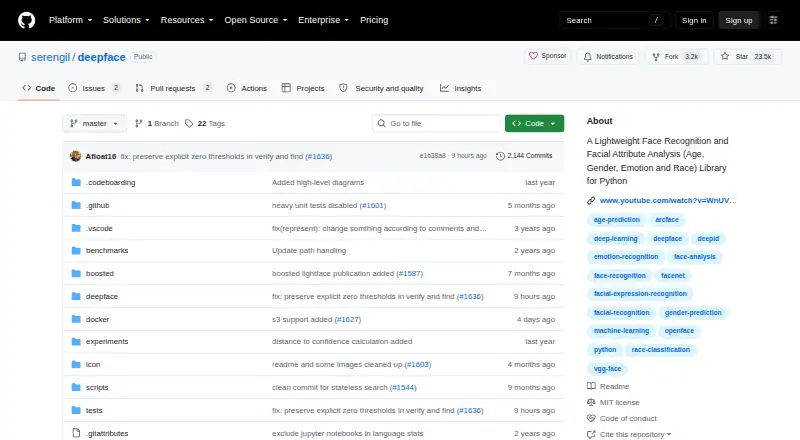
What DeepFace is
DeepFace is a Python framework for face recognition and facial attribute analysis, available as a free, MIT-licensed library for self-hosting. It supports face verification, finding identities in a folder, image analysis and face embedding generation. Attribute analysis includes age, gender, emotion and race. Recognition options include VGG-Face, FaceNet, OpenFace, DeepFace, DeepID, ArcFace, Dlib, SFace, GhostFaceNet and Buffalo_L. Detection backends include OpenCV, SSD, Dlib, MTCNN, RetinaFace, MediaPipe, YOLO, YuNet and CenterFace, with configurable alignment. An optional anti-spoofing module assesses whether a face image is real or fake. Database-backed operations work with PostgreSQL, MongoDB, Neo4j, pgvector, Pinecone, Milvus, Qdrant and Weaviate. The library can be served through REST or gRPC for verification, attribute analysis, vector representation, registration and search. Install it from PyPI or source, using TensorFlow, PyTorch or ONNX Runtime backends. The managed deepface.dev API offers verification, embedding generation and vector comparison without users managing GPU infrastructure. Its free access provides monthly calls under three access conditions. DeepFace cautions that wrapped models may have separate licenses, which should be checked for production use. The hosted service excludes VGG-Face, and InsightFace-based ArcFace models require a separate commercial license.
Who it suits
DeepFace suits developers building face recognition or facial attribute analysis into Python projects, whether they want to self-host or use a managed API. Its database and serving options also fit teams connecting face operations to existing data systems or REST and gRPC services.
What it does well
- Free MIT-licensed Python library for self-hosting
- Supports verification, image analysis and face embeddings
- Multiple recognition models and detection backends
- Optional anti-spoofing module
- REST and gRPC serving options
- Managed API avoids managing GPU infrastructure
What to know first
- Wrapped models may have separate license terms
- Hosted API excludes VGG-Face
- InsightFace-based ArcFace models need a separate commercial license
Limits
deepface.dev free access allows 10 calls per month anonymously, 50 calls per month with a full account, or 100 calls per month with an active saved card. Hosted access excludes VGG-Face, and InsightFace-based ArcFace models require a separate commercial license.
Plans
| Plan | Billed and limits | Price |
|---|---|---|
| Open-source DeepFace | MIT-licensed Python library | Free |
| deepface.dev free access | 10 free calls per month anonymously · 50 free calls per month with a full account · 100 free calls per month with an active saved card | Free |
| DeepFace open-source package | MIT-licensed Python library · self-hosted | Free |
| deepface.dev free allowance | 50 API calls monthly for confirmed accounts · 100 with a saved card | Free |
| Anonymous trial | 10 API calls monthly · one standard API key | Free |
| deepface.dev Enterprise | Custom contracts · Higher rate limits · dedicated queue capacity · SLAs · custom privacy controls | On request |
As github.com lists them, read 4 Oct 2026. The maker's own page has the final word.
Getting started
- Install the library from PyPI or source code.
- Choose TensorFlow, PyTorch or ONNX Runtime as the backend.
- For hosted access, sign up at deepface.dev and obtain an API key.
- Use the hosted API through REST or MCP, or serve the library through REST or gRPC.
Verdict
Choose DeepFace if you need a free Python library with multiple recognition models, configurable detection and self-hosting options. The deepface.dev managed API is an alternative when you want hosted verification and embedding services; check model licensing for production use, especially for the hosted model exclusions and ArcFace requirements.
Questions
Is DeepFace free?
The open-source Python library is free. deepface.dev also offers free access with monthly call limits based on account status.
What platforms does DeepFace support?
The listed platforms are API and self-hosted.
Is DeepFace open source?
Yes. The library is MIT licensed; wrapped models may have separate licenses.
What can the API do?
Its API covers verification, facial attribute analysis, vector representation, registration and search. The hosted API also offers embedding generation and vector comparison.
Who makes DeepFace?
The listed website is the serengil/deepface GitHub repository.
What is the hosted API price?
The deepface.dev free access plan costs nothing. Enterprise uses custom contracts, with no price listed.
Facts from DeepFace's own pages
- Accepted image inputs
- The API accepts uploaded files, local paths, URLs and base64-encoded image data. · github.com, 21 Oct 2026
- Anti-spoofing
- Face extraction and streaming can optionally enable anti-spoofing checks to distinguish real faces from spoof inputs. · github.com, 21 Oct 2026
- API options
- DeepFace can be served through REST or gRPC, and its API covers verification, facial attribute analysis, vector representation, registration, and search. · github.com, 4 Oct 2026
- Attribute analysis
- The analyze function predicts age, gender, emotion and race attributes. · deepwiki.com, 21 Oct 2026
- Database integrations
- Database-backed registration and search support PostgreSQL, MongoDB, Weaviate, Neo4j, PGVector and Pinecone, with additional backends listed in the project README. · deepwiki.com, 21 Oct 2026
- Detection and alignment
- Available detector backends include OpenCV, SSD, Dlib, MTCNN, RetinaFace, MediaPipe, YOLO, YuNet, and CenterFace, and alignment can be configured. · github.com, 4 Oct 2026
- Detector choices
- Documented detector backends include OpenCV, SSD, MTCNN, RetinaFace, MediaPipe, YOLO variants, Dlib, YuNet, CenterFace and FastMTCNN. · deepwiki.com, 21 Oct 2026
- Documentation depth
- Independent documentation indexes installation, quick start, core APIs, database integrations, models, REST deployment, Docker, benchmarking and testing. · deepwiki.com, 21 Oct 2026
- Embeddings
- The represent function converts faces into multidimensional embedding vectors. · deepwiki.com, 21 Oct 2026
- Face search
- The find function searches for an input face inside a file-based image database and returns matched identities. · deepwiki.com, 21 Oct 2026
- Face tasks
- Its functions support face verification, finding identities in a folder, image analysis, and producing face embeddings. · github.com, 4 Oct 2026
- Face verification
- The verify function determines whether two supplied face images belong to the same person and returns a verification result with distance information. · github.com, 21 Oct 2026
- gRPC API
- A gRPC service is available with a protobuf contract covering the same core operations as the REST service. · github.com, 21 Oct 2026
- Hosted API
- deepface.dev provides a managed API for verification, embedding generation and vector comparison while handling hosting, scaling and model updates. · deepface.dev, 21 Oct 2026
- Hosted API authentication
- The managed service uses account-created REST or MCP keys and exposes its REST gateway at api.deepface.dev. · docs.deepface.dev, 21 Oct 2026
- Hosted API endpoints
- The managed public API documents POST /verify, POST /represent, POST /compare and GET /capabilities. · docs.deepface.dev, 21 Oct 2026
- Hosted API request controls
- The hosted quickstart documents API keys, model allowlists, optional remote URL fetching checks and an x-request-id for troubleshooting. · docs.deepface.dev, 21 Oct 2026
- Hosted inputs and access
- The hosted API accepts files and base64 by default, provides REST and MCP access, and offers self-serve signup, API keys, usage, and billing. · deepface.dev, 4 Oct 2026
- Hosted model limits
- The hosted service excludes VGG-Face because its released weights are restricted to non-commercial research use and says InsightFace-based ArcFace models require a separate commercial license. · deepface.dev, 4 Oct 2026
- Installation
- The primary installation method is pip from PyPI, with optional TensorFlow and PyTorch extras and ONNX as the default backend in the current release. · pypi.org, 21 Oct 2026
- Install options
- The library can be installed from PyPI or source code with TensorFlow, PyTorch, or ONNX Runtime backends. · github.com, 4 Oct 2026
- Latest release
- PyPI lists DeepFace 0.0.102 as released on October 9, 2026, with one maintainer identified as Sefik Ilkin Serengil. · pypi.org, 21 Oct 2026
- Licence
- DeepFace is distributed under the MIT licence. · github.com, 21 Oct 2026
- License and model caveat
- DeepFace is MIT licensed, but the repository cautions that wrapped models can carry separate licenses that should be checked for production use. · github.com, 4 Oct 2026
Where DeepFace stands on Freedom251
- AI Face Swap Tools#1 of 57
- AI Image Recognition Software#2 of 37
- Image Recognition Software#2 of 28
- Facial Recognition Software#2 of 16