Freedom251 › Rank Tracking Software
Decodo Rank Tracker
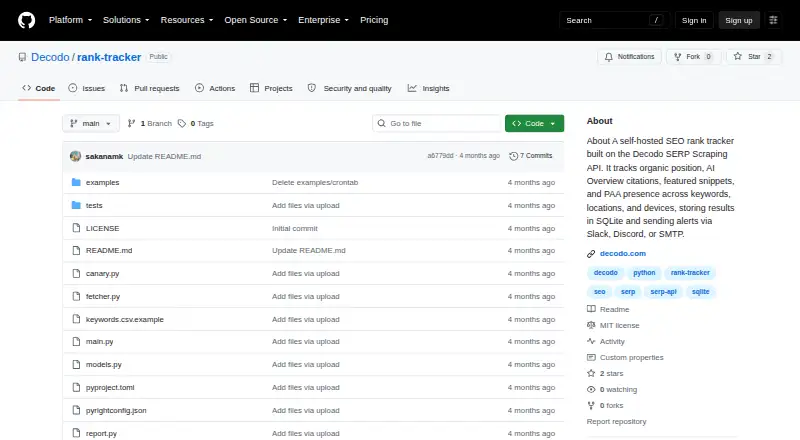
What Decodo Rank Tracker is
Decodo Rank Tracker is a free, MIT-licensed, self-hosted SEO tool built on the Decodo SERP Scraping API. It tracks organic rankings, AI Overview citations, featured snippets, and People Also Ask presence by keyword, location, and device. Results are stored in SQLite, with terminal trend reports, competitor comparisons, and shareable HTML reports. Checks can be scheduled from the command line or operating-system schedulers, with examples for cron, launchd, and systemd. Alerts can go to Slack, Discord, or SMTP email for new rankings, gains, drops, and lost rankings. Keywords are set up in a CSV file with required keyword and target-domain fields, plus optional location, locale, device, activity, and frequency settings. Each keyword, location, device, and locale combination consumes a Decodo API call; less frequent checks can reduce calls. Setup instructions cover Linux and macOS shells, with Windows equivalents for activation and file copying. The tracker requires Decodo API credentials. The API pricing page lists a free tier with up to 5K crawls or 10K pages scraped per month.
Who it suits
It suits SEO users comfortable self-hosting a command-line tool and configuring keyword checks in a CSV file. It can also suit users who want scheduled rank monitoring and alerts through Slack, Discord, or email.
What it does well
- Tracks organic results, AI citations, snippets, and PAA presence.
- Stores results in SQLite and provides HTML reports.
- Supports scheduled checks and Slack, Discord, or SMTP alerts.
- MIT-licensed self-hosted software is listed as free.
- Windows, macOS, and Linux setup paths are described.
What to know first
- Decodo SERP Scraping API credentials are required.
- Each keyword, location, device, and locale combination consumes an API call.
- Microsoft Teams alerts require a separate Power Automate setup.
Limits
The free software requires Decodo SERP Scraping API credentials. Each keyword, location, device, and locale combination consumes an API call; the API's listed free plan allows up to 5K crawls or 10K pages scraped per month.
Plans
| Plan | Billed and limits | Price |
|---|---|---|
| Rank Tracker | MIT-licensed self-hosted software · Requires Decodo SERP Scraping API credentials | Free |
As github.com lists them, read 11 Oct 2026. The maker's own page has the final word.
Getting started
- Open the Decodo Rank Tracker GitHub repository.
- Prepare Decodo SERP Scraping API credentials.
- Use a Linux or macOS shell, or follow the repository's Windows equivalents.
- Configure keywords in a CSV file with keyword and target-domain columns.
- Set optional location, locale, device, activity, and frequency values as needed.
- Run checks from the command line or schedule them with cron, launchd, or systemd.
Decodo Rank Tracker is a self-hosted SEO monitor for people comfortable configuring a command-line tool and using Decodo’s SERP Scraping API. It suits users who want Google ranking history and visibility across several result types without paying for the tracker software. Its broad coverage comes with a practical constraint: every keyword, location, device, and locale combination uses an API call.
Overview
The tracker monitors organic rankings, AI Overview citations, featured snippets, and People Also Ask presence. Checks can be scoped by keyword, location, and device, giving SEO practitioners more context than a position-only tracker. Google is the supported search engine, so it is not the right choice for monitoring rankings across multiple engines.
Results are kept in SQLite and can be reviewed through terminal trend reports, competitor comparisons, and shareable HTML reports. Historical data supports tracking changes over time. Self-hosting gives the operator control of where the software and its data run, but it also means handling setup and keeping the scheduled jobs working.
Key features
Configurable checks and schedules
Keywords and target domains go in a CSV file; location, locale, device, activity, and frequency are optional settings. Checks can run from the command line or through system schedulers, with examples for cron, launchd, and systemd. That flexibility suits users who already manage scripts or servers, while the file-based workflow is less attractive to people seeking a graphical setup.
Frequency can be set daily, weekly, or monthly. Less frequent checks reduce API consumption, which matters when monitoring many keyword and location combinations. Each combination of keyword, location, device, and locale counts as a separate check, so expanding coverage can use calls quickly.
Alerts and data
Alerts can flag new rankings, improvements, drops, and lost rankings, with delivery through Slack, Discord, or SMTP email. Microsoft Teams requires a separate Power Automate setup, so Teams users should expect extra configuration rather than a direct alert connection.
SQLite storage uses write-ahead logging, migrations, UTC timestamps, and thread-safe per-call connections. These implementation details support reliable local recordkeeping, but the storage remains part of a self-hosted workflow rather than a managed online service.
Pricing
The Rank Tracker plan costs free. The software is MIT-licensed and self-hosted, but requires Decodo SERP Scraping API credentials; free tracker software does not mean unlimited data collection. Decodo’s API free plan allows up to 5K crawls or 10K pages scraped per month, and checks consume API calls according to their keyword, location, device, and locale combinations.
Daily tracking is the stated update frequency, with country location tracking, competitor tracking, Google results, mobile rank tracking, and historical ranking data. The published plan does not state a seat limit. Users with broad keyword or geographic coverage should account for API usage and may need to reduce check frequency to fit their allowance.
Platforms
Decodo Rank Tracker supports Linux, macOS, and Windows as a self-hosted tool. The quick start uses a Linux or macOS shell and provides Windows equivalents for virtual-environment activation and file copying. This is a practical fit for users who can follow shell-based setup, not a turnkey hosted dashboard.
Who it's for
Choose it if you want a free, open-source tracker you can run yourself, need Google result features beyond organic positions, and value competitor comparisons and exportable HTML reports. It is less suitable if you want a browser-based service, multiple search engines, or predictable monitoring without managing API-call consumption.
Pros and cons
- Pros: Tracks organic rankings, AI Overview citations, featured snippets, and People Also Ask presence, providing several views of Google visibility.
- Pros: Historical records, competitor comparisons, terminal trends, and shareable HTML reports support both ongoing analysis and reporting.
- Pros: MIT licensing and self-hosting avoid a software subscription and let operators keep the deployment under their control.
- Cons: Each keyword-location-device-locale combination consumes an API call, making extensive tracking dependent on usage limits and frequency choices.
- Cons: CSV configuration and command-line or scheduler setup put the operational work on the user.
- Cons: Google-only coverage and separate Power Automate setup for Microsoft Teams limit flexibility for some workflows.
Alternatives
Browse rank tracking software for other approaches to ranking and monitoring needs.
- GBP Rank Tracker is another free, MIT-licensed option, with unlimited scans and a 13×13+ grid; consider it when those scan and grid terms better match the job.
- Positionly is a freemium option with Android, iOS, API, and web platforms; its free plan covers 5 keywords and 1 website, while Basic costs $15 a month billed for 12 months (20% off) for 100 keywords and 10 websites. Pick it if those platform options or stated quotas fit better.
- Rank Tracker has a free plan for Linux, macOS, and Windows that includes scheduled SEO tasks, project saving, and one competitor per project; choose it if those project features are a closer fit.
- Rankinity offers a free version with 300 checks per month and a full version with unlimited checks at custom pricing. It may suit users prioritizing a stated check allowance or unlimited-check plan.
- SerpBear is free software with self-hosted availability; external scraping services may have usage limits or costs. Consider it if you want another self-hosted free option.
- CanIRank is a web-based freemium alternative whose free plan includes one website and five keyword reports total; choose it if a web platform and that limited free allowance suit you.
- Geogrid is a freemium API and web option with a free plan of 200 credits and one weekly scheduled rescan; it may suit users who want those specific scanning terms.
- Grid My Business is a freemium API and web alternative; consider it if that platform mix better fits your needs.
Verdict
Decodo Rank Tracker is a strong fit for technically comfortable SEO practitioners who want a free, self-hosted way to track several kinds of Google results and compare competitors over time. The breadth of tracked result features is its main reason to choose it; API-call consumption and the command-line setup are the main reasons to look elsewhere.
Verdict
Decodo Rank Tracker combines several Google results signals with scheduled checks, competitor comparisons, and alerts in a self-hosted package. Factor in API-call usage and the separate setup noted for Microsoft Teams alerts.
Questions
How much does Decodo Rank Tracker cost?
The Rank Tracker plan is free. It is MIT-licensed self-hosted software and requires Decodo SERP Scraping API credentials.
Which platforms does it support?
It supports Linux, macOS, Windows, and self-hosted use.
What can it track?
It tracks Google organic rankings, AI Overview citations, featured snippets, and People Also Ask presence by keyword, location, and device. Competitor and historical ranking data are also listed.
Can it send alerts and generate reports?
Alerts can go to Slack, Discord, or SMTP email. It provides terminal trend reports, competitor comparisons, and shareable HTML reports.
What does the API usage depend on?
Each keyword, location, device, and locale combination counts as a check and consumes an API call. Daily, weekly, or monthly frequency settings can reduce calls.
Who makes Decodo?
Decodo says it has provided proxy and scraping solutions since 2018 and was formerly known as Smartproxy. It lists its headquarters in Vilnius, Lithuania.
Facts from Decodo Rank Tracker's own pages
- Alerts
- Alerts support Slack, Discord, and SMTP email, including notifications for new rankings, improvements, drops, and rankings lost. · github.com, 11 Oct 2026
- API pricing
- Decodo's SERP Scraping API pricing page lists a free plan with up to 5K crawls or 10K pages scraped per month. · decodo.com, 11 Oct 2026
- Configuration
- Keywords are configured in a CSV file with required keyword and target-domain columns and optional location, locale, device, activity, and frequency settings. · github.com, 11 Oct 2026
- Data handling
- The README describes SQLite storage with write-ahead logging, migrations, UTC timestamps, and thread-safe per-call connections. · github.com, 11 Oct 2026
- Headquarters
- Decodo lists its headquarters at Švitrigailos str. 34, Vilnius, Lithuania. · decodo.com, 11 Oct 2026
- Integrations
- The tracker uses Decodo's SERP Scraping API and connects alert delivery to Slack, Discord, or SMTP; the README says Microsoft Teams requires a separate Power Automate setup. · github.com, 11 Oct 2026
- License
- The repository is licensed under the MIT license. · github.com, 11 Oct 2026
- Maker history
- Decodo's About page says the company has provided proxy and scraping solutions since 2018 and was formerly known as Smartproxy. · decodo.com, 11 Oct 2026
- Platform setup
- The quick-start instructions use a Linux or macOS shell and give Windows equivalents for virtual-environment activation and file copying. · github.com, 11 Oct 2026
- Purpose
- Rank Tracker is a self-hosted SEO tool built on the Decodo SERP Scraping API. · github.com, 11 Oct 2026
- Scheduling
- Checks can run on a schedule using the command line or operating-system schedulers, with example configurations for cron, launchd, and systemd. · github.com, 11 Oct 2026
- Storage and reports
- It stores results in SQLite and provides terminal trend reports, competitor comparisons, and shareable HTML reports. · github.com, 11 Oct 2026
- Tracked results
- It tracks organic rankings, AI Overview citations, featured snippets, and People Also Ask presence by keyword, location, and device. · github.com, 11 Oct 2026
- Usage limits
- Each keyword, location, device, and locale combination is a check that consumes a Decodo API call, and daily, weekly, or monthly frequency settings can reduce calls. · github.com, 11 Oct 2026
Where Decodo Rank Tracker stands on Freedom251
- Rank Tracking Software#3 of 67