Freedom251 › Data Transformation Tools

dbplyr
What dbplyr is
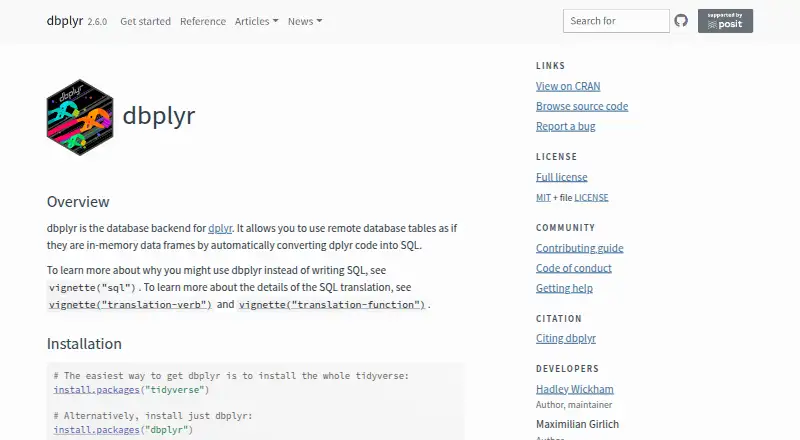
dbplyr is an R package that translates dplyr code into SQL for remote database tables. It is intended for data that already resides in a database or is too large to fit into memory at once. Operations on remote tables are delayed until results are requested, at which point they are sent to the database. Documented operations include filtering, selecting, mutating, grouping, summarising, joins, set operations and row modifications. dbplyr concentrates on generating SELECT statements rather than translating every part of SQL. Its listed database dialects include SQLite, PostgreSQL, MySQL/MariaDB, SQL Server, Oracle, Snowflake, Redshift, Spark SQL, Teradata and Hive, among others. DBI coordinates database connections, and using a database requires installing its backend package. Functions can display generated SQL and query plans. Installation instructions cover CRAN and a development version from GitHub. dbplyr is free under the MIT license and supports Linux, macOS and Windows.
Who it suits
It suits R users who work with data in databases or datasets too large to fit in memory. Users need the DBI backend package for the database they plan to connect to.
What it does well
- Free package under the MIT license
- Delays remote operations until results are requested
- Supports multiple database dialects
- Can show generated SQL and query plans
- Available for Linux, macOS and Windows
What to know first
- Does not translate all of SQL
- Requires a DBI backend package for the database
Limits
dbplyr focuses on generating SELECT statements and does not translate all of SQL. Using a database also requires the DBI backend package for that database.
Plans
| Plan | Billed and limits | Price |
|---|---|---|
| dbplyr | Open-source R package · MIT license | Free |
As dbplyr.tidyverse.org lists them, read 5 Oct 2026. The maker's own page has the final word.
Getting started
- Visit the dbplyr documentation site.
- Install the package from CRAN using the installation command in the documentation, or follow its GitHub instructions for the development version.
- Install a DBI backend package for the database you want to connect to.
- Use dbplyr on Linux, macOS, or Windows.
Verdict
dbplyr lets users apply dplyr operations to remote database tables while deferring execution to the database. Its SQL translation has a defined scope, and each database connection requires an appropriate backend package.
Questions
How much does dbplyr cost?
dbplyr is free: the listed plan is free. It is an open-source R package under the MIT license.
Does dbplyr have a free trial?
No. The listed free trial availability is no; the package itself has a free plan.
Which operating systems are supported?
The listed platforms are Linux, macOS, and Windows.
Which databases can dbplyr work with?
The package index lists backends or dialects including SQLite, PostgreSQL, MySQL/MariaDB, SQL Server, Oracle, Snowflake, Redshift, Spark SQL, Teradata, and Hive, among others. A DBI backend package is required for the database you use.
Does dbplyr translate all SQL?
No. Its focus is generating SELECT statements, and it does not translate all of SQL.
Who maintains dbplyr?
The site lists Hadley Wickham as author and maintainer. Maximilian Girlich and Edgar Ruiz are also named as authors.
Facts from dbplyr's own pages
- Connection interface
- Database connections are coordinated through DBI, and users install a backend package for the database they want to connect to. · dbplyr.tidyverse.org, 5 Oct 2026
- Database backends
- The package index lists built-in dialects or backends including SQLite, PostgreSQL, MySQL/MariaDB, SQL Server, Oracle, Snowflake, Redshift, Spark SQL, Teradata, Hive, and others. · dbplyr.tidyverse.org, 5 Oct 2026
- Inspect queries
- The package provides functions to show generated SQL and query plans. · dbplyr.tidyverse.org, 5 Oct 2026
- Installation
- The documentation gives installation commands for dbplyr from CRAN and for the development version from GitHub. · dbplyr.tidyverse.org, 5 Oct 2026
- Intended users
- The documentation describes using dbplyr when data already lives in a database or is too large to fit in memory at once. · dbplyr.tidyverse.org, 5 Oct 2026
- Lazy queries
- Operations on remote tables are delayed and sent to the database when results are requested. · dbplyr.tidyverse.org, 5 Oct 2026
- License
- The dbplyr site identifies the package license as MIT. · dbplyr.tidyverse.org, 5 Oct 2026
- Maintainers
- The site lists Hadley Wickham as author and maintainer and names Maximilian Girlich and Edgar Ruiz as authors. · dbplyr.tidyverse.org, 5 Oct 2026
- Maker history
- Posit says RStudio, now Posit, was founded in 2009 to create open-source software for data scientists. · posit.co, 5 Oct 2026
- Purpose
- dbplyr is the database backend for dplyr and converts dplyr code into SQL for remote database tables. · dbplyr.tidyverse.org, 5 Oct 2026
- Requirements
- Using dbplyr with a database requires a DBI backend package for that database. · dbplyr.tidyverse.org, 5 Oct 2026
- SQL scope
- dbplyr focuses on generating SELECT statements and does not translate all of SQL. · dbplyr.tidyverse.org, 5 Oct 2026
- Support
- The site links users to a getting-help page and a GitHub issue tracker for reporting bugs. · dbplyr.tidyverse.org, 5 Oct 2026
- Supported operations
- Documented operations include filtering, selecting, mutating, grouping, summarising, joins, set operations, and row modifications. · dbplyr.tidyverse.org, 5 Oct 2026
Where dbplyr stands on Freedom251
- Data Transformation Tools#12 of 37