Freedom251 › Database Design Tools

DBModeler
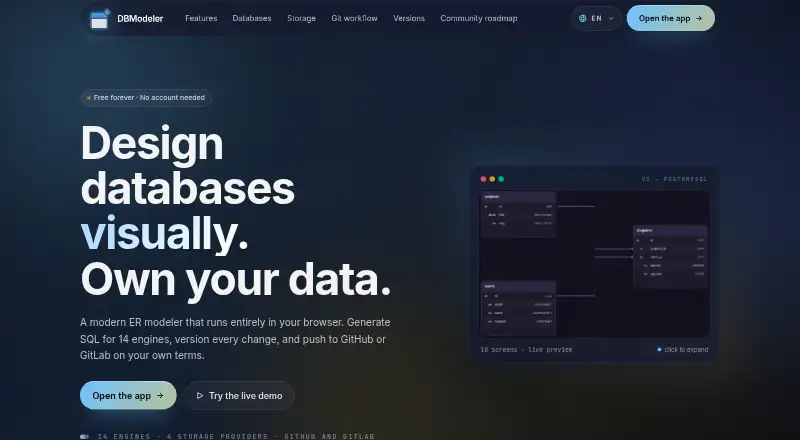
What DBModeler is
DBModeler is a browser-based entity-relationship modeling tool for designing databases and generating SQL for 14 engines. Its visual editor supports table editing, relationships, undo and redo, automatic arrangement, and PNG diagram export. It can generate engine-aware CREATE SQL for an initial model and ALTER migrations for later revisions. Users can also paste or upload existing DDL; an import planner previews proposed changes before they affect the model.
Each version has a snapshot and diff that can be compared, rolled back, regenerated as SQL, or synced to Git. Models may be kept in the browser or synced through Google Drive, OneDrive, or Dropbox. Schemas can be published to GitHub or GitLab as commits, branches, or pull or merge requests. The editor works offline when installed as a progressive web app, with syncing resuming after the user reconnects. DBModeler also produces schema-validator outputs for libraries including Yup, Zod, Joi, Ajv, and Pydantic.
The free plan includes every feature, has no usage quotas, supports all 14 engines, and does not require an account. DBModeler runs on the web and supports reverse and forward engineering and SQL export. Team collaboration is not available; the site describes a managed team edition as coming soon and shared diagrams across cloud storage as in progress.
Who it suits
DBModeler suits individuals who want to design database schemas in a browser, generate SQL, or work from existing DDL. Its version history, cloud storage sync, Git publishing, and offline mode can support individual workflows, while teams needing collaboration inside the tool may find its current scope limiting.
What it does well
- Free plan includes every feature, all 14 engines, and no usage quotas.
- No account is required to use the free plan.
- Imports existing DDL with a preview of proposed model changes.
- Version snapshots and diffs can be rolled back or synced to Git.
- Works offline when installed as a progressive web app.
- Exports validator outputs for libraries including Yup and Pydantic.
What to know first
- Team collaboration is not available.
- The managed edition for teams is still forthcoming.
- Shared diagrams across cloud storage are in progress.
Limits
The free plan has no usage quotas and includes every feature and all 14 engines. Team collaboration is unavailable, and shared diagrams across cloud storage are in progress.
Plans
| Plan | Billed and limits | Price |
|---|---|---|
| Free | Every feature · no usage quotas · all 14 engines · no account required | Free |
As dbmodeler.io lists them, read 8 Oct 2026. The maker's own page has the final word.
Getting started
- Open the DBModeler website in a browser.
- Start using the free plan; an account is not required.
- Create a model in the visual editor, or paste or upload existing DDL.
- Choose a supported database engine for SQL generation.
- Optionally sync models with Google Drive, OneDrive, or Dropbox, or publish schemas to GitHub or GitLab.
- Install it as a progressive web app to use the editor offline.
Verdict
Pick DBModeler for free browser-based database modeling with SQL generation, version history, and support for 14 engines. Its main limitation for groups is that team collaboration is unavailable, while the managed team edition and shared cloud diagrams are still in progress.
Questions
How much does DBModeler cost?
DBModeler is free. Its Free plan is listed as free.
Do I need an account?
No. The Free plan does not require an account.
Which databases does it support?
It supports PostgreSQL, MySQL, MariaDB, Oracle, SQL Server, SQLite, IBM Db2, Snowflake, BigQuery, Redshift, CockroachDB, YugabyteDB, TiDB, and DuckDB.
Can DBModeler generate and export SQL?
Yes. It generates CREATE SQL for an initial version and ALTER migrations for later versions, and SQL export is available.
Does DBModeler support team collaboration?
No. Team collaboration is listed as unavailable; a managed team edition is described as coming soon.
Can I use it offline or connect it to storage and Git?
The editor works offline when installed as a progressive web app. Models can sync through Google Drive, OneDrive, or Dropbox, and schemas can be published to GitHub or GitLab.
Facts from DBModeler's own pages
- Git integrations
- Users can publish schemas to GitHub or GitLab as commits, branches, or pull or merge requests. · dbmodeler.io, 8 Oct 2026
- Notable limitation
- The site says a managed edition for teams is coming soon; shared diagrams across cloud storage are listed as in progress. · dbmodeler.io, 8 Oct 2026
- Offline access
- The editor works offline when installed as a progressive web app, with sync resuming when the user is back online. · dbmodeler.io, 8 Oct 2026
- Purpose
- DBModeler is a browser based ER modeler for designing databases and generating SQL for 14 engines. · dbmodeler.io, 8 Oct 2026
- Security
- The site says there is no backend and that provider tokens and repository secrets are encrypted at rest using a key derived from the user's master password. · dbmodeler.io, 8 Oct 2026
- SQL and migrations
- It generates engine aware CREATE SQL for the initial version and ALTER migrations for later versions. · dbmodeler.io, 8 Oct 2026
- SQL import
- Users can paste or upload existing DDL, and the import planner previews changes before they affect the model. · dbmodeler.io, 8 Oct 2026
- Storage integrations
- Models can be stored in the browser or synced through Google Drive, OneDrive, or Dropbox. · dbmodeler.io, 8 Oct 2026
- Support and feedback
- Users can report bugs or request features through a feedback form whose submissions go to the public roadmap. · dbmodeler.io, 8 Oct 2026
- Validation exports
- DBModeler offers schema validator outputs for libraries including Yup, Zod, Joi, Ajv, and Pydantic. · dbmodeler.io, 8 Oct 2026
- Version history
- Each version has a snapshot and diff that users can compare, roll back, regenerate as SQL, or sync to Git. · dbmodeler.io, 8 Oct 2026
- Visual modeling
- Its editor supports table editing, relationships, undo and redo, auto arrange, and PNG diagram export. · dbmodeler.io, 8 Oct 2026
Where DBModeler stands on Freedom251
- Database Design Tools#10 of 35