Freedom251 › Data Transformation Tools
csvkit
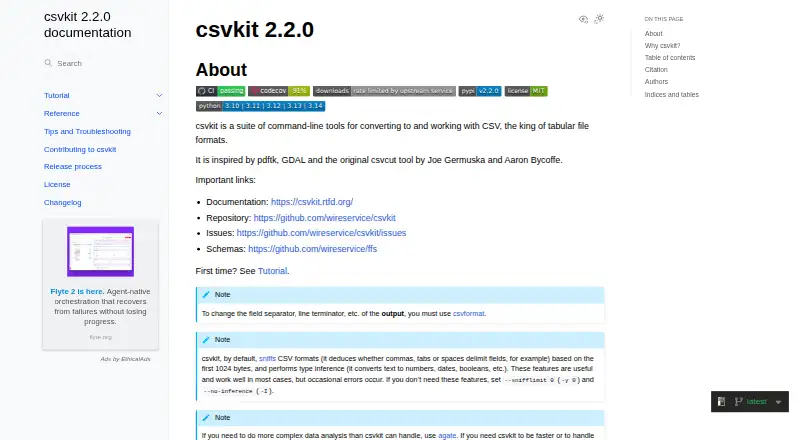
What csvkit is
csvkit is a free, open-source command-line toolkit for converting and working with CSV files on Linux, macOS and Windows. Its commands cover imports, cleaning, selecting, filtering, joining, sorting and stacking, along with formatting and analysis. in2csv converts Excel XLS/XLSX, JSON and fixed-width files into CSV. For SQL workflows, csvsql can query CSV data and import it into PostgreSQL, while sql2csv extracts PostgreSQL query results. Database connections use SQLAlchemy dialects; PostgreSQL and MySQL are listed in the troubleshooting guide. By default, csvkit detects delimiters from the first 1024 bytes and infers data types such as numbers, dates and booleans, though the documentation warns that inference can be wrong. Installation options include pip and Homebrew, and the project recommends virtual environments. Current project metadata requires Python 3.10 or newer. Some tools stream rows, while others hold whole files in memory, so large inputs may reach the toolkit’s limits. It is distributed under the MIT License, which provides the software as-is without warranty. Support is available through documentation, GitHub issues and community contributions.
Who it suits
csvkit suits developers, desktop users and science or research users who are comfortable with command-line data workflows. It can also fit SQL-based CSV workflows involving PostgreSQL.
What it does well
- Free command-line toolkit under the MIT License
- Converts Excel, JSON and fixed-width files to CSV
- Supports CSV queries and PostgreSQL imports
- Available on Linux, macOS and Windows
- Installation documented for pip and Homebrew
What to know first
- Current metadata requires Python 3.10 or newer
- Some tools buffer entire files in memory
- Type inference can occasionally be erroneous
Limits
Some commands buffer entire files in memory, and the documentation warns that large files may reach csvkit's limits. Its maintainers generally no longer add new tools because of limited maintenance time and a desire to keep the toolkit focused.
Plans
| Plan | Billed and limits | Price |
|---|---|---|
| Open-source csvkit | Free of charge under the MIT License · Command-line toolkit · no paid tiers stated | Free |
As csvkit.readthedocs.io lists them, read 1 Oct 2026. The maker's own page has the final word.
Getting started
- Open the csvkit documentation website.
- Choose a supported Linux, macOS, or Windows system with Python 3.10 or newer.
- Install with pip, or use Homebrew; the project recommends a virtual environment.
- Add the optional Zstandard extra if needed.
csvkit is a self-hosted command-line toolkit for turning, cleaning, joining and examining tabular files. It is best for developers, desktop power users and research teams who prefer scripted, repeatable data work. Its broad format and SQL coverage is compelling at no cost, but Python-version requirements, type-guessing mistakes and memory-heavy commands make large or unpredictable datasets a harder fit.
Overview
The toolkit covers CSV, DBF, fixed-width files, GeoJSON, JSON, NDJSON, Excel XLS/XLSX and compressed CSV input in gzip, bz2 and xz forms. That makes it useful at the boundary between spreadsheets, APIs, flat files and databases, provided a terminal-based workflow suits the team. Workflow orchestration and data-quality checks are supported, and deployment is self-hosted rather than a hosted service.
csvkit is MIT-licensed and supplied as-is without warranty. Maintainers say they generally do not add new tools, choosing a focused scope because maintenance time is limited. That stability can help established scripts, but buyers wanting a fast-growing command catalog should look elsewhere.
Key features
Conversion and file shaping
in2csv turns Excel workbooks, JSON and fixed-width data into CSV, while sql2csv brings query results out of PostgreSQL. The processing set includes csvclean for cleanup, csvcut for selecting columns, csvgrep for filtering, csvjoin for relational-style joins, csvsort for ordering and csvstack for combining files. These small, composable commands are well suited to scheduled scripts and one-off investigations, though they presume comfort with shell syntax and piping.
Output, inspection and SQL
csvformat, csvjson, csvlook, csvpy, csvsql and csvstat cover reformatting, JSON output, readable previews, Python-oriented handling, SQL operations and statistics. csvsql can query CSV data with SQL and import it into PostgreSQL, giving analysts a bridge from files to a database. Database connections use SQLAlchemy dialects; PostgreSQL and MySQL are specifically supported in troubleshooting guidance.
Parsing behavior and scale
Delimiter detection samples the first 1,024 bytes by default, which is convenient for ordinary files but can misread unusual files whose opening segment is unrepresentative. Automatic inference recognizes numbers, dates, booleans and other types, yet the project warns that it can occasionally be wrong; pipelines requiring strict schemas should validate and override assumptions. Some commands stream rows, while others buffer a complete file, so large inputs can exceed practical limits and require careful command selection or a different tool.
Installation and support
Installation is documented through pip, with virtual environments recommended; Homebrew is also supported, and an optional Zstandard extra is available. Current metadata requires Python 3.10 or newer, and supported non-end-of-life Python environments span Linux, macOS and Windows. Help comes through the documentation, GitHub issues and community contributions rather than a paid support channel.
Pricing
| Plan | Price | What it includes |
|---|---|---|
| Open-source csvkit | free | Command-line toolkit, free of charge under the MIT License; no paid tiers stated. |
There are no seat allowances, usage quotas, trial periods or renewal charges attached to this plan. It fits individuals, teams and organizations able to run and maintain software themselves; organizations needing contractual warranties or vendor-managed hosting should account for the self-hosted model and the MIT license's no-warranty terms.
Platforms
csvkit runs on Linux, macOS and Windows when paired with a supported, non-end-of-life Python release. Installation can use pip or Homebrew, with virtual environments recommended. It is code-driven and self-hosted, not a browser-first application.
Who it's for
Choose csvkit for repeatable engineering, research or desktop data tasks involving mixed file formats, SQL queries and shell automation. It is particularly effective when a team values transparent scripts over a graphical interface and can police schemas in its own pipeline. It is less suitable for very large files that trigger whole-file buffering, users who need guaranteed type detection, or organizations seeking active expansion and managed support.
Pros and cons
- Pro: One free toolkit spans spreadsheet, JSON, fixed-width and database-oriented CSV workflows.
- Pro: Focused commands can be chained into auditable conversion and quality-check pipelines.
- Pro: PostgreSQL SQL import and export reduce friction between flat files and relational storage.
- Con: Automatic type inference can be erroneous, so sensitive pipelines need explicit validation.
- Con: Memory-buffering commands may hit limits on large files.
- Con: Python 3.10-or-newer support excludes older runtimes, and maintenance intentionally limits new tools.
Alternatives
jq is a free MIT-licensed option with standalone Linux, macOS and Windows binaries; pick it when JSON-focused command-line processing matters more than csvkit's CSV and SQL breadth.
Polars offers a free open-source library plus a freemium model and web/API availability; choose it for programmatic data manipulation across those environments.
Apache Beam is a free open-source programming model whose execution costs depend on the runner and infrastructure; it fits distributed pipelines rather than local CSV command chains.
Bonobo is free Apache-licensed software for users seeking a different open-source data-processing framework.
Bruin for Customer Success has a free cloud tier with $100 in credits and 50 AI tasks without a credit card; choose it when a hosted workflow and those allowances suit the job.
data.table, dbplyr and dplyr are free R-based alternatives; select them when your work is centered on R and its package ecosystem.
Data Transformation Tools provides a broader category comparison when csvkit's command-line focus is not enough.
Verdict
csvkit is a strong choice for technical users who need a free, scriptable way to convert, validate, analyze and move CSV-family data, especially alongside PostgreSQL. Look elsewhere if your files routinely exceed in-memory limits, require faultless automatic typing, or you want a hosted product with a rapidly expanding feature set and formal warranties.
Verdict
csvkit offers a broad set of command-line operations for CSV conversion, processing and analysis without a paid tier. Its memory use on some commands and fallible type inference are worth considering with large or varied data.
Questions
How much does csvkit cost?
The Open-source csvkit plan is free, free of charge under the MIT License. No paid tiers are stated.
Which systems does csvkit support?
It supports Linux, macOS, and Windows with non-end-of-life Python versions. Current project metadata requires Python 3.10 or newer.
What file formats can it work with?
Listed formats include CSV, DBF, fixed-width, GeoJSON, JSON, NDJSON, XLS, and XLSX, as well as gzip, bz2, and xz-compressed CSV input.
Can csvkit work with databases?
Yes. csvsql can query CSV data with SQL and import it into PostgreSQL, while sql2csv extracts query results from PostgreSQL. Database connections use SQLAlchemy dialects; PostgreSQL and MySQL backends are listed in troubleshooting guidance.
Is csvkit open source?
Yes. It is released under the MIT License, which states that the software is provided as-is without warranty.
How can I install it?
The project documents installation with pip and Homebrew, recommends virtual environments, and offers an optional Zstandard extra.
Facts from csvkit's own pages
- Database integrations
- Database connections use SQLAlchemy dialects; the troubleshooting guide specifically lists PostgreSQL and MySQL backends. · csvkit.readthedocs.io, 1 Oct 2026
- File conversion
- in2csv converts Excel XLS/XLSX, JSON, and fixed-width files to CSV. · csvkit.readthedocs.io, 1 Oct 2026
- Format detection
- csvkit sniffs delimiters using the first 1024 bytes of input by default. · csvkit.readthedocs.io, 1 Oct 2026
- Input tools
- Its input tools include in2csv and sql2csv. · csvkit.readthedocs.io, 1 Oct 2026
- Installation
- The project documents installation with pip, recommends virtual environments, supports Homebrew installation, and offers an optional Zstandard extra. · csvkit.readthedocs.io, 1 Oct 2026
- Maintenance scope
- The maintainers say csvkit generally no longer adds new tools because of limited maintenance time and a desire to keep the toolkit focused. · csvkit.readthedocs.io, 1 Oct 2026
- Output and analysis
- Its output and analysis tools include csvformat, csvjson, csvlook, csvpy, csvsql, and csvstat. · csvkit.readthedocs.io, 1 Oct 2026
- Performance limits
- Some tools stream rows, while others buffer entire files in memory; the documentation says large files may reach csvkit's limits. · csvkit.readthedocs.io, 1 Oct 2026
- Processing tools
- Its processing tools include csvclean, csvcut, csvgrep, csvjoin, csvsort, and csvstack. · csvkit.readthedocs.io, 1 Oct 2026
- Runtime requirement
- The current project metadata requires Python 3.10 or newer. · github.com, 1 Oct 2026
- Security and licensing
- csvkit is released under the MIT License and the license states the software is provided as-is without warranty. · csvkit.readthedocs.io, 1 Oct 2026
- SQL workflows
- csvsql can query CSV data with SQL and import it into PostgreSQL, while sql2csv extracts query results from PostgreSQL. · csvkit.readthedocs.io, 1 Oct 2026
- Support
- User support is provided through the documentation, GitHub issues, and community contributions. · csvkit.readthedocs.io, 1 Oct 2026
- Supported systems
- The documentation states csvkit is supported on non-end-of-life Python versions on Linux, macOS, and Windows. · csvkit.readthedocs.io, 1 Oct 2026
- Target users
- Project metadata identifies developers, end users/Desktop, and science/research users as intended audiences. · github.com, 1 Oct 2026
- Type inference
- csvkit automatically infers numbers, dates, booleans, and other data types, and the documentation warns that inference can occasionally be erroneous. · csvkit.readthedocs.io, 1 Oct 2026
- What it does
- csvkit is a suite of command-line tools for converting to and working with CSV files. · csvkit.readthedocs.io, 1 Oct 2026
Where csvkit stands on Freedom251
- Data Transformation Tools#7 of 37