Freedom251 › Static Analysis Tools
Coverity Scan
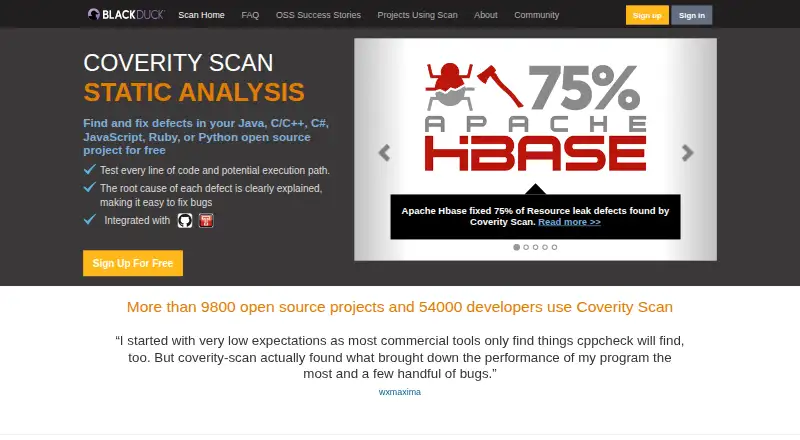
What Coverity Scan is
Coverity Scan provides static analysis for registered open source projects. It examines source code without running it and can trace possible execution paths to identify defects, including resource leaks, null pointer dereferences, memory corruption, buffer overruns, concurrency issues, and insecure data handling. For each defect, it explains the root cause to help developers address the underlying problem. Supported languages are Java, C/C++, C#, JavaScript, Ruby, and Python. Developers can sign in with GitHub and import projects for analysis. Build automation with Travis CI is also described on the sign-in page. Registered Eclipse Foundation projects can send build and source control information for cloud analysis using a Coverity Scan plugin on a Hudson server. The service is cloud-only and offers web and API access. Its free plan is limited to registered open source projects, with possible discretionary approval for projects initiated and maintained by for-profit corporations. Detailed results are generally available to project members approved by the project administrator, under a responsible disclosure policy. Build allowances depend on project size, and only the latest two tool releases are supported.
Who it suits
Coverity Scan suits maintainers of registered open source projects who want static analysis across its listed programming languages. It may also fit registered Eclipse Foundation projects using Hudson, or teams automating builds with Travis CI.
What it does well
- Free plan for eligible registered open source projects
- Supports the listed programming languages
- Explains the root cause of each defect
- Can import GitHub projects for analysis
- Supports build automation with Travis CI
What to know first
- Use is limited to registered open source projects
- Weekly and daily build limits vary by project size
- Only the latest two tool releases are supported
Limits
The free plan is restricted to registered open source projects, with weekly limits of 7 to 28 builds and daily limits of 1 to 4 depending on project size. Excess weekly build requests are rejected.
Plans
| Plan | Billed and limits | Price |
|---|---|---|
| Coverity Scan | Registered open source projects only · Build frequency varies by project size | Free |
As scan.coverity.com lists them, read 7 Oct 2026. The maker's own page has the final word.
Getting started
- Open the Coverity Scan website
- Sign in with GitHub
- Import a GitHub project for analysis
- Automate builds with Travis CI if needed
- For a registered Eclipse Foundation project, use the Coverity Scan plugin on a Hudson server to send build and source control information
Verdict
Choose Coverity Scan if your registered open source project needs cloud static analysis and its build allowances suit your needs. Look elsewhere if your project is not eligible or needs support for older tool releases.
Questions
Is Coverity Scan free?
Yes. Coverity Scan offers a free plan for registered open source projects only.
Which languages does it support?
The listed languages are Java, C/C++, C#, JavaScript, Ruby, and Python.
Which platforms are available?
Coverity Scan is cloud-only and lists web and API access.
Can I connect it to GitHub or a CI service?
Users can sign in with GitHub and import projects. The sign-in page says builds can be automated with Travis CI.
Who can see detailed results?
Access is generally limited to project members approved by the project administrator, under a responsible disclosure policy.
Facts from Coverity Scan's own pages
- Analysis
- Its static analysis examines source code without executing it and can follow possible execution paths through the code. · scan.coverity.com, 7 Oct 2026
- Build limits
- Weekly build limits range from 7 to 28 per project depending on lines of code, with daily limits from 1 to 4; excess weekly requests are rejected. · scan.coverity.com, 7 Oct 2026
- Defects
- Examples of issues it finds include resource leaks, null pointer dereferences, memory corruption, buffer overruns, concurrency issues, and insecure data handling. · scan.coverity.com, 7 Oct 2026
- Eclipse integration
- Registered Eclipse Foundation projects can use a Coverity Scan plugin on a Hudson server to send build and source control information for cloud analysis. · scan.coverity.com, 7 Oct 2026
- Eligibility
- Use is limited to registered open source projects, though projects initiated and maintained by for-profit corporations may be approved at Black Duck's discretion. · scan.coverity.com, 7 Oct 2026
- Founded
- 2006 · scan.coverity.com, 28 Sept 2026
- GitHub
- Users can sign in with GitHub and import GitHub projects for analysis. · scan.coverity.com, 7 Oct 2026
- Languages
- The site lists Java, C/C++, C#, JavaScript, Ruby, and Python as supported languages. · scan.coverity.com, 7 Oct 2026
- Project access
- Access to detailed results is generally limited to project members approved by the project administrator, and the service follows responsible disclosure. · scan.coverity.com, 7 Oct 2026
- Purpose
- Coverity Scan provides static analysis results for registered open source projects. · scan.coverity.com, 7 Oct 2026
- Results
- The site says the root cause of each defect is explained to help developers fix bugs. · scan.coverity.com, 7 Oct 2026
- Support policy
- The site says only the latest two tool releases are supported and projects should expect to update approximately once a year or more often. · scan.coverity.com, 7 Oct 2026
- Travis CI
- The sign-in page says users can automate Coverity Scan builds with Travis CI. · scan.coverity.com, 7 Oct 2026
- Upload API
- The site announced a new API endpoint for uploading builds larger than the previous 500 MB request limit. · scan.coverity.com, 7 Oct 2026
Where Coverity Scan stands on Freedom251
- Static Analysis Tools#12 of 38