Freedom251 › Test Coverage Tools

Coveralls
What Coveralls is
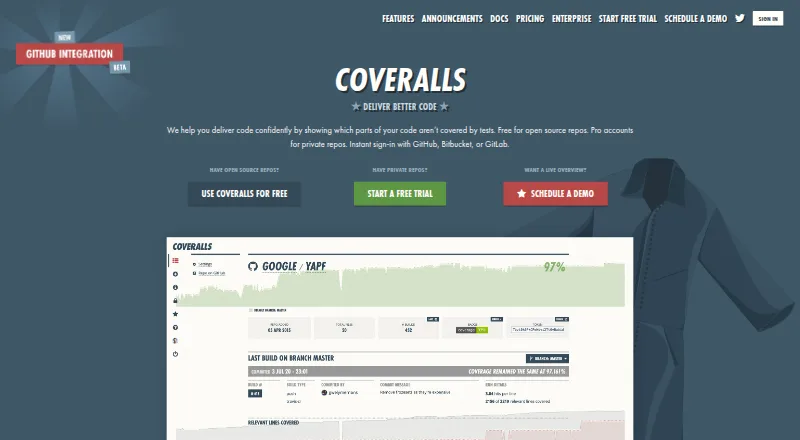
Coveralls analyzes test coverage to show which parts of a codebase have not been exercised by tests. Its dashboard summarizes project coverage and tracks changes over time, while repository views drill down to sub-projects, files, and individual lines. Build history shows coverage changes across branches, including pull requests. Coveralls can post coverage summaries in pull requests and send status updates that apply coverage criteria to merge decisions. Notifications can go to Slack or webhooks. The service says it works with any CI service and lists more than 30 community-created integrations, as well as a GitHub Action and CircleCI Orb. It supports line and branch coverage, with languages including C/C++, Go, Java, JavaScript, .NET, PHP, Python, Ruby, and Scala. Open-source and public repositories are free. Starter costs $10 a month for one private repository and includes a 30-day trial. A self-hosted enterprise installation can operate within existing security controls without outbound network access.
Who it suits
Coveralls suits software teams that want coverage detail in their repositories and pull requests. Its free option serves open-source and public repositories, while self-hosted deployment is available for enterprise use.
What it does well
- Coverage views reach individual code lines.
- Pull-request reports can apply coverage criteria to merges.
- Supports line and branch coverage.
- Works with any CI service, according to Coveralls.
- Self-hosted enterprise option can run without outbound network access.
What to know first
- Starter covers one private repository.
- Detailed file coverage is retained for 12 months on paid repositories.
- Starter costs $10 a month.
Limits
The free Open Source plan is for open-source projects. Starter costs $10.00 per month and includes one private repository; the 30-day free trial applies to that plan. Detailed file coverage is retained for 12 months for paid repositories and six months for public repositories.
Plans
| Plan | Billed and limits | Price |
|---|---|---|
| Open Source | Free for open-source projects | Free |
| Starter | $10/mo · 1 private repo · 30-day free trial | $10 a month |
| Org+ | $100/mo · 20 private repos · unlimited users | $100 a month |
| Pro | $200/mo · 40 private repos · unlimited users | $200 a month |
| Support add-on | $200/mo · Premium support · priority response · live chat · combines with any Cloud Plan | $200 a month |
| Usage add-on | $30/mo · +3,000 uploads/mo · priority processing · repo scoped · combines with any Cloud Plan | $30 a month |
| Enterprise Cloud | $35/user/mo · Unlimited orgs, repos, and users · secure private infrastructure · guaranteed performance · premium support · 40-seat minimum ($1,400/mo) | $35 a month |
| Unlimited | $400/mo · Unlimited private repos · unlimited users | $400 a month |
The first 8 of 10 plans, as coveralls.io lists them, read 28 Sept 2026. The maker's own page has the final word. Every plan
Getting started
- Open https://coveralls.io/.
- Choose the Open Source plan for open-source projects, or review the cloud plans for private repositories.
- For Starter, begin the 30-day free trial; the plan includes one private repository and costs $10.00 per month.
- Connect your repository through a CI integration, GitHub Action, CircleCI Orb, or another supported integration.
- Use the dashboard and repository views to review coverage, then configure pull request reports or coverage status updates as needed.
Overview
Coveralls is a test-coverage service for teams that want to find untested code and follow coverage across builds. It is strongest for projects that put coverage results into pull-request review and merge decisions; the cloud plans make private-repository capacity the key buying constraint.
Key features
A dashboard pairs current project coverage with trend graphs, and repository views drill from aggregate results through sub-projects and files to individual lines. That detail helps teams locate gaps rather than relying on a single headline percentage. Coveralls tracks line and branch coverage and accepts formats including LCOV, SimpleCov, Cobertura, JaCoCo, Gcov, Pytest-Cov, and Clover XML.
Build history follows coverage across branches and builds, including pull requests. Pull-request summaries and annotations bring results into code review, while coverage criteria can allow or block merges. Slack and webhook notifications can flag changes. Together, these features suit teams that want coverage to affect review decisions, not just produce an archive of reports.
Coveralls says it works with any CI service and offers more than 30 community-created integrations, as well as a GitHub Action and CircleCI Orb. Its supported languages include .NET, C/C++, Go, Java, JavaScript, PHP, Python, Ruby, Scala, and others. The API can add repositories programmatically and return recent-build statistics, useful for teams automating coverage workflows.
For cloud privacy, Coveralls says it reads code through an SCM OAuth token, accesses repositories read-only, and does not store or cache private code. Detailed file coverage is retained for 12 months on paid repositories and six months on public ones; aggregated build-level coverage is retained indefinitely. The self-hosted enterprise installation can run within a customer's existing security controls and without outbound network access, a meaningful option for organizations with tighter infrastructure requirements.
Pricing
Open-source and public repositories are free. For private cloud use, the Starter plan costs $10 a month, billed $10/mo, for one private repository and a 30-day free trial. It is a low-cost entry for a single private project, but not a broad team allocation.
Org costs $50 a month, billed $50/mo, for 10 private repositories and unlimited users; Org+ costs $100 a month, billed $100/mo, for 20 private repositories and unlimited users. Pro costs $200 a month, billed $200/mo, for 40 private repositories and unlimited users. These tiers scale repository capacity without imposing a seat cap. Unlimited costs $400 a month, billed $400/mo, for unlimited private repositories and users, fitting larger portfolios that do not need the stated premium-support package.
Cloud Premium costs $800 a month, billed $800.00/mo, for unlimited private repositories, premium support, custom SLA terms, and multi-org billing. Enterprise Cloud costs $35 a month, billed $35/user/mo, and includes unlimited organizations, repositories, and users, secure private infrastructure, guaranteed performance, and premium support; its 40-seat minimum makes the starting total $1,400/mo. It is aimed at larger organizations prepared for that minimum rather than smaller teams.
The Usage add-on costs $30 a month, billed $30/mo, for 3,000 additional uploads per month and priority processing, is repository-scoped, and combines with any Cloud Plan. The Support add-on costs $200 a month, billed $200/mo, for premium support, priority response, and live chat, and also combines with any Cloud Plan. These add-ons address upload volume and support needs, not repository-count expansion. Cloud pricing therefore ranges from a one-repository foothold to high-capacity plans, with seats, repository limits, and add-ons shaping the actual fit.
Platforms
Coveralls supports API, Linux, self-hosted, and web use. Its range of report formats and language integrations makes it relevant across varied development stacks, while self-hosting is available for organizations that need coverage analysis inside their own security controls.
Who it's for
Coveralls is a good fit for open-source maintainers and development teams that want coverage history, line-level investigation, and pull-request checks in one workflow. Teams with a handful of private repositories can start at the lower cloud tiers, while organizations needing unlimited repositories or private infrastructure have higher-tier options. It is less compelling for a small private project that does not need review integration, or for teams whose repository count exceeds a cheaper tier's cap.
Pros and cons
- Pro: Coverage detail reaches individual code lines, making project summaries actionable when teams need to find specific gaps.
- Pro: Pull-request reporting and coverage gates connect results to review and merge decisions.
- Pro: Open-source and public repositories are free, and paid plans retain detailed file coverage for 12 months.
- Con: Private-repository limits rise by tier; the Starter plan covers just one repository.
- Con: Enterprise Cloud's 40-seat minimum sets a $1,400/mo floor, which is a substantial commitment for smaller teams.
- Con: Public repositories retain detailed file coverage for six months, shorter than the paid-repository period.
Alternatives
Test Coverage Tools is a useful place to compare options. Choose OpenClover if you want a free coverage tool with no usage limits. SimpleCov is a free, MIT-licensed option for Ruby coverage. Choose cargo-llvm-cov for free Rust coverage under Apache-2.0 or MIT licensing, or Coverage.py for an open-source Python coverage tool with an enterprise subscription available through Tidelift.
Coverlet is a free, MIT-licensed option for modern .NET SDK-style projects. EclEmma is a free Eclipse plug-in for Java coverage. Choose gcov when working with code compiled using GCC and coverage instrumentation. gofmt is included with Go and is used from the command line.
Verdict
Choose Coveralls if your team needs coverage trends and line-level detail tied directly to pull requests and merge criteria, especially for open-source projects or private portfolios that fit its repository tiers. Look elsewhere if you need a free private-repository workflow or cannot justify the seat minimum on Enterprise Cloud.
Verdict
Coveralls connects coverage history and detail with pull-request reporting and merge criteria. Open-source and public repositories are free; teams with private repositories should check plan limits and file-coverage retention.
Questions
Does Coveralls have a free plan?
Yes. Its Open Source plan is free and is free for open-source projects. Coveralls also states that public repositories are always free.
How much does the Starter plan cost?
Starter is $10.00 per month and includes one private repository. It has a 30-day free trial.
Which platforms does Coveralls support?
The listed platforms are API, Linux, self-hosted, and web.
Can I host Coveralls myself?
Yes. An enterprise self-hosted installation can run within the customer’s existing security controls and operate without outbound network access.
Which CI services and integrations does it support?
Coveralls says it works with any CI service and offers over 30 community-created integrations, a GitHub Action, and a CircleCI Orb.
Who operates Coveralls?
Coveralls, Inc. is identified as the operator and is described as based in Venice, California.
Facts from Coveralls's own pages
- API
- The API can add repositories programmatically and return statistics on recent builds. · coveralls.io, 28 Sept 2026
- Build history
- Build history shows coverage changes for each build across branches, including pull requests. · coveralls.io, 28 Sept 2026
- Coverage dashboard
- The dashboard summarizes projects' current coverage percentages and graphs changes over time. · coveralls.io, 28 Sept 2026
- Coverage detail
- Repository pages show aggregate coverage down to sub-project, file, and individual code line. · coveralls.io, 28 Sept 2026
- Data retention
- The cloud terms specify detailed file coverage retention of 12 months for paid repositories and six months for public repositories, while aggregated build-level coverage is retained indefinitely. · coveralls.io, 28 Sept 2026
- Enterprise security
- The Enterprise security page says its on-premises installation runs within the customer's existing security controls and can operate without outbound network access. · enterprise.coveralls.io, 28 Sept 2026
- Founded
- 2011 · coveralls.io, 23 Sept 2026
- Integrations
- Coveralls says it works with any CI service and offers over 30 community-created integrations plus a GitHub Action and CircleCI Orb. · coveralls.io, 28 Sept 2026
- Maker and location
- The About page identifies Coveralls, Inc. as the operator and describes it as based in Venice, California. · coveralls.io, 28 Sept 2026
- Notifications
- Coverage change notifications can be sent to Slack or to webhooks. · coveralls.io, 28 Sept 2026
- Open source
- Coveralls states that it is always free for open-source and public repositories. · coveralls.io, 28 Sept 2026
- Privacy and security
- The cloud terms state that Coveralls reads code through the SCM OAuth token, does not store or cache private code, and accesses repositories on a read-only basis for coverage analysis. · coveralls.io, 28 Sept 2026
- Pull requests
- Coveralls posts summarized coverage reports in pull requests and can send status updates that allow or block merges based on coverage criteria. · coveralls.io, 28 Sept 2026
- Purpose
- Coveralls analyzes test coverage to show which parts of code are not covered by tests. · coveralls.io, 28 Sept 2026
- Source languages
- The homepage lists integration packages for languages including C/C++, Go, Java, JavaScript, .NET, PHP, Python, Ruby, Scala, and others. · coveralls.io, 28 Sept 2026
- Support
- The pricing page offers a $200/month Support add-on with premium support, priority response, and live chat. · coveralls.io, 28 Sept 2026
Where Coveralls stands on Freedom251
- Test Coverage Tools#6 of 27
- Code Coverage Tools#3 of 10