Freedom251 › Test Coverage Tools
BullseyeCoverage
What BullseyeCoverage is
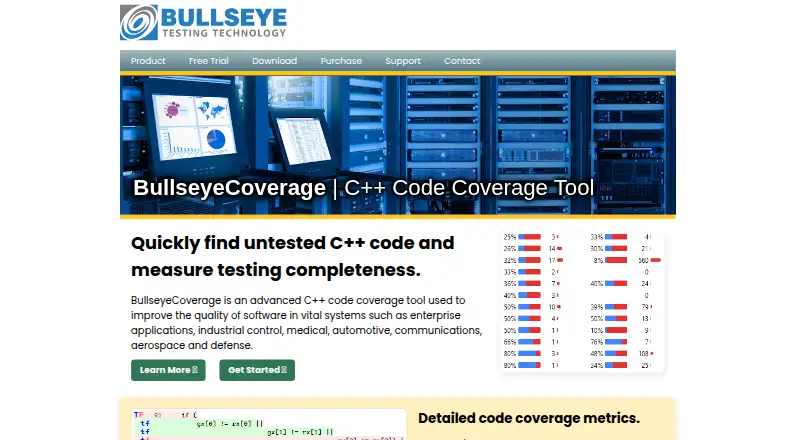
BullseyeCoverage measures C and C++ code coverage to help teams locate untested code and assess testing completeness. It instruments source code and reports function coverage and condition/decision coverage, which the company says provides more detail than statement or branch coverage. Results can be explored interactively in Coverage Browser or produced as HTML, text, annotated source code, XML, Cobertura, or CSV reports. Coverage data can be exported in XML or CSV, and results gathered on multiple computers can be merged. Supported tools include Visual Studio, Clang, GCC, Xcode, CMake, Eclipse, and embedded development tools such as Code Composer Studio. The company lists Windows, Linux desktop and server, macOS, and embedded systems as supported environments. It supports standard C versions from C90 and C++ versions from C++98 through the latest versions, along with compiler extensions. The maker reports that instrumented execution time increases by 1.3–1.9× and instrumented code and data size increases to 1.4×; build-time effects vary by compiler. A temporary, fully functional evaluation license is available free of charge and must be requested by email. The paid license is perpetual, with optional maintenance or renewal. BullseyeCoverage was founded in 1990 and is headquartered in Redmond, Washington, USA.
Who it suits
BullseyeCoverage is aimed at C and C++ developers and testers, particularly those working on mission-critical systems such as embedded devices. It suits teams that need function or condition/decision coverage, report exports, or merged results across computers.
What it does well
- Measures both function and condition/decision coverage.
- Provides interactive results and six listed report formats.
- Exports coverage data in XML or CSV.
- Merges results from multiple computers.
- Supports Windows, Linux, macOS, and embedded systems.
What to know first
- Evaluation access is temporary and requires an email request.
- The paid license is perpetual, with optional maintenance or renewal.
- Instrumented execution time increases by 1.3–1.9×, according to the maker.
Limits
The evaluation license is temporary and expires at the end of its evaluation period. The paid license limits the maximum number of users at one time, licenses each host operating system separately, and offers discounted pricing for 10 or more users.
Plans
| Plan | Billed and limits | Price |
|---|---|---|
| Evaluation license | Fully functional · temporary; expires at the end of the evaluation period · request by email | Free |
| BullseyeCoverage license | Perpetual license; optional maintenance/renewal · Maximum licensed users at one time · each host operating system licensed separately · discounted pricing for 10 or more users | On request |
As bullseye.com lists them, read 9 Oct 2026. The maker's own page has the final word.
Getting started
- Visit the BullseyeCoverage website.
- Request the evaluation license by email, or obtain a BullseyeCoverage license.
- Use the supported operating system and a supported C or C++ toolchain.
- Instrument source code and collect coverage results.
- Review results in Coverage Browser or generate a report in a listed format.
BullseyeCoverage is a coverage tool for C and C++ code, aimed especially at developers and testers building mission-critical or embedded software. Its function and condition/decision metrics offer a detailed view of test reach, while its paid perpetual license and reported instrumentation overhead make it a considered choice for teams with specific coverage needs.
Overview
BullseyeCoverage instruments C and C++ source code to show which functions and conditions tests exercise. Function coverage provides a broad view of execution; condition/decision coverage offers more detail than statement or branch counts, which can help teams examine whether tests cover decision logic. That extra resolution is useful when test completeness matters, though it requires teams to interpret more than a single coverage percentage.
The tool spans standard C versions from C90 and C++ versions from C++98 through the latest versions, including compiler extensions. It is focused on those two languages, so teams seeking a single coverage tool for a mix of languages should look elsewhere.
Key features
Reports and merged results
Coverage Browser provides an interactive view, with HTML and console reports for review and automation. Other report formats include text, annotated source code, XML, Cobertura, and CSV. XML and CSV exports suit downstream handling, and results from multiple computers can be merged, helping teams consolidate coverage across distributed test runs.
Compiler and workflow support
Supported tools include Visual Studio, Clang, GCC, Xcode, CMake, Eclipse, and embedded development tools such as Code Composer Studio. Integrations or support involving Teamscale, MathWorks Embedded Coder, and TICS extend its relevance to established development workflows. The range is a strength for C/C++ teams working across toolchains, though it does not change the product's narrow language focus.
Instrumentation overhead
The maker reports instrumented execution time at 1.3–1.9× and code and data size increasing to 1.4×; build-time effects vary by compiler. Those costs can matter on resource-constrained embedded targets or in time-sensitive test loops, so teams should account for them when deciding where to instrument and how to evaluate the tool.
Pricing
| Plan | Price | What it includes |
|---|---|---|
| Evaluation license | free | Fully functional, temporary license that expires at the end of the evaluation period; request by email. |
| BullseyeCoverage license | Custom pricing | Perpetual license with optional maintenance or renewal. The maximum number of users is licensed at one time; each host operating system is licensed separately. Discounted pricing applies to 10 or more users. |
The evaluation license gives teams a way to assess the full product before purchasing, but its temporary term makes it unsuitable for ongoing use. The paid license fits teams that want perpetual use and can budget for custom pricing; maintenance or renewal is optional. Continuous integration counts as one user under the license agreement, and technical support is included with every purchase.
Platforms
BullseyeCoverage supports Windows, Linux desktop and server, macOS, and embedded systems. The license agreement treats each host operating system as a separate license, a factor for teams deploying across multiple environments.
Who it's for
This is a strong fit for C/C++ developers and testers who need function and condition/decision coverage, especially on mission-critical software or embedded devices. Its broad compiler and development-tool support, report options, and merged results suit teams coordinating coverage across several machines or workflows. Teams working primarily in other languages, or those unable to accommodate the reported execution and size increases, have reason to choose another tool.
Genuen offers a BullseyeCoverage Tool Qualification Kit supporting processes for DO-178B/C, ISO 26262, and IEC 62304. That makes it relevant to teams pursuing those processes, though the kit is a separate offering from the coverage license.
Pros and cons
- Pros: Function and condition/decision metrics give C/C++ teams detail beyond statement or branch coverage.
- Pros: Multiple report formats, XML and CSV exports, and merged results support varied review and reporting workflows.
- Pros: Support for desktop, server, and embedded environments and a wide set of compilers and tools suits diverse C/C++ setups.
- Cons: The product covers C and C++ only, limiting its fit for teams with broader language needs.
- Cons: Reported runtime and code/data size increases may be material for constrained targets or frequent test execution.
- Cons: The paid license has custom pricing, and separate host operating systems affect licensing across environments.
Alternatives
For a wider set of coverage tools, browse Test Coverage Tools. For C and C++ teams comparing BullseyeCoverage with free options, OpenClover is free forever with no license tiers, keys, or usage limits; gcov is a free option when code is compiled with GCC and coverage instrumentation is used.
For other languages, choose by your stack: SimpleCov covers Ruby; cargo-llvm-cov is open source; Coverage.py covers Python; Coveralls is always free for open-source and public repositories; Coverlet supports modern .NET SDK-style projects; and EclEmma is an Eclipse plug-in for Java coverage.
Verdict
Choose BullseyeCoverage when C or C++ projects need detailed function and condition/decision coverage across desktop, server, or embedded environments. Its strongest case is the combination of fine-grained metrics, broad tool support, and mergeable results. Look elsewhere if your team needs multi-language coverage, a fixed published price, or lower instrumentation overhead.
Verdict
Choose BullseyeCoverage for C or C++ projects that need function and condition/decision coverage across desktop, server, or embedded environments. The evaluation license is temporary; the full license is paid and perpetual, with optional maintenance or renewal. Factor in the maker’s reported execution-time and code-size increases when evaluating instrumentation.
Questions
Is BullseyeCoverage free?
A fully functional evaluation license is listed as free. It is temporary and must be requested by email; the regular license is paid.
Which languages does it cover?
It supports C and C++, including standard versions from C90 and C++98 through the latest versions, plus compiler extensions.
What coverage types does it provide?
It provides function coverage and condition/decision coverage.
Which report formats are available?
Listed formats include HTML, text, annotated source code, XML, Cobertura, and CSV. Coverage data can also be exported in XML or CSV.
Which environments and tools are supported?
Supported environments include Windows, Linux desktop and server, macOS, and embedded systems. Listed tools include Visual Studio, Clang, GCC, Xcode, CMake, Eclipse, and Code Composer Studio.
How is the paid license structured?
The license is perpetual, with optional maintenance or renewal. Each host operating system is licensed separately, and a continuous integration system counts as one user.
Facts from BullseyeCoverage's own pages
- Coverage metrics
- It provides function coverage and condition/decision coverage, which the company says gives more detail than statement or branch coverage. · bullseye.com, 9 Oct 2026
- Exports and merging
- Coverage data can be exported in XML or CSV and results from multiple computers can be merged. · bullseye.com, 9 Oct 2026
- Founded
- 1990 · bullseye.com, 28 Sept 2026
- Headquarters
- Redmond, Washington, USA · bullseye.com, 28 Sept 2026
- Instrumentation
- BullseyeCoverage instruments source code and works with C++ and C code. · bullseye.com, 9 Oct 2026
- Integration partners
- The maker lists integrations or support involving Teamscale, CMake, MathWorks Embedded Coder, and TICS. · bullseye.com, 9 Oct 2026
- Intended users
- The company identifies its core market as C/C++ developers and testers working on mission critical systems, including embedded devices. · bullseye.com, 9 Oct 2026
- Language support
- It supports standard versions of C++ from C++98 and C from C90 through the latest versions, plus compiler extensions. · bullseye.com, 9 Oct 2026
- License limits
- The license agreement says a continuous integration system counts as one user and each host operating system is licensed separately. · bullseye.com, 9 Oct 2026
- Operating systems
- The company lists Windows, Linux desktop and server, macOS, and embedded systems as supported environments. · bullseye.com, 9 Oct 2026
- Performance impact
- The maker reports instrumented execution time increases of 1.3–1.9× and instrumented code and data size increases to 1.4×; build time increases vary by compiler. · bullseye.com, 9 Oct 2026
- Purpose
- BullseyeCoverage measures C and C++ code coverage to help find untested code and assess testing completeness. · bullseye.com, 9 Oct 2026
- Reports
- Coverage can be viewed interactively in Coverage Browser or generated as HTML or console reports. · bullseye.com, 9 Oct 2026
- Safety qualification
- Genuen offers a BullseyeCoverage Tool Qualification Kit supporting processes for DO-178B/C, ISO 26262, and IEC 62304. · bullseye.com, 9 Oct 2026
- Security and warranty terms
- The license agreement includes an anti-virus warranty and a 90-day warranty that the software will substantially perform according to its documentation. · bullseye.com, 9 Oct 2026
- Support
- The company says technical support is included with every purchase and provides a technical support request form. · bullseye.com, 9 Oct 2026
- Tool compatibility
- The supported tools include Visual Studio, Clang, GCC, Xcode, CMake, Eclipse, and embedded development tools such as Code Composer Studio. · bullseye.com, 9 Oct 2026
Where BullseyeCoverage stands on Freedom251
- Test Coverage Tools#4 of 27
- Code Coverage Tools#2 of 10