Freedom251 › Legal Research Software

CourtListener
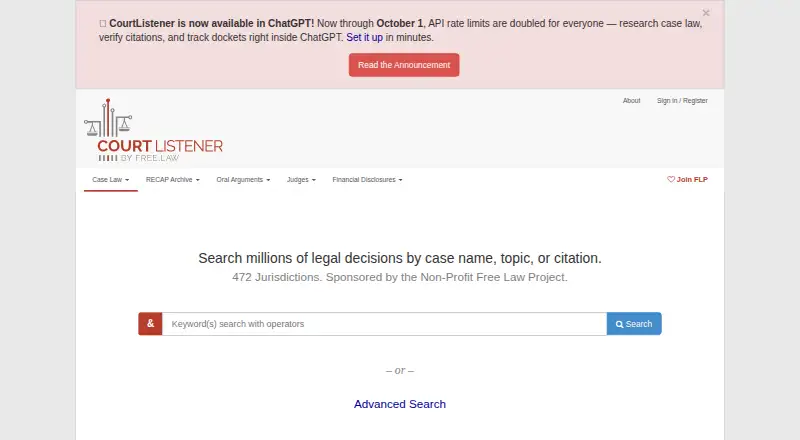
What CourtListener is
CourtListener is a free legal research website for finding opinions from U.S. federal and state courts. Its searchable archive also covers oral arguments, judges, judicial financial records, and federal filings. The RECAP Archive contains nearly every federal case, hundreds of millions of docket entries, and tens of millions of legal documents. Users can create alerts for topics, people, companies, citations, and other monitored searches. Developer resources include REST APIs, bulk data files, webhooks, database replication, and an MCP server that lets AI assistants such as Claude and ChatGPT access CourtListener data and APIs. Built on open source technology, the project serves lawyers, journalists, academics, researchers, organizations, and the public. Free Law Project's help documentation covers data coverage, developer tools, content removal, memberships, and support. The non-member free tier limits alerts and API requests. Paid membership tiers list higher limits, with billing notes ranging from $10/mo or $100/yr to $100/mo or $1,000/yr. Qualifying faculty, students, and researchers with valid .edu email addresses can receive complimentary EDU memberships; eligible U.S.-based nonprofit legal services organizations can receive free LSO memberships.
Who it suits
It suits lawyers, journalists, academics, researchers, organizations, and members of the public looking for U.S. court materials. Developers can also use its APIs, bulk data, webhooks, database replication, or MCP server.
What it does well
- Searches opinions from federal and state courts.
- RECAP includes extensive federal case and docket materials.
- Alerts cover topics, people, companies, and citations.
- Developer access includes APIs and bulk data.
What to know first
- Free non-members have limited docket alerts.
- Free non-members have limited API requests.
- The website is web-only.
Limits
The Free Tier Non-Members plan is free and allows 5 docket alerts, unlimited daily opinion search alerts, 5 daily RECAP search alerts, 5 Pray & Pay requests, and API use of 5 per minute, 50 per hour, and 125 per day. Paid tiers list higher limits, with billing notes ranging from $10/mo or $100/yr to $100/mo or $1,000/yr.
Plans
| Plan | Billed and limits | Price |
|---|---|---|
| Free Tier Non-Members | 5 docket alerts · unlimited daily opinion search alerts · 5 daily RECAP search alerts · 5 Pray & Pay requests · API 5/minute, 50/hour, 125/day | Free |
| Tier 1 | $10/mo or $100/yr · unlimited docket alerts · unlimited real-time opinion search alerts · 10 daily RECAP search alerts · 5 real-time RECAP search alerts · 15 Pray & Pay requests · API 10/minute, 75/hour, 300/day | $10 a month |
| Tier 4 | $100/mo or $1000/yr · unlimited docket alerts · unlimited real-time opinion search alerts · 100 daily RECAP search alerts · 50 real-time RECAP search alerts · 15 Pray & Pay requests · API 25/minute, 300/hour, 1,400/day · $150 shop credits | $100 a month |
| Tier 2 | $25/mo or $250/yr · unlimited docket alerts · unlimited real-time opinion search alerts · 25 daily RECAP search alerts · 10 real-time RECAP search alerts · 15 Pray & Pay requests · API 15/minute, 150/hour, 600/day · $38 shop credits | $25 a month |
| Tier 3 | $50/mo or $500/yr · unlimited docket alerts · unlimited real-time opinion search alerts · 50 daily RECAP search alerts · 25 real-time RECAP search alerts · 15 Pray & Pay requests · API 20/minute, 250/hour, 1,000/day · $75 shop credits | $50 a month |
As courtlistener.com lists them, read 1 Oct 2026. The maker's own page has the final word.
Getting started
- Open https://www.courtlistener.com/ in a web browser
- Search case law, dockets, or other archive materials
- Create alerts for the topics, people, companies, citations, or searches to monitor
- Use the REST API, bulk files, webhooks, database replication, or MCP server for developer access
- Review membership options if you need limits beyond the free non-member tier
Overview
CourtListener is a legal research service centered on U.S. court opinions, dockets, and filings. It is best suited to lawyers, researchers, journalists, and developers who need broad access to public legal materials. Its breadth is a major strength; users who need generous monitoring or API capacity should weigh the paid tiers against the free limits.
Founded in 2010 and built on open-source technology, CourtListener brings together opinions, oral arguments, judges, judicial financial records, and federal filings. Its RECAP Archive covers nearly every federal case and includes hundreds of millions of docket entries and tens of millions of legal documents. That makes the service useful for more than case-law lookup: it can also support research into federal litigation and court records.
Key features
Search and alerts
Case-law and docket search, citation tools, and coverage of federal and state courts make CourtListener a strong public starting point for U.S. legal research. Alerts can follow topics, people, companies, citations, and other searches. The free non-member tier allows five docket alerts and five daily RECAP search alerts, but unlimited daily opinion search alerts. That balance works for broad case-law monitoring and light docket tracking, not for users following many active matters.
Data access and AI integration
Free Law Project provides REST APIs, bulk data files, webhooks, database replication, and an MCP server. Developers can choose among several ways to work with CourtListener data; the trade-off is that API request limits depend on membership tier. The MCP server also lets Claude, ChatGPT, and other AI assistants access CourtListener data and APIs directly.
Support and security
Help documentation covers memberships and donations, data coverage, developer documentation, content removal, and direct contact support. Free Law Project’s vulnerability disclosure policy applies to CourtListener, its API, alerts, and RECAP extensions, and requests coordinated disclosure for up to 90 days. The policy says DNSSEC is not currently planned, a limitation security-conscious organizations may want to consider.
Pricing
The non-member tier is free, and complimentary EDU memberships are available to faculty, students, and researchers with a valid .edu email address. Qualifying U.S.-based nonprofit legal services organizations can receive free LSO memberships. Paid tiers raise alert and API allowances; the supplied prices show monthly and annual billing terms.
| Plan | Price and main allowances |
|---|---|
| Free Tier Non-Members | free. Five docket alerts, unlimited daily opinion search alerts, five daily RECAP search alerts, five Pray & Pay requests, and API limits of 5/minute, 50/hour, and 125/day. |
| Tier 1 | $10,100 a month (billed $10/mo or $100/yr). Unlimited docket alerts and real-time opinion search alerts, 10 daily and five real-time RECAP search alerts, 15 Pray & Pay requests, and API limits of 10/minute, 75/hour, and 300/day. |
| Tier 2 | $25,250 a month (billed $25/mo or $250/yr). Unlimited docket alerts and real-time opinion search alerts, 25 daily and 10 real-time RECAP search alerts, 15 Pray & Pay requests, API limits of 15/minute, 150/hour, and 600/day, plus $38 shop credits. |
| Tier 3 | $50,500 a month (billed $50/mo or $500/yr). Unlimited docket alerts and real-time opinion search alerts, 50 daily and 25 real-time RECAP search alerts, 15 Pray & Pay requests, API limits of 20/minute, 250/hour, and 1,000/day, plus $75 shop credits. |
| Tier 4 | $1,001,000 a month (billed $100/mo or $1000/yr). Unlimited docket alerts and real-time opinion search alerts, 100 daily and 50 real-time RECAP search alerts, 15 Pray & Pay requests, API limits of 25/minute, 300/hour, and 1,400/day, plus $150 shop credits. |
For occasional use, the free tier preserves unlimited daily opinion alerts but caps docket monitoring and RECAP searches. Tier 1 removes the docket-alert ceiling and adds real-time opinion alerts, while higher tiers mainly increase RECAP search and API capacity and add shop credits. The published membership allowances do not state seat counts or trial terms.
Platforms
CourtListener is available on the web. Its developer access includes APIs and bulk data, while the MCP server provides a route for compatible AI assistants to access its data and APIs.
Who it's for
CourtListener fits lawyers, journalists, academics, the public, researchers, and organizations seeking searchable U.S. court materials. Developers and teams building research workflows can use its APIs, bulk data, webhooks, database replication, and MCP server. It is less suited to users whose work depends on monitoring more docket matters or making more API requests than the free tier permits and who do not want a paid membership.
Pros and cons
- Pro: The archive combines opinions, oral arguments, judicial records, and federal filings, with particularly broad RECAP coverage.
- Pro: Search, citation tools, and alerts span both case law and dockets, including monitoring by topic, person, company, or citation.
- Pro: Multiple developer access options, including an MCP server, make the archive useful beyond the website.
- Con: The free tier limits docket alerts to five and daily RECAP searches to five, which can hinder active litigation monitoring.
- Con: API quotas are capped even on the highest described tier, so high-volume integrations need to account for request limits.
- Con: The vulnerability policy says DNSSEC is not currently planned, which may matter to organizations with specific security requirements.
Alternatives
Legal Research Software is a broader category directory for comparing legal research options.
- Indian Kanoon is worth considering for Android access or research into Indian legal materials; its free plan has a few Prism credits, 25 court copies per month, and two query alerts.
- RECAP is an alternative from the same nonprofit maker, with extension, iOS, and web platforms.
- AustLII offers free access to public legal materials and is a better fit for readers seeking that library.
- BAILII provides free access to its databases, but does not permit bulk downloading.
- CanLII is a free option for Canadian legal information; CanLII Search+ requires a free myCanLII account and has a daily usage limit.
- Docket Alarm has a free allowance of five weekly actions across searches, docket views, and document views, excluding government-purchased documents such as PACER filings.
- GovInfo is a free choice for official publications from all three branches of the U.S. federal government.
- HeinOnline is another legal research option.
Verdict
CourtListener is a strong choice for anyone who needs broad, searchable access to U.S. opinions and court records, especially researchers and developers who can make use of its substantial RECAP archive and data tools. Its principal drawback is that free docket and RECAP monitoring, along with API use, is capped; users with heavier workloads should compare the paid tiers or consider an alternative aligned with their jurisdiction and research needs.
Verdict
CourtListener combines legal search, alerts, and developer access around a substantial archive of court materials. The free non-member tier has usage limits, while membership tiers list higher limits.
Questions
Is CourtListener free?
Yes. The Free Tier Non-Members plan is free. Complimentary EDU memberships are available to qualifying faculty, students, and researchers with a valid .edu email address; qualifying U.S.-based nonprofit legal services organizations may receive free LSO memberships.
What does the free non-member tier include?
It includes 5 docket alerts, unlimited daily opinion search alerts, 5 daily RECAP search alerts, 5 Pray & Pay requests, and API limits of 5 per minute, 50 per hour, and 125 per day.
Which courts and materials can I search?
CourtListener covers U.S. federal and state courts. Its archive includes opinions, oral arguments, judges, judicial financial records, and federal filings, with case-law search, docket search, and citation tools.
Is CourtListener open source?
CourtListener is built on open source technology.
Does CourtListener offer developer access or AI connections?
Free Law Project provides REST APIs, bulk data files, webhooks, database replication, and an MCP server. The MCP server lets Claude, ChatGPT, and other AI assistants access CourtListener data and APIs.
What do the paid membership tiers cost?
The listed Tier 1 through Tier 4 prices are $10,100 a month, $25,250 a month, $50,500 a month, and $1,001,000 a month. Their billing notes say $10/mo or $100/yr, $25/mo or $250/yr, $50/mo or $500/yr, and $100/mo or $1,000/yr, respectively.
Facts from CourtListener's own pages
- AI integration
- The CourtListener MCP server lets Claude, ChatGPT, and other AI assistants access CourtListener data and APIs directly. · wiki.free.law, 1 Oct 2026
- Alerts
- CourtListener provides alerts for topics, people, companies, citations, and other monitored searches. · free.law, 1 Oct 2026
- Archive
- The service is a searchable archive of opinions, oral arguments, judges, judicial financial records, and federal filings. · free.law, 1 Oct 2026
- Audience
- The project describes CourtListener as serving lawyers, journalists, academics, the public, researchers, and organizations. · courtlistener.com, 1 Oct 2026
- Developer access
- Free Law Project provides REST APIs, bulk data files, webhooks, database replication, and an MCP server for CourtListener data. · wiki.free.law, 1 Oct 2026
- Founded
- 2010 · courtlistener.com, 28 Sept 2026
- Free memberships
- EDU memberships are complimentary for faculty, students, and researchers with a valid .edu email address, and LSO memberships are free for qualifying U.S.-based nonprofit legal services organizations. · free.law, 1 Oct 2026
- Headquarters
- Oakland, California, United States · courtlistener.com, 28 Sept 2026
- Open source
- CourtListener is built on open source technology. · free.law, 1 Oct 2026
- Purpose
- CourtListener is a free legal research website containing millions of legal opinions from federal and state courts. · courtlistener.com, 1 Oct 2026
- RECAP
- Its RECAP Archive contains nearly every federal case, hundreds of millions of docket entries, and tens of millions of legal documents. · free.law, 1 Oct 2026
- Security limitation
- The vulnerability disclosure policy states that DNSSEC is not currently planned. · wiki.free.law, 1 Oct 2026
- Security policy
- Free Law Project's vulnerability disclosure policy covers courtlistener.com, its API, alerts, and RECAP extensions, with coordinated disclosure requested for up to 90 days. · wiki.free.law, 1 Oct 2026
- Support
- CourtListener help documentation covers donations and memberships, data coverage, developer documentation, content removal, and direct contact support. · courtlistener.com, 1 Oct 2026
Where CourtListener stands on Freedom251
- Legal Research Software#9 of 31