Freedom251 › Process Mining Software
Cortado
What Cortado is
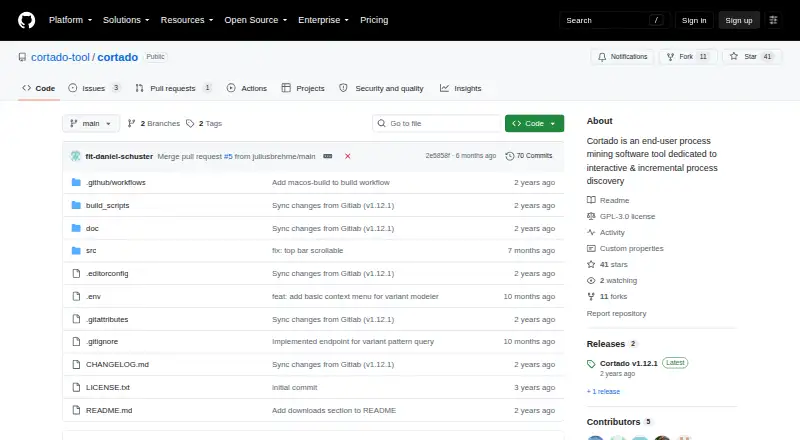
Cortado is an end-user process mining tool for exploring event logs and building process models interactively. It imports event logs in `.xes` format and initial models in `.ptml` format. Its variant explorer lets users examine event-log variants and select process behavior to discover an initial model, then extend it incrementally. Users can also edit models manually while they are under construction.
Discovered models can be exported as `.ptml` or `.pnml` files. Cortado supports temporal performance analysis both with a model and independently of one, as well as conformance checking. The application has an Angular web frontend embedded in an Electron executable and a Python-based backend. It is open source under the GPL-3.0 license and uses a self-hosted deployment model. Standalone builds are listed for Windows 10/11, Linux, and macOS with Apple Silicon only. The project identifies v1.12.1 as its latest release and gives its release date as June 25. Cortado is free.
Who it suits
Cortado suits process mining users who want to explore event logs and build or edit models incrementally. Its listed standalone builds cover Windows 10/11, Linux, and macOS with Apple Silicon.
What it does well
- Imports `.xes` event logs and `.ptml` initial models.
- Supports incremental process-model discovery and manual editing.
- Exports models as `.ptml` or `.pnml` files.
- Includes temporal performance analysis and conformance checking.
What to know first
- The listed macOS build requires Apple Silicon.
- The latest release listed is v1.12.1, dated June 25.
Getting started
- Open the Cortado GitHub repository.
- Choose the standalone build for Windows 10/11, Linux, or macOS with Apple Silicon.
- Import an event log in `.xes` format or an initial model in `.ptml` format.
- Use the variant explorer to select behavior and discover or extend a process model.
- Edit the model as needed, then export it as `.ptml` or `.pnml`.
Cortado is a free, open-source desktop tool for interactive process mining. It suits analysts, researchers, and other end users who need to inspect selected event-log behavior and shape a process model incrementally. Its self-hosted design favors control and focused analysis, while cloud-first teams and users without compatible hardware should choose another route.
Overview
Cortado links event-log exploration, process discovery, model editing, and performance analysis in one workflow. It imports event logs in .xes format and initial process models in .ptml, giving users a defined interchange path rather than a proprietary-only project format. The project is released under GPL-3.0 and is self-hosted, so organizations retain local deployment but also take responsibility for installation and administration.
The application is built as an Angular frontend embedded in an Electron executable, with a Python backend. Help for selected functions appears inside the tool, and the project accepts questions and custom requests by email. Administrator rights may be required to run it, which matters in managed workplace environments.
Key features
Explore behavior before modeling
The visual variant explorer lets users examine the ways cases move through an event log before selecting behavior for discovery. That makes Cortado better suited to analysts who want to focus on meaningful variants than to workflows that simply produce one unattended model from an entire log.
Incremental discovery and editing
Users can discover an initial process model from selected process behavior, then extend it with further selected behavior. Manual editing is available while the model is under construction, so the analyst can combine algorithmic discovery with deliberate modeling decisions instead of restarting after every change.
Analysis and conformance
Temporal performance analysis works both from a model and independently of one, allowing timing questions to be examined even when a complete model is not yet the right starting point. Cortado also supports conformance checking, which helps compare recorded behavior with a process representation as the model develops.
Export
Discovered models can be exported as .ptml or .pnml. Those formats make the output practical for workflows that need to preserve or pass on the resulting model.
Pricing
Cortado is free and open source. There are no paid tiers, seat charges, quotas, or trial-renewal terms to weigh. That makes it a strong fit for individual analysts, teaching, research, and teams able to operate their own software. The trade-off is that the product is self-hosted rather than a managed service, so the cost advantage does not remove deployment and administration work.
Platforms
Standalone builds are provided for Windows 10 and 11, Linux, and macOS. The macOS build requires Apple Silicon, so Intel-based Mac users need a different platform or tool. Cortado is delivered as an Electron application with a Python backend; administrator rights may be necessary to run it.
Who it's for
Cortado is aimed at end-user process-mining work where people need to inspect variants, select specific behavior, and refine a model over several passes. It is particularly appropriate for technically comfortable users who value an open-source license, local deployment, editable models, and PTML or PNML export. It is less suitable for organizations seeking a hosted, centrally administered service or for Mac users whose hardware is not Apple Silicon.
Pros and cons
Pros
- Free and GPL-3.0 licensed: removes subscription pricing and permits an open-source deployment model.
- Incremental workflow: selected behavior can produce and extend a model without abandoning manual edits.
- Broad analysis path: variant exploration, conformance checking, and model-based or model-independent temporal analysis cover different stages of investigation.
- Useful model exchange: PTML and PNML export supports downstream process-model workflows.
- Windows, Linux, and Apple Silicon macOS builds: supports the major desktop operating systems, subject to the Mac hardware requirement.
Cons
- Self-hosted operation: users must handle deployment and administration rather than rely on a managed cloud service.
- macOS hardware restriction: the standalone build is for Apple Silicon only.
- Possible administrator requirement: installation or execution may conflict with locked-down workplace machines.
Alternatives
Choose Mindzie Process Mining when a freemium option with a Free Desktop Edition supporting up to 1,000 cases and full functionality is a better fit, or when web, API, and hosted deployment choices matter.
PM4Py is the better choice for a free process-mining library spanning Linux, macOS, Windows, and API use, especially where AGPL v3 licensing for teaching, research, and open-source projects is acceptable.
Pick ProM for a free cross-platform desktop environment built around separately installed packages and plug-ins, with Java 8 or later required.
Celonis Process Mining Platform is an alternative for teams considering a paid platform with web and API access and a free plan.
Choose ProcessMind for a freemium web/API service whose Free plan includes one member, unlimited models, and 20 AI credits per month.
bupaR is a free, open-source R package for business process analysis.
RuM is another free option for Linux, macOS, and Windows.
StereoLOGIC Process Mining is a paid alternative available through web, self-hosted, Linux, and Windows deployments.
For a wider category view, see Process Mining Software.
Verdict
Cortado is a convincing choice for analysts and researchers who want free, local process mining with variant-level exploration, incremental discovery, editable models, conformance checking, and open model export. Choose it when control and an iterative modeling workflow matter more than managed hosting. Look elsewhere if you need a cloud service, frictionless enterprise administration, or a macOS build for Intel hardware.
Verdict
Cortado offers interactive process discovery, model editing, and analysis in a free, self-hosted tool. Check the listed operating-system builds before choosing it, particularly the Apple Silicon requirement for macOS.
Questions
Does Cortado cost anything?
Cortado is free and open source under the GPL-3.0 license.
Which operating systems have standalone builds?
Builds are listed for Windows 10/11, Linux, and macOS with Apple Silicon.
Which file formats can it import and export?
It imports event logs in `.xes` format and initial models in `.ptml` format. Discovered models can be exported as `.ptml` or `.pnml` files.
Can Cortado analyze performance or check conformance?
It supports temporal performance analysis that can be model-based or model-independent, and conformance checking.
How is Cortado deployed?
Cortado uses a self-hosted deployment model. Its frontend is an Angular web application embedded in an Electron executable, with a Python-based backend.
Who can I contact with questions or custom requests?
The repository invites questions and custom requests by email to [email protected].
Facts from Cortado's own pages
- Application architecture
- The frontend is an Angular web application embedded in an Electron executable, and the backend is Python-based. · github.com, 4 Oct 2026
- Architecture
- The frontend is an Angular web application embedded in an Electron executable, with a Python-based backend. · github.com, 11 Oct 2026
- Downloads
- Standalone builds are available for Windows 10/11, Linux, and macOS on Apple Silicon only. · github.com, 11 Oct 2026
- Event logs
- It imports event logs in XES format and initial process models in PTML format. · github.com, 11 Oct 2026
- Export
- Discovered process models can be exported as PTML or PNML files. · github.com, 11 Oct 2026
- Headquarters
- Sankt Augustin, Germany · github.com, 28 Sept 2026
- Help
- Help pages for selected functionalities are available directly in the tool. · vdaalst.rwth-aachen.de, 11 Oct 2026
- Intended users
- The project describes Cortado as an end-user process mining software tool. · github.com, 4 Oct 2026
- License
- The repository identifies the software license as GPL-3.0. · github.com, 11 Oct 2026
- Model discovery
- Users can discover initial process models from selected process behavior and incrementally extend them with further selected behavior. · github.com, 11 Oct 2026
- Model editing
- Users can manually edit process models while they are under construction. · github.com, 11 Oct 2026
- Model export
- Discovered process models can be exported as `.ptml` or `.pnml` files. · github.com, 4 Oct 2026
- Performance analysis
- It provides temporal performance analysis that is both model-based and model-independent. · github.com, 11 Oct 2026
- Process discovery
- Users can discover initial process models from selected process behavior and extend models incrementally using selected behavior. · github.com, 4 Oct 2026
- Product
- Cortado is an end-user process mining tool for interactive and incremental process discovery. · github.com, 11 Oct 2026
- Release
- The releases page identifies Cortado v1.12.1 as the latest release and shows a release date of June 25. · github.com, 4 Oct 2026
- Runtime requirement
- The paper’s software metadata says administrator rights may be required to run Cortado. · vdaalst.rwth-aachen.de, 11 Oct 2026
- Support
- The repository invites questions and custom requests by email to [email protected]. · github.com, 11 Oct 2026
- Support contact
- The repository invites questions and custom requests by email to [email protected]. · github.com, 4 Oct 2026
- Variant explorer
- It visually explores event logs with a variant explorer. · github.com, 11 Oct 2026
Where Cortado stands on Freedom251
- Process Mining Software#5 of 28