Freedom251 › K-12 Curriculum Platforms

Common Sense Digital Literacy & Well-Being Curriculum
Visit Common Sense Digital Literacy & Well-Being Curriculum Alternatives Pricing
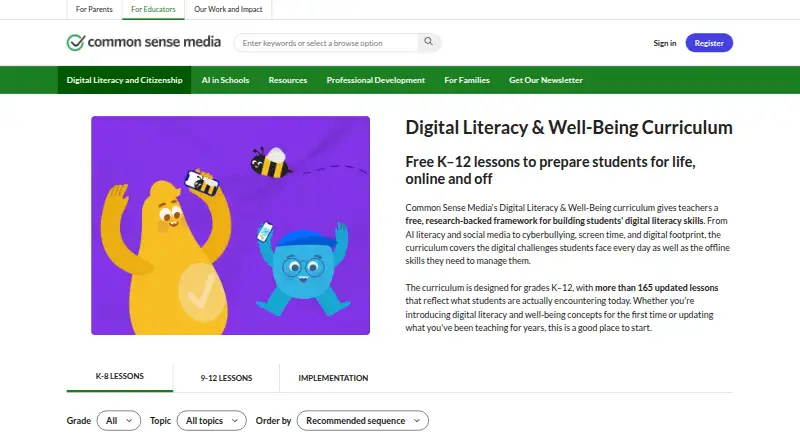
What Common Sense Digital Literacy & Well-Being Curriculum is
Common Sense Digital Literacy & Well-Being Curriculum is a free web curriculum that helps teachers build students’ digital literacy skills in grades K–12. It offers more than 165 updated lessons, described on its About page as 170+ lessons, across six topics: healthy habits; relationships and communication; privacy and safety; cyberbullying and online harm; digital footprint; and information and media literacy. Lessons combine interactive activities and discussion guides. They take approximately 20 minutes in K–8 and 40 minutes in grades 9–12, and address current issues such as AI literacy, social media, screen time, deepfakes, consent, and AI hallucinations.
Schools can work through the grade-level sequence across a school year or choose and reorder lessons. The material can fit library and media lab sessions, core-subject classes, advisory, health, and social-emotional learning programs. Teachers and administrators can take a free, self-paced course on implementing the curriculum. Development involved Project Zero at Harvard Graduate School of Education, with input from experts at Georgetown, Wellesley, and Cornell; researchers at the London School of Economics and the University of New Hampshire independently evaluated it. Common Sense also offers implementation support and district partnerships.
Who it suits
It suits K–12 teachers and school leaders who want a structured way to teach digital literacy across grade levels. Schools can use the full sequence or select lessons for library time, core classes, advisory, health, or social-emotional learning.
What it does well
- Free K–12 curriculum with 170+ lessons.
- Covers six areas of digital literacy and well-being.
- Lesson activities and discussion guides support teaching.
- Schools can select and reorder individual lessons.
- Free, self-paced implementation course for educators.
- Standards-aligned and includes teacher tools.
What to know first
- Sessions are approximately 20 or 40 minutes, depending on grade band.
- The curriculum is delivered on the web.
Plans
| Plan | Billed and limits | Price |
|---|---|---|
| Free | K–12 curriculum · 170+ lessons | Free |
As commonsense.org lists them, read 8 Oct 2026. The maker's own page has the final word.
Getting started
- Open the Common Sense Education digital literacy curriculum website.
- Choose the full grade-level sequence or select individual lessons.
- Use the scope-and-sequence and integration-guide documents to plan delivery.
- Take the free, self-paced implementation course if useful.
- Contact Common Sense about school or district implementation support.
Verdict
Choose it if your school wants a free, standards-aligned K–12 curriculum with flexible lesson sequencing and a broad set of digital well-being topics. Its grade-specific lesson lengths and web delivery are practical considerations when planning where it fits in the school schedule.
Questions
How much does the curriculum cost?
The Free plan costs nothing. The curriculum is offered free.
What grades does it cover?
It is designed for grades K–12 and is offered to districts, schools, and classrooms.
How many lessons are included?
It includes more than 165 updated lessons; the About page describes the offering as 170+ K–12 lessons.
What topics do the lessons cover?
The six core topics are healthy habits, relationships and communication, privacy and safety, cyberbullying and online harm, digital footprint, and information and media literacy.
How can a school use the lessons?
A school can follow the full grade-level sequence over a school year or choose and reorder lessons. They can be used in libraries, media labs, core-subject classrooms, advisory, health, or social-emotional learning programs.
Is it available outside the web?
The listed platform is web, with lessons and implementation resources presented on Common Sense Education web pages.
Facts from Common Sense Digital Literacy & Well-Being Curriculum's own pages
- Audience
- The curriculum is designed for grades K–12 and is offered to every district, school, and classroom. · commonsense.org, 8 Oct 2026
- Current issues
- The curriculum addresses topics including AI literacy, social media, cyberbullying, screen time, digital footprint, deepfakes, consent, and AI hallucinations. · commonsense.org, 8 Oct 2026
- Delivery
- Lessons and implementation resources are presented on Common Sense Education web pages, and the implementation page links to scope-and-sequence and integration-guide documents. · commonsense.org, 8 Oct 2026
- Founded
- 2003 · commonsense.org, 28 Sept 2026
- Headquarters
- San Francisco, California, United States · commonsense.org, 28 Sept 2026
- Implementation
- Schools can use the full grade-level sequence across a school year or select individual lessons and reorder them as needed. · commonsense.org, 8 Oct 2026
- Integration
- The curriculum can be used during library or media lab time, in core-subject classrooms, advisory periods, or health and social-emotional learning programs. · commonsense.org, 8 Oct 2026
- Lesson count
- The curriculum includes more than 165 updated lessons; its About page describes the offering as 170+ K–12 lessons. · commonsense.org, 8 Oct 2026
- Lesson format
- Lessons include interactive activities, discussion guides, and flexibility, and are approximately 20 minutes for K–8 or 40 minutes for grades 9–12. · commonsense.org, 8 Oct 2026
- Professional development
- Common Sense offers a free, self-paced course for teachers and administrators implementing the curriculum. · commonsense.org, 8 Oct 2026
- Purpose
- The curriculum gives teachers a free, research-backed framework for building students’ digital literacy skills. · commonsense.org, 8 Oct 2026
- Research and partners
- The curriculum was developed with Project Zero at Harvard Graduate School of Education, informed by experts at Georgetown, Wellesley, and Cornell, and independently evaluated by researchers at the London School of Economics and the University of New Hampshire. · commonsense.org, 8 Oct 2026
- Security and privacy
- Common Sense describes its Privacy Program as evaluating privacy policies to help parents, teachers, schools, and districts make informed choices about learning tools. · privacy.commonsense.org, 8 Oct 2026
- Support and partnerships
- School and district leaders can access implementation support and district partnerships, and Common Sense invites schools to contact it about partnering. · commonsense.org, 8 Oct 2026
- Topics
- The six core topics are healthy habits, relationships and communication, privacy and safety, cyberbullying and online harm, digital footprint, and information and media literacy. · commonsense.org, 8 Oct 2026
Where Common Sense Digital Literacy & Well-Being Curriculum stands on Freedom251
- K-12 Curriculum Platforms#5 of 29