Freedom251 › Dyslexia Learning Apps

Cody Reading
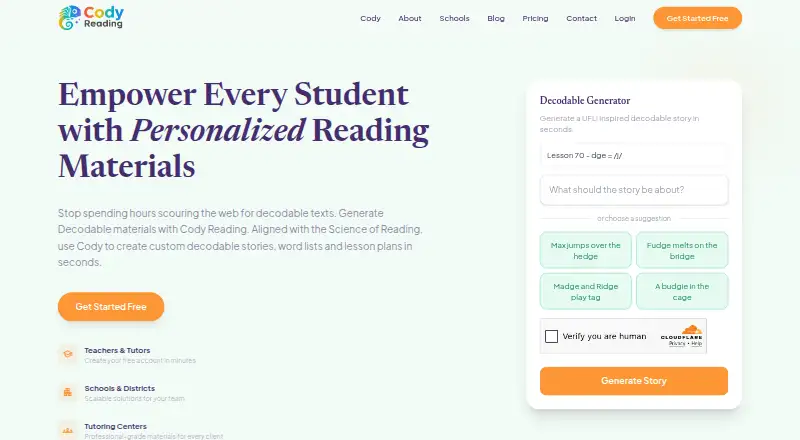
What Cody Reading is
Cody Reading helps educators create decodable reading materials shaped by phonics instruction. Educators can begin with a lesson or student profile, then select phonics patterns to guide generated stories, word lists, worksheets, and lesson plans. Other options include connected text, nonfiction passages, Reader’s Theater, bingo, word searches, word cards, and reading activities. Users can also submit an existing passage for a check against a selected lesson; Cody identifies words that may need teaching first. Documented sequence choices include UFLI Inspired, Custom Pattern Selection, Slant System, and Phonics, Reading, and Me, though availability varies by organization. AI drafts the materials, while teachers choose a student’s place in the scope and sequence and control what students see. Cody is designed for Pre-K through fifth grade and can also support older struggling readers who need explicit phonics instruction. The free plan allows three decodable stories per week for one user. Individual costs $20 per month, with annual billing available at $200 per year. Some creation options depend on plan and account settings.
Who it suits
Cody Reading suits reading specialists, interventionists, classroom teachers, tutors, schools, and districts. Its stated age range is Pre-K through fifth grade, with support also noted for older struggling readers who need explicit phonics instruction.
What it does well
- Generated materials follow selected phonics patterns
- Passage checks flag words to teach first
- Teachers choose sequence placement and student visibility
- Privacy notice describes identifier removal before AI processing
- Free plan allows three stories per week
What to know first
- Free plan is limited to three stories weekly
- Free plan is for one user
- Some creation options depend on plan and settings
Limits
The Free forever plan provides three decodable stories per week with phonetic pattern matching for one user. Individual costs $20 per month and has no team invitations; some creation options also depend on plan, organization settings, enabled features, or whether creation begins from a lesson or student.
Plans
| Plan | Billed and limits | Price |
|---|---|---|
| Free forever | Free forever, no time limit. · 3 decodable stories per week · phonetic pattern matching · single user | Free |
| Schools & Tutoring Centers | Per building, billed yearly. · Everything in Individual · invite tutors and assistants · centralized billing · shared student rosters · onboarding support | $1,000 a year |
| Individual | Billed monthly; annual billing is also available at $200 per year. · Unlimited decodable stories · worksheets, word lists, and Reader's Theater · no team invitations | $20 a month |
| Enterprise | Volume pricing; contact Cody Reading. · Multi-building deployments · integrated scope and sequence · SSO and IT integrations · white-label branding · dedicated implementation manager | On request |
As codyreading.com lists them, read 3 Oct 2026. The maker's own page has the final word.
Getting started
- Open https://www.codyreading.com/ in a web browser.
- Choose the Free forever plan or a paid plan; a 14-day trial is available.
- Start with a lesson or student profile and select phonics patterns.
- Generate materials or submit a passage for a decodability check.
Overview
Cody Reading is an educator-focused tool that uses students’ phonics skills to draft decodable reading materials and teaching resources. It suits reading specialists, classroom teachers, tutors, and schools that want materials shaped around a chosen lesson or student profile. Its strongest case is teacher-controlled, phonics-aligned creation; its free plan is narrow, and some options depend on the account or organization.
Teachers select a place in the scope and sequence, then Cody uses the chosen phonics patterns to shape stories and other materials. It can also check a passage a teacher supplies against a selected lesson and flag words students may need to learn first. That makes Cody useful both for drafting resources and for evaluating whether existing text fits a lesson.
The scope is broader than stories: educators can create nonfiction passages, Reader’s Theater, word lists, bingo, word searches, word cards, worksheets, reading activities, and lesson plans. Cody documents UFLI Inspired, Custom Pattern Selection, Slant System, and Phonics, Reading, and Me as supported sequences or options, though availability varies by organization. The choice is meaningful for educators who need alignment to a particular approach, but they should expect access to vary.
Key features
Phonics-aligned creation and checking
Starting from either a lesson or a student profile gives educators a way to tailor generated materials to the phonics patterns they are teaching. Cody’s passage-matching feature adds a practical check before assigning text: it identifies words that could require prior instruction. These tools are particularly relevant for explicit phonics teaching and intervention, where text fit matters. AI drafts the materials, while teachers decide placement and what students see; the platform therefore supports, rather than replaces, instructional judgment.
Privacy and support
Cody says it removes student names and direct identifiers before sending information to AI providers, which are contractually barred from training models on that information or using it secondarily. It describes FERPA school-official processing when covered by an educational agency data privacy agreement and commits to COPPA compliance. Its privacy notice also describes encryption in transit and at rest, access controls, and U.S.-based hosting for children’s personal information. Users who need help beyond the guides can contact a team member through the in-product chat widget.
Pricing
Cody is freemium, with a 14-day trial and paid plans starting at $20 per month. The free plan, Free forever, costs nothing, has no time limit, and permits three decodable stories per week for a single user. It includes phonetic pattern matching, but the story cap and single-user limit make it better for trying the workflow than for sustained team use.
Individual costs $20 a month, billed monthly, or $200 per year with annual billing. It adds unlimited decodable stories, worksheets, word lists, and Reader’s Theater. This is the clearest fit for one educator who has outgrown the weekly story allowance; it does not allow team invitations.
Schools & Tutoring Centers costs $1,000 a year, billed per building and yearly. It includes everything in Individual, plus tutor and assistant invitations, centralized billing, shared student rosters, and onboarding support. A school or tutoring center that needs shared rosters and multiple staff has a reason to step up, while a solo educator would be paying for team functions they may not need.
Enterprise has custom pricing, with volume pricing by contacting Cody Reading. It is aimed at multi-building deployments and adds an integrated scope and sequence, SSO and IT integrations, white-label branding, and a dedicated implementation manager. Those are organization-level capabilities rather than reasons for an individual teacher to choose this tier.
Platforms
Cody Reading is available on the web. That suits educators working through a browser, but it is not a choice for those seeking a dedicated mobile app.
Who it's for
Cody is built for reading specialists, interventionists, classroom teachers, tutors, schools, and districts. It is designed for Pre-K through fifth grade and can also support older struggling readers who need explicit phonics instruction. Its teacher-selected placement makes it a better fit for educators directing instruction than for families looking for an independent, student-led reading app.
Pros and cons
- Pro: Materials can be shaped by phonics patterns selected from a lesson or student profile, which helps educators target the skill they are teaching.
- Pro: Passage matching flags potentially untaught words, adding a check for existing text as well as newly generated material.
- Pro: The school plan provides shared rosters and staff invitations, making it more suitable for teams than an individual subscription.
- Con: The free tier is limited to three stories per week and one user, so it is restrictive for regular classroom or team use.
- Con: Individual has no team invitations; collaboration requires the $1,000 a year school plan.
- Con: Creation options depend on plan, organization settings, enabled features, or whether a task starts from a lesson or student, so not every educator will have the same workflow.
Alternatives
For a broader set of dyslexia-focused options, start with Dyslexia Learning Apps. Consider Lexy instead if you want an iOS, macOS, or web option with up to five students on its free plan and AI tutoring, voice-based learning, and adaptive phonics.
Reading Mountain is an alternative across Android, iOS, and web, with a free Basecamp app focused separately on phonemic awareness. DytectiveU is another freemium option on Android, iOS, and web, with free school and therapist plans described in euros.
EduFlip may suit users looking for web-based self-paced practice: its free plan includes Level 1 forever and one student profile. Lumira is a free web option offering decodable readers, phonics lessons, and shared reading sessions.
Grafari is a paid alternative available on Android, iOS, macOS, web, and Windows, with free trial access. Legasthenie & LRS Trainer offers a freemium option on Android, iOS, and web, with a one-time premium package priced in euros. OgStar Reading is available on iOS and web, and its school license is priced per student per year.
Verdict
Cody Reading is a strong fit for educators who want to generate and check phonics-aligned materials while retaining control over instructional placement and student access. The free tier offers a limited way to begin, and Individual removes the story quota for a solo teacher; teams need the substantially more expensive per-building school plan. Look elsewhere if you need mobile apps, student-led practice, or dependable access to the same creation options across organizations.
Verdict
Cody Reading offers educators several ways to create and check phonics-aligned materials, with teachers retaining control over placement and what students see. The free plan is limited, and access to some creation options varies by account or organization.
Questions
Is Cody Reading free?
Yes. Its Free forever plan costs nothing and includes three decodable stories per week for one user.
What do the paid plans cost?
Individual costs $20 a month, with annual billing available at $200 per year. Schools & Tutoring Centers costs $1,000 a year per building. Enterprise uses volume pricing, with the price available by contacting Cody Reading.
Is there a free trial?
Yes. Cody Reading offers a 14-day trial.
Which platforms can I use?
Cody Reading is available on the web.
Who makes Cody Reading?
Cody Reading is the product name. Its listed headquarters are 2810 North Church Street, PMB 936381, Wilmington, DE 19802, United States.
How does Cody Reading handle student information?
Its privacy notice says student names and direct identifiers are removed before information is sent to AI providers, which are contractually barred from model training and secondary use. Cody describes FERPA processing under covered school agreements, COPPA compliance, encryption in transit and at rest, access controls, and U.S.-based hosting for children’s personal information.
Facts from Cody Reading's own pages
- Age range
- The site says Cody is designed for Pre-K through fifth grade and can also support older struggling readers who need explicit phonics instruction. · codyreading.com, 3 Oct 2026
- AI and teacher control
- Cody uses AI to draft materials; teachers choose students’ place in the scope and sequence and control what students see. · codyreading.com, 3 Oct 2026
- Curricula
- Cody documents UFLI Inspired, Custom Pattern Selection, Slant System, and Phonics, Reading, and Me as supported sequences or options, with availability varying by organization. · help.codyreading.com, 3 Oct 2026
- Decodability checking
- Users can paste an existing passage for Cody to match it to a selected lesson and identify words that may need to be taught first. · help.codyreading.com, 3 Oct 2026
- Headquarters
- 2810 North Church Street, PMB 936381, Wilmington, DE 19802, United States · codyreading.com, 28 Sept 2026
- Limits
- Some creation options depend on the account plan, organization settings, enabled features, or whether creation starts from a lesson or a student. · help.codyreading.com, 3 Oct 2026
- Other materials
- Creation options include connected text, nonfiction passages, Reader’s Theater, word lists, bingo, word searches, word cards, and reading activities. · help.codyreading.com, 3 Oct 2026
- Personalization
- Educators can start with a lesson or student profile, and Cody uses the selected phonics patterns to shape generated materials. · codyreading.com, 3 Oct 2026
- Purpose
- Cody Reading turns students’ phonics skills into decodable stories, word lists, worksheets, and lesson plans for educators. · codyreading.com, 3 Oct 2026
- Security
- The privacy notice describes encryption in transit and at rest, access controls, and U.S.-based hosting for children’s personal information. · codyreading.com, 3 Oct 2026
- Student data and AI
- The privacy notice says student names and direct identifiers are removed before information is sent to AI providers, which are contractually barred from model training and secondary use. · codyreading.com, 3 Oct 2026
- Student privacy
- Cody says it processes student data under FERPA school-official terms when covered by an educational agency data privacy agreement and commits to COPPA compliance. · codyreading.com, 3 Oct 2026
- Support
- Cody’s help center says users can contact a team member through the chat widget inside Cody when its guides do not answer their question. · help.codyreading.com, 3 Oct 2026
- Target users
- Cody is built for reading specialists, interventionists, classroom teachers, tutors, schools, and districts. · codyreading.com, 3 Oct 2026
Where Cody Reading stands on Freedom251
- Dyslexia Learning Apps#4 of 23