Freedom251 › Mobile Development IDEs

Code on the Go
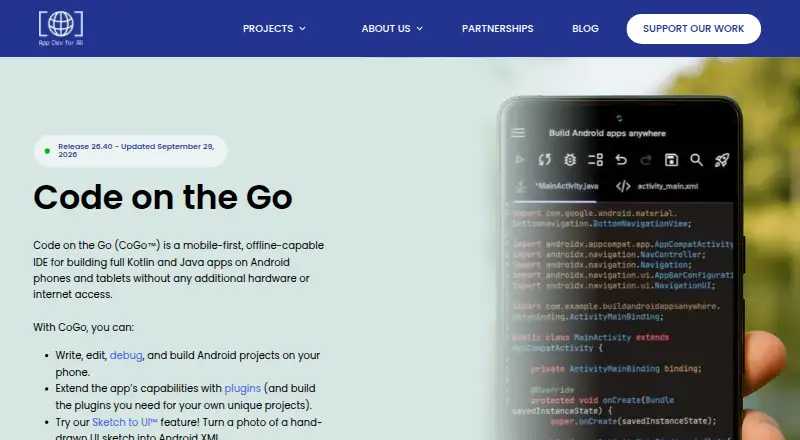
What Code on the Go is
Code on the Go is an Android IDE for creating Kotlin and Java apps on a phone or tablet. It lets users write and edit code, debug projects, and build apps on the device, with offline use designed to cover all three activities. For interface work, Sketch to UI converts a photo of a hand-drawn layout into Android XML; the app also includes a visual UI designer and app packaging. Its on-device debugging stack does not require additional hardware. Optional plugins, templates, and other add-ons can extend the environment, and users can build their own plugins. The maker, App Dev for All, describes its tools as free and open source, for people who need development tools and educational resources without a traditional computer or reliable internet. Code on the Go is free and has no subscription or paywall. It requires Android 9 or later on 32-bit or 64-bit ARM, approximately 3.5 GB of storage, and 1.5 GB of free RAM. The included toolchain is JDK 21 and Kotlin 1.9.2.
Who it suits
Code on the Go suits people building Android apps in Kotlin or Java who want to code, debug, and build on an Android phone or tablet. Its offline design may also suit learners and developers without reliable internet or access to a traditional computer.
What it does well
- Free and open source, with no subscription or paywall.
- Supports Kotlin and Java Android projects.
- Designed for offline coding, debugging, and builds.
- Turns photos of hand-drawn layouts into Android XML.
- On-device debugging requires no additional hardware.
- Users can create their own plugins.
What to know first
- Requires Android 9 or later on ARM devices.
- Needs approximately 3.5 GB of storage and 1.5 GB of free RAM.
- Officially supports JDK 21; other JDK versions are not supported.
- Older projects may need migration to build on newer releases.
Plans
| Plan | Billed and limits | Price |
|---|---|---|
| Free | Free and open source · No subscription or paywall | Free |
As appdevforall.org lists them, read 8 Oct 2026. The maker's own page has the final word.
Getting started
- Open the Code on the Go website for the app.
- Use an Android device running Android 9 or later on 32-bit or 64-bit ARM.
- Make sure the device has approximately 3.5 GB of storage and 1.5 GB of free RAM.
- Start an Android project in Kotlin or Java.
- Use the editor, UI design tools, debugging, and build features on the device.
Verdict
Choose Code on the Go if you want to create Kotlin or Java Android apps directly on an Android device, including when working offline. Look elsewhere if you need a supported JDK other than 21 or cannot meet its Android, storage, or RAM requirements.
Questions
How much does Code on the Go cost?
The Free plan costs nothing. It is free and open source, with no subscription or paywall.
Which devices can run it?
It targets Android and requires Android 9 or later on 32-bit or 64-bit ARM. The stated requirements include approximately 3.5 GB of storage and 1.5 GB of free RAM.
Which programming languages and toolchain versions does it support?
It supports Kotlin and Java. It ships with JDK 21 and Kotlin 1.9.2; the maker does not officially support other JDK versions or guarantee testing of newer Kotlin versions.
Can I use it offline?
The IDE is designed to work offline for coding, debugging, and building apps.
Can I add plugins?
It supports optional plugins, templates, and other add-ons, and users can build plugins. Community-built plugins have not been audited or reviewed by the maker and are provided without guarantees of stability, security, or compatibility.
Who makes Code on the Go?
App Dev for All makes it. The maker is based in Belmont, California.
Facts from Code on the Go's own pages
- Editor and builds
- Users can write, edit, debug, and build Android projects on their phone. · appdevforall.org, 8 Oct 2026
- Headquarters
- Belmont, California · appdevforall.org, 28 Sept 2026
- Maker and audience
- App Dev for All says it builds free, open-source tools for people who need app development and educational resources without a traditional computer or reliable internet. · appdevforall.org, 8 Oct 2026
- Offline use
- The IDE is designed to work offline, including for coding, debugging, and building apps. · appdevforall.org, 8 Oct 2026
- On-device debugging
- The maker describes an on-device debugging stack that does not require additional hardware. · appdevforall.org, 8 Oct 2026
- Plugins
- Code on the Go supports optional plugins, templates, and other add-ons, and users can build their own plugins. · appdevforall.org, 8 Oct 2026
- Plugin safety
- The maker says community-built plugins have not been audited or reviewed by its team and are provided as-is without guarantees of stability, security, or compatibility. · appdevforall.org, 8 Oct 2026
- Privacy
- The maker's privacy notice says it does not process sensitive personal information and describes collecting information users provide, such as email addresses, and technical usage data when visiting its services. · appdevforall.org, 8 Oct 2026
- Project migration
- Projects created with release 26.37 or earlier may fail to build on release 26.38 and later unless migrated. · appdevforall.org, 8 Oct 2026
- Purpose
- Code on the Go is a mobile-first IDE for building Kotlin and Java Android apps on phones and tablets. · appdevforall.org, 8 Oct 2026
- Requirements
- The stated minimum is Android 9 on 32-bit or 64-bit ARM, with approximately 3.5 GB of storage and 1.5 GB of free RAM. · appdevforall.org, 8 Oct 2026
- Sketch to UI
- The Sketch to UI feature turns a photo of a hand-drawn app layout into Android XML. · appdevforall.org, 8 Oct 2026
- Support
- Users can find in-app documentation through long-press tooltips, join the support and discussion forum, or submit issues and suggestions through GitHub. · appdevforall.org, 8 Oct 2026
- Toolchain limits
- The app ships with JDK 21 and Kotlin 1.9.2; the maker says it does not officially support other JDK versions and does not guarantee testing of newer Kotlin versions. · appdevforall.org, 8 Oct 2026
Where Code on the Go stands on Freedom251
- Mobile Development IDEs#19 of 41
- Java IDEs#11 of 23