Freedom251 › Code Refactoring Tools
CodART
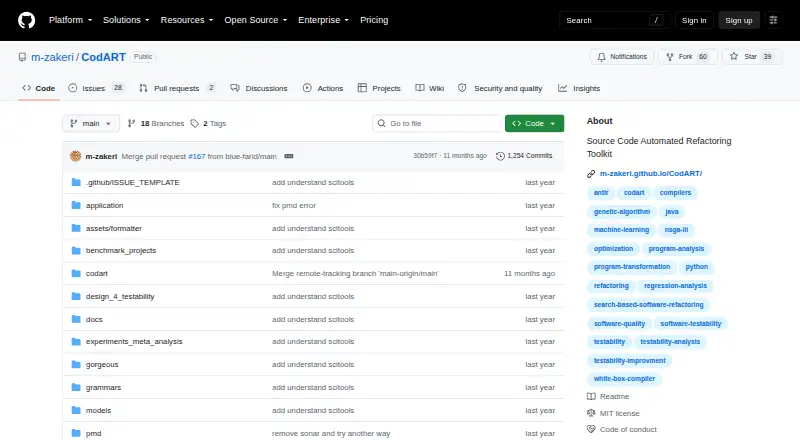
What CodART is
CodART is a free toolkit for automated refactoring and multi-objective optimization of Java source code. It documents 47 refactoring operations, including Extract Class, Move Method, and Encapsulate Field, and supports project-level and batch work. Its optimization uses NSGA-II and NSGA-III across eight QMOOD quality metrics. The toolkit also includes PPO-based generation of refactoring sequences and models that predict testability from source-code metrics. For code quality analysis, CodART integrates PMD with custom rulesets for detecting code smells. SciTools Understand handles code parsing and metric computation. The documented interfaces include a React web interface and a FastAPI REST API, and Docker Compose instructions cover running the services locally. CodART supports Java and is distributed under an MIT License with stated conditions permitting use, copying, modification, distribution, sublicensing, and sale. The setup requires a separate SciTools Understand professional license; academic licenses are available for research. The quick-start calls for at least 8 GB of RAM and 4 CPU cores, with 12 GB or more recommended for large projects.
Who it suits
CodART suits Java developers and teams seeking automated project-level or batch refactoring, optimization, and code analysis. Its documented setup is aimed at users who can meet the system requirements and obtain a SciTools Understand license.
What it does well
- Documents 47 automated refactoring operations.
- Optimizes across eight QMOOD quality metrics.
- Includes PPO-based refactoring sequence generation.
- Provides a React interface and FastAPI REST API.
- MIT-licensed software is free.
What to know first
- Setup requires a separate SciTools Understand professional license.
- Quick-start requires at least 8 GB RAM and 4 CPU cores.
Limits
CodART is free under the MIT license, but its documented setup requires a separate SciTools Understand professional license; academic licenses are available for research. The quick start requires at least 8 GB RAM and 4 CPU cores, and recommends 12 GB or more for large projects.
Plans
| Plan | Billed and limits | Price |
|---|---|---|
| MIT licensed software | MIT license terms apply · SciTools Understand requires a separate professional license | Free |
As github.com lists them, read 8 Oct 2026. The maker's own page has the final word.
Getting started
- Open the CodART project website on GitHub.
- Review the Docker Compose instructions for running the services locally.
- Prepare a system with at least 8 GB RAM and 4 CPU cores; 12 GB or more is recommended for large projects.
- Obtain a SciTools Understand professional license, or an academic license for research purposes.
- Use the documented React web interface or FastAPI REST API.
CodART is a Java toolkit for project-wide automated refactoring, quality analysis, and optimization. It best suits engineering teams and researchers who need batch transformations or want to study algorithmic code improvement rather than just apply an occasional editor fix. The broad scope is useful, but adoption requires accommodating its external analysis dependency and relatively demanding hardware guidance.
Overview
CodART focuses exclusively on Java and works at project scope, making it relevant when a change must be coordinated across a codebase. Batch refactoring and AI assistance extend it beyond a menu of isolated source edits. The project is open source under the MIT License, which permits use, modification, distribution, sublicensing, and sale subject to the license conditions.
Key features
The toolkit documents 47 automated refactoring operations, including Extract Class, Move Method, and Encapsulate Field. That breadth gives teams a way to handle varied structural changes in repeatable batches, while project-wide scope is better suited to larger migrations than to a single-file cleanup.
CodART applies NSGA-II and NSGA-III to eight QMOOD quality metrics for multi-objective optimization. It also provides PPO-based generation of refactoring sequences and models that predict testability from source-code metrics. These capabilities are valuable for experimentation, research, and teams investigating competing quality goals; they add complexity when the requirement is simply a known, deterministic refactoring.
PMD integration with custom rulesets supports code-smell detection. SciTools Understand performs code parsing and metric computation, so the documented workflow depends on a separate professional license; academic licenses are available for research. A React web interface offers browser access, while a FastAPI REST API supports programmatic integration. Docker Compose instructions describe local service deployment.
Pricing
The MIT licensed software plan costs nothing. It includes the open-source CodART software under MIT terms, with no separate CodART subscription described. The documented setup still requires a SciTools Understand professional license, which is an additional product and cost; academic licensing is available for research use.
There are no published paid CodART tiers, seat allowances, usage quotas, trial period, renewal schedule, or free-plan caps. Teams should therefore budget for the external Understand license and their own infrastructure rather than assume that the free software removes all deployment expense.
Platforms
CodART supports web, API, Linux, and self-hosted deployment. Docker Compose instructions are aimed at running its services locally. The quick-start guidance calls for at least 8 GB of RAM and four CPU cores, with 12 GB or more recommended for large projects, so modest development machines may not be a comfortable fit for substantial codebases.
Who it's for
CodART is a strong fit for Java teams performing coordinated, repeatable refactoring across projects, and for researchers studying optimization, refactoring sequences, or testability models. Its API and self-hosting options also suit organizations that want to place automation in their own workflows.
It is less suitable for developers seeking lightweight editor assistance, for projects outside Java, or for organizations unwilling to procure and operate the separate SciTools Understand dependency. Straightforward one-off transformations may not justify its optimization and machine-learning stack.
Pros and cons
Pros
- 47 documented refactoring operations: covers substantially more than a handful of common structural edits.
- Project-wide and batch scope: supports coordinated changes across multiple files.
- Optimization and machine learning: combines NSGA-II/III quality trade-offs with PPO sequence generation and testability prediction.
- Multiple interfaces: web and FastAPI access can serve both interactive and automated workflows.
- MIT licensing: permits broad use and modification of the CodART code.
Cons
- Separate Understand license: parsing and metrics depend on a professional license, creating an external cost and setup requirement.
- Java only: teams working in other languages need another tool.
- Hardware floor: 8 GB RAM and four CPU cores are specified, with more recommended for large projects.
- Potentially excessive machinery: optimization and ML features may be unnecessary for simple, predefined refactoring.
Alternatives
Choose ast-grep when you want a free tool spanning API, extensions, web, and major desktop platforms, rather than CodART's Java-focused optimization stack.
CodeRush is the alternative for an editor-oriented extension available free for commercial use, with the same features and updates across its free and paid subscriptions.
Pick ReSharper if you need a freemium extension with a free non-commercial option and a stated 389.00 USD paid plan.
Roslynator suits users wanting free tools and extensions without a paid plan, while Coccinelle is a free Linux and macOS option.
Choose OpenRewrite for an Apache-licensed core that runs one repository at a time, or Sourcery for a free open-source plan with AI reviews, PR summaries, diagrams, one-click fixes, and custom review rules.
Spoon is another free, open-source API, Linux, and self-hosted choice with no paid plans or usage limits stated.
See the Code Refactoring Tools list for a broader comparison.
Verdict
Choose CodART when you need Java project-wide and batch refactoring combined with quality-metric optimization, code-smell analysis, and programmable access. Look elsewhere if you want a lighter editor tool, support for other languages, or a setup that does not rely on a separately licensed Understand installation.
Verdict
CodART combines Java refactoring operations, optimization, and code-quality analysis with web and API interfaces. Account for the separate SciTools Understand license and stated hardware requirements before adopting it.
Questions
How much does CodART cost?
The listed MIT licensed software plan is free. SciTools Understand requires a separate professional license.
Is CodART open source?
Yes. The repository includes an MIT License, whose terms permit use, copying, modification, distribution, sublicensing, and sale subject to its stated conditions.
Which programming languages does CodART support?
Java.
What platforms and interfaces does it offer?
The listed platforms are API, Linux, self-hosted, and web. The project documents a React web interface, a FastAPI REST API, and Docker Compose instructions for local services.
What are the system requirements?
The quick start specifies at least 8 GB RAM and 4 CPU cores. It recommends 12 GB or more for large projects.
Does CodART require another license?
Yes. The documented setup requires a SciTools Understand professional license. Academic licenses are available for research.
Facts from CodART's own pages
- Analysis integration
- CodART integrates SciTools Understand for code parsing and metrics computation. · github.com, 8 Oct 2026
- Code quality
- The repository describes PMD integration with custom rulesets for code smell detection. · github.com, 8 Oct 2026
- Deployment
- The repository provides Docker Compose instructions for running its services locally. · github.com, 8 Oct 2026
- External license requirement
- The documented setup requires a SciTools Understand professional license, with academic licenses available for research purposes. · github.com, 8 Oct 2026
- Interface and API
- The project documents a React web interface and a FastAPI REST API. · github.com, 8 Oct 2026
- License
- The repository includes an MIT License that permits use, copying, modification, distribution, sublicensing, and sale subject to its stated conditions. · github.com, 8 Oct 2026
- Machine learning
- CodART includes PPO-based refactoring sequence generation and testability prediction models using source code metrics. · github.com, 8 Oct 2026
- Optimization
- The repository describes NSGA-II and NSGA-III optimization of eight QMOOD quality metrics. · github.com, 8 Oct 2026
- Purpose
- CodART is a toolkit for automated refactoring and multi-objective optimization of Java source code. · github.com, 8 Oct 2026
- Refactoring operations
- The documentation lists 47 automated refactoring operations, including Extract Class, Move Method, and Encapsulate Field. · m-zakeri.ir, 8 Oct 2026
- Support
- The repository invites questions by email at [email protected] and welcomes project contributions and discussion comments. · github.com, 8 Oct 2026
- System requirements
- The quick-start documentation specifies at least 8 GB RAM and 4 CPU cores, with 12 GB or more recommended for large projects. · github.com, 8 Oct 2026
Where CodART stands on Freedom251
- Code Refactoring Tools#2 of 22