Freedom251 › Continuous Integration Software

CloudBees CI
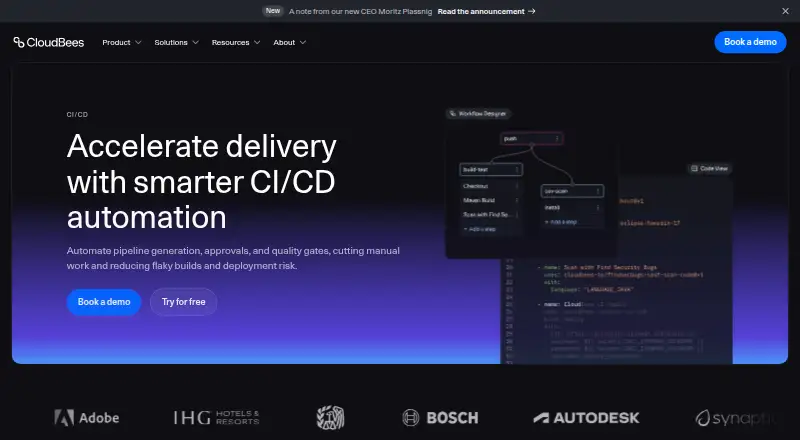
What CloudBees CI is
CloudBees CI is a centrally managed Jenkins environment for development teams that need continuous integration across multiple controllers. Operations Center gives administrators a central view for managing those controllers. The product can run on-premise or in a public cloud, with a modern cloud edition designed for Kubernetes and a traditional platform edition also available. Its pipeline features include declarative syntax, complex delivery pipelines, and builds that can withstand controller or agent failures. Plugin stability is supported through the CloudBees Assurance Program and Beekeeper upgrade management. Integrations include GitHub, Bitbucket, Slack, and Microsoft Teams. Security options include role-based access, single sign-on, centrally managed controls, and connections to external credential stores such as CyberArk and HashiCorp Vault. CloudBees CI is paid, with pricing on request, and has no free plan. Support availability depends on the customer's agreement, and only CloudBees-certified plugins are supported on CloudBees services based on Jenkins core.
Who it suits
It suits development teams seeking a shared, centrally managed Jenkins setup, including organizations running CI on Kubernetes. Administrators should note that support for Jenkins-core-based services is limited to CloudBees-certified plugins.
What it does well
- Central view across CI controllers
- Pipelines can survive controller and agent failures
- Role-based access and single sign-on
- Integrations include GitHub, Slack, and Teams
What to know first
- No free plan
- Pricing is available on request
- Support depends on the customer agreement
- Only certified plugins are supported on applicable services
Limits
CloudBees CI has no free plan. Its support policy covers only CloudBees-certified plugins on CloudBees services based on Jenkins core, and expert support availability depends on the customer’s support agreement.
Plans
| Plan | Billed and limits | Price |
|---|---|---|
| CloudBees CI | Pricing and additional features supplied through CloudBees Sales or account team | On request |
As cloudbees.com lists them, read 15 Oct 2026. The maker's own page has the final word.
Getting started
- Visit the CloudBees CI website.
- Choose the modern cloud or traditional platform edition.
- Use the documented installation guidance for your Kubernetes provider, including AKS or Amazon EKS.
- Contact Sales or your account team for pricing and additional features or services.
CloudBees CI is a centrally managed Jenkins environment for organizations running continuous integration across many teams and controllers. It is best suited to enterprises that need governed, self-service pipelines on their own infrastructure or Kubernetes. Its centralized operations and resilience features are compelling, but custom pricing and certified-plugin support rules deserve scrutiny before purchase.
Overview
Operations Center gives administrators a central view and management layer across CI controllers while development teams retain self-service Jenkins workflows. CloudBees CI can run on-premise or in a public cloud; its modern cloud platform is designed for Kubernetes, with installation guidance for providers such as AKS and Amazon EKS. Traditional platform editions are also documented, making it relevant to organizations with mixed infrastructure.
This is a paid product with no free plan and no hosted option. Customers run self-hosted runners and choose their deployment model, so the operational benefits of central governance come with responsibility for infrastructure and administration.
Key features
Pipeline and build continuity
Complex delivery pipelines and declarative pipeline syntax support standardized automation for sophisticated release flows. Builds designed to survive controller and agent failures are valuable when interruptions would otherwise delay teams or waste long-running jobs. Pull-request checks, artifact or dependency caching, flaky-test detection, failure analysis, and execution-trend reports add useful feedback around everyday CI work.
Governance and security
The CloudBees Assurance Program vets plugins, while Beekeeper helps administrators monitor and manage upgrades. That combination addresses a major Jenkins administration risk: uncontrolled plugin changes. The trade-off is material for teams relying on a broad plugin estate: CloudBees support policies cover only CloudBees-certified plugins on CloudBees services based on Jenkins core.
Central security controls include role-based access control, single sign-on, audit logs, approval workflows, and connections to external credential stores such as CyberArk and HashiCorp Vault. For Kubernetes deployments, CloudBees recommends Pod Security Admission policies to limit pod privileges. These controls suit regulated or multi-team environments that need consistent access and change governance.
Integrations and delivery controls
Documented source-control integrations include GitHub and Bitbucket, with Slack and Microsoft Teams notifications. Deployment integrations span AWS, AWS Lambda, Helm, Kubernetes, Ansible, Octopus, Spinnaker, and SSH. Environment tracking, release templates, rollback planning, targeting rules, percentage rollouts, and user segments support controlled promotion beyond the build stage. Supported test and build frameworks include Maven, Gradle, Ant, Bazel, CTest, GoogleTest, dotnet test, Cypress, Jest, pytest, RSpec, and others; SDK coverage includes Java, Go, Python, JavaScript, .NET/C#, PHP, Ruby, mobile languages, and more.
Pricing
CloudBees CI: custom pricing. CloudBees directs customers to Sales or their account team for additional features or services, and no public price is shown. There is no free plan, no hosted option, and self-hosted runners are supported.
This model fits organizations able to budget for an enterprise CI platform and negotiate support and services. It is a poor match for small teams seeking transparent monthly pricing, a permanent free tier, or a ready-made hosted service. Confirm the support agreement and the certified-plugin requirement during procurement, since 24/7 expert support depends on that agreement.
Platforms
CloudBees CI supports Linux, Windows, web access, and self-hosted deployment models. It runs on-premise or in public clouds, with Kubernetes-oriented modern cloud deployment and documented AKS and Amazon EKS installation paths.
Who it's for
Choose CloudBees CI when several development groups share Jenkins and need central administration, consistent security, plugin oversight, and visibility across controllers. It is particularly appropriate for Kubernetes adopters, organizations managing their own infrastructure, and delivery programs requiring approvals, auditability, staged rollouts, and resilient builds. Teams wanting a simple hosted CI service or unrestricted third-party plugin support should look elsewhere.
Pros and cons
Pros
- Centralized controller management: Operations Center provides a shared operational view instead of isolated Jenkins administration.
- Resilient pipelines: Builds can survive controller and agent failures, reducing disruption to critical delivery work.
- Governed plugin lifecycle: Assurance and Beekeeper support more controlled stability and security management.
- Enterprise controls: RBAC, SSO, credential-store integrations, audit logs, and approvals support regulated environments.
- Broad delivery tooling: Extensive framework, CI/CD, source-control, messaging, and deployment integrations cover varied toolchains.
Cons
- Custom pricing: Buyers cannot compare a published rate and must engage Sales or an account team.
- No hosted or free option: Smaller teams must fund and operate infrastructure without a free entry tier.
- Certified-plugin boundary: Unsupported plugins may limit choices for Jenkins installations dependent on community extensions.
- Support tied to agreement: 24/7 expert assistance depends on the customer’s support terms.
Alternatives
For value-stream planning rather than Jenkins-centered CI, consider ValueStream by MapVS, whose free plan supports two maps with five stages each and 50 MB of storage.
HCL DevOps Velocity is a freemium release and deployment option with an always-free Community Edition for two to three licenses and forum support.
Allstacks offers a free Starter plan with unlimited usage and sessions for now, making it worth considering for teams prioritizing software-delivery analytics.
Swarmia has a free plan for companies with fewer than 10 software developers, while paid options add capabilities.
For broader release-management suites, evaluate Planview AdaptiveWork, Cora Value Stream Management, Digital.ai TeamForge, or Kovair Value Stream Management Platform; each uses custom or unlisted pricing.
Other categories to explore include Value Stream Management Software, IT Release Management Software, Release Orchestration Software, Release Management Software, Feature Flag Software, and Test Analytics Software.
Verdict
CloudBees CI is a strong choice for organizations standardizing Jenkins across teams, controllers, and Kubernetes environments. Its main reason to choose is centralized governance combined with resilient, security-conscious pipelines; its main reason to look elsewhere is the operational and commercial friction of self-hosting, custom pricing, and certified-plugin-only support.
Verdict
CloudBees CI combines centralized Jenkins administration with pipeline and security controls for teams delivering CI at scale. Check the support agreement and certified-plugin policy, and request pricing from CloudBees before choosing it.
Questions
How much does CloudBees CI cost?
Pricing is available on request. CloudBees directs customers to Sales or their account team for additional features or services.
Is there a free plan?
No. CloudBees CI is a paid product.
Where can CloudBees CI run?
It can run on-premise or in the public cloud. Its modern cloud platform is designed for Kubernetes, and a traditional platform edition is also available.
Which integrations are documented?
Source control integrations include GitHub and Bitbucket. CloudBees CI also documents Slack and Microsoft Teams integrations.
Which plugins does CloudBees support?
CloudBees support policies cover only CloudBees-certified plugins on CloudBees services based on Jenkins core.
What platforms are listed?
The listed platforms are Linux, self-hosted, web, and Windows.
Facts from CloudBees CI's own pages
- Agent sizing
- CloudBees suggests 2 CPUs, 8 GB RAM and 50 GB storage for a build agent. · docs.cloudbees.com, 15 Oct 2026
- API authentication
- API access uses user-generated authentication tokens created in the CloudBees CI dashboard, and the same tokens work with the CLI. · docs.cloudbees.com, 15 Oct 2026
- Central management
- An operations center provides a central view and management layer for multiple client controllers. · docs.cloudbees.com, 15 Oct 2026
- CI as code
- Pipelines can be defined as code so teams can version, review and automate their delivery configuration. · docs.cloudbees.com, 15 Oct 2026
- Company headquarters and size
- LinkedIn lists CloudBees headquarters in San Jose, California, with 501–1,000 employees. · linkedin.com, 15 Oct 2026
- Company legal name
- CloudBees documentation identifies the maker as CloudBees, Inc. · docs.cloudbees.com, 15 Oct 2026
- Configuration as Code
- CloudBees CI supports CasC for controllers and operations centers, including inherited bundles and centrally distributed configurations. · docs.cloudbees.com, 15 Oct 2026
- Deployment
- CloudBees CI can run on-premise or in the public cloud; its modern cloud platform is designed for Kubernetes. · docs.cloudbees.com, 2 Oct 2026
- Deployment models
- The modern-cloud edition runs on Kubernetes, while the traditional edition targets on-premises installations. · docs.cloudbees.com, 15 Oct 2026
- Founded
- CloudBees was founded in 2010 by former JBoss CTO Sacha Labourey and colleagues. · cloudbees.com, 15 Oct 2026
- Funding news
- On June 27, 2018, CloudBees announced a $62 million growth round and said cumulative funding exceeded $100 million. · cloudbees.com, 15 Oct 2026
- Installation prerequisites
- Kubernetes installations require practical knowledge of Kubernetes, Helm and the Kubernetes Gateway API. · docs.cloudbees.com, 15 Oct 2026
- Integrations
- Official integration guides cover GitHub, Bitbucket, Slack and Microsoft Teams for source reporting, notifications and collaboration. · docs.cloudbees.com, 15 Oct 2026
- Kubernetes security
- For modern cloud deployments, CloudBees recommends Pod Security Admission policies to limit pod privileges. · docs.cloudbees.com, 2 Oct 2026
- License model
- CloudBees CI requires a CloudBees trial or standard license and adds proprietary enterprise tools to Jenkins. · docs.cloudbees.com, 15 Oct 2026
- Limit: complexity
- G2 reviewers report that setup, configuration and plugin management can be difficult and require specialized expertise. · g2.com, 15 Oct 2026
- Limit: price
- G2 reviewers, including small-business users, frequently describe CloudBees as expensive for smaller organizations. · g2.com, 15 Oct 2026
- Limit: scalability
- A Gartner critical review reports scalability difficulties for large enterprises despite generally meeting service and support expectations. · gartner.com, 15 Oct 2026
- Pipeline features
- The feature comparison lists complex delivery pipelines, declarative pipeline syntax, and builds that can survive controller and agent failures. · docs.cloudbees.com, 2 Oct 2026
- Pipeline policy
- Administrators can enforce policies governing build and deployment processes for compliance and governance. · docs.cloudbees.com, 15 Oct 2026
- Platform options
- CloudBees CI has modern cloud and traditional platform editions, with documented installation guidance for Kubernetes providers including AKS and Amazon EKS. · docs.cloudbees.com, 2 Oct 2026
- Plugin ecosystem
- The feature comparison documents an ecosystem of more than 1,800 Jenkins plugins and a curated set of over 200 compatible plugins. · docs.cloudbees.com, 15 Oct 2026
- Plugin governance
- The CloudBees Assurance Program classifies plugin versions and dependencies by support and testing status to improve upgrade stability. · docs.cloudbees.com, 15 Oct 2026
- Plugin management
- The CloudBees Assurance Program vets plugins and Beekeeper helps administrators monitor and manage plugin upgrades for stability and security. · docs.cloudbees.com, 2 Oct 2026
Where CloudBees CI stands on Freedom251
- Continuous Integration Software#45 of 58