Freedom251 › Social Media Listening Software
Cloud-Radar
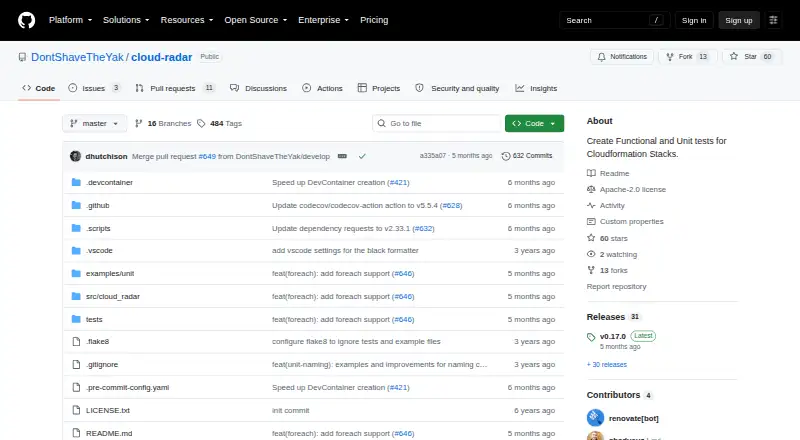
What Cloud-Radar is
Cloud-Radar is a Python module for writing unit and functional tests for AWS CloudFormation templates and stacks. Unit testing renders templates with a selected region and parameters, so users can check conditions, resource creation, properties, and names locally without AWS credentials. It supports a subset of CloudFormation transforms focused on AWS::LanguageExtensions, including Fn::ForEach and extended Fn::FindInMap behavior. By default, Ref and GetAtt resolve to placeholder strings rather than realistic AWS resource values; template metadata can supply test values. For functional testing, Cloud-Radar wraps Taskcat so tests can use boto3 to interact with deployed resources and manage stack lifecycles. The project is built with Taskcat and cfn_tools from cfn-flip. Installation uses pip, with an optional cloud-radar[e2e] extra for functional testing, and requires Python 3.8 or newer. Cloud-Radar is distributed under the Apache License 2.0 and classified as Pre-Alpha. Its README points to GitHub issues for bug reports and feature requests. The listed roadmap gaps include incomplete pseudo-parameter functionality, references to conditionally removed resources, and updating a stack instance in Taskcat.
Who it suits
Cloud-Radar suits Python users writing local unit tests or functional tests for AWS CloudFormation templates and stacks. Functional tests are relevant when tests need to interact with deployed AWS resources.
What it does well
- Unit tests run locally without AWS credentials
- Checks conditions, resource creation, properties, and names
- Functional tests can use boto3 on deployed resources
- Apache License 2.0
- Python 3.8 or newer
What to know first
- Package is classified as Pre-Alpha
- Ref and GetAtt default to placeholder strings
- Transform support covers a subset of CloudFormation
- Functional testing needs optional extra dependencies
Limits
Unit testing covers only a subset of CloudFormation transforms. Ref and GetAtt return placeholder strings by default, and the roadmap lists incomplete pseudo-parameter behavior, conditionally removed-resource references, and Taskcat stack-instance updates.
Getting started
- Install Python 3.8 or newer
- Run pip install cloud-radar
- Add the optional cloud-radar[e2e] extra for functional testing
- Write unit tests for templates locally without AWS credentials
- Use functional tests with Taskcat and boto3 against deployed resources
- Report bugs or request features through GitHub issues
Verdict
Cloud-Radar provides local template checks as well as functional testing through Taskcat and boto3. Its Pre-Alpha classification, limited transform support, and placeholder Ref and GetAtt values are important considerations.
Questions
Is Cloud-Radar free?
Yes. It is open source and distributed under the Apache License 2.0, a no-charge, royalty-free license subject to its terms.
What does Cloud-Radar test?
It tests AWS CloudFormation templates and stacks with local unit tests and Taskcat-based functional tests.
Does it require AWS credentials for unit tests?
No. The local unit-testing workflow can run without AWS credentials.
What are the installation requirements?
Install it with pip and use Python 3.8 or newer. The optional cloud-radar[e2e] extra enables functional-testing dependencies.
Which integrations does it use?
The project uses Taskcat and cfn_tools from cfn-flip; functional tests also use boto3.
Where is support handled?
The README directs bug reports and feature requests to GitHub issues and names Levi as a contact.
Facts from Cloud-Radar's own pages
- AWS resource access
- Functional tests can interact with deployed resources using boto3 and control stack lifecycle, including testing whether resources are retained after stack deletion. · github.com, 7 Oct 2026
- Dependencies
- The project is built with Taskcat and cfn_tools from cfn-flip; the E2E testing feature requires optional extra dependencies. · github.com, 7 Oct 2026
- Functional tests
- Cloud-Radar wraps Taskcat to help write functional tests for CloudFormation deployments across AWS Regions. · github.com, 7 Oct 2026
- Install
- The README documents installation with pip install cloud-radar and an optional cloud-radar[e2e] extra for functional testing. · github.com, 4 Oct 2026
- Installation
- The maker documents installation with pip as cloud-radar and lists Python 3.8 or newer as a prerequisite. · github.com, 7 Oct 2026
- Integrations
- The project is built with Taskcat and cfn_tools from cfn-flip; Taskcat is used for functional testing. · github.com, 4 Oct 2026
- Intended users
- The project is for people writing unit or functional tests for AWS CloudFormation templates and stacks in Python. · github.com, 7 Oct 2026
- Known gaps
- The roadmap lists incomplete pseudo parameter functionality, references to conditionally removed resources, and updating a stack instance in Taskcat as remaining work. · github.com, 7 Oct 2026
- Known limits
- The README says not all Taskcat or CloudFormation features may be supported and lists incomplete pseudo-parameter functionality and resource references affected by conditionals on its roadmap. · github.com, 4 Oct 2026
- License
- The project is distributed under the Apache-2.0 license. · github.com, 7 Oct 2026
- Local testing
- The maker says unit tests can run locally without AWS credentials. · github.com, 7 Oct 2026
- Maturity
- PyPI classifies the package as Pre-Alpha. · pypi.org, 7 Oct 2026
- Purpose
- Cloud-Radar is a Python module for testing AWS CloudFormation templates and stacks. · github.com, 7 Oct 2026
- Requirement
- Cloud-Radar requires Python >= 3.8. · github.com, 4 Oct 2026
- Support
- The README directs users to GitHub issues to report bugs and request features, and names Levi as the contact. · github.com, 4 Oct 2026
- Template support
- Unit testing supports a subset of CloudFormation transforms, focused on AWS::LanguageExtensions, including Fn::ForEach and extended Fn::FindInMap behavior. · github.com, 7 Oct 2026
- Testing limitation
- For unit tests, Ref and GetAtt return placeholder strings by default rather than realistic AWS resource values; template metadata can supply test values. · github.com, 7 Oct 2026
- Unit tests
- It renders templates with a chosen region and parameters so tests can check conditions, conditional resources, resource properties, and names generated with !Sub. · github.com, 7 Oct 2026
Where Cloud-Radar stands on Freedom251
- Social Media Listening Software#24 of 86
- CI Failure Analysis And Flaky Test Tools#10 of 21
- Test Flakiness Management Software#21 of 31
- Infrastructure Testing Tools#22 of 28
- Disk Space Analyzers#88 of 105