Clock Signal
What Clock Signal is
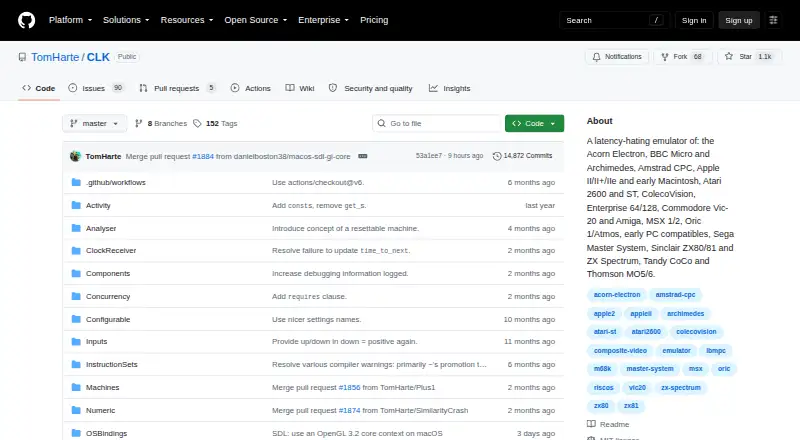
Clock Signal is a free, MIT-licensed emulator for launching classic software on Linux and macOS without first learning an emulator or the original computer. It supports systems including the BBC Micro, Apple II, Atari 2600, Commodore Vic-20, early Macintosh, MSX, Sega Master System, and ZX Spectrum. Emulation for the Acorn Archimedes, Commodore Amiga, and early PC compatibles is described as less rounded. When given disk, tape, or ROM media, Clock Signal can identify and configure a machine, issue needed commands, and speed loading where feasible; it does not require importing files. It processes video signals such as composite video and produces audio at the emulated system’s source rate before filtering it for host output. The README reports typical audio latency of 5–10 ms, while display latency depends on host hardware. The emulator attempts cycle-accurate operation, which the README says it achieves in some cases. macOS builds use Cocoa and Metal; Linux options include Qt, OpenGL, and SDL builds. A BIOS is required.
Who it suits
It suits people who want to run classic computer and console software on Linux or macOS without a separate file-import process. Check that your chosen system is supported and that you can provide a BIOS.
What it does well
- Handles disk, tape, and ROM media directly.
- Supports numerous classic computers and consoles.
- Does not take ownership of user files.
- MIT licensed and free to use.
What to know first
- BIOS is required.
- Some listed systems have less-rounded emulation.
- No Android support.
- Display latency depends on host hardware.
Limits
BIOS support is required. Emulation for the Acorn Archimedes, Commodore Amiga, and early PC compatibles is described as less rounded than for the other listed systems.
Plans
| Plan | Billed and limits | Price |
|---|---|---|
| Clock Signal | Open-source emulator · macOS and Linux builds, plus source releases | Free |
As github.com lists them, read 9 Oct 2026. The maker's own page has the final word.
Getting started
- Visit the Clock Signal GitHub repository.
- Choose a macOS release hosted on GitHub or a Linux build, such as the Qt-based Snap.
- Provide BIOS support.
- Open disk, tape, or ROM media for CLK to analyze and configure.
Verdict
Clock Signal brings a broad range of classic systems together with media detection and automated loading steps. Its platform support is limited to Linux and macOS, and the README distinguishes several less-rounded systems from the others.
Questions
How much does Clock Signal cost?
The Clock Signal plan is free. It is an open-source emulator.
Which platforms does it support?
Clock Signal has macOS and Linux builds. Android support is listed as unavailable.
Which machines can it emulate?
Listed systems include the BBC Micro, Apple II, Atari 2600, Commodore Vic-20, early Macintosh, MSX, Sega Master System, and ZX Spectrum. It also emulates the Acorn Archimedes, Commodore Amiga, and early PC compatibles, with less rounded emulation described for those systems.
Do I need to import my files?
No import procedure is required. CLK analyzes disk, tape, or ROM media and does not take ownership of users’ files.
Is Clock Signal open source?
Yes. The GitHub repository identifies it as MIT licensed.
Is a BIOS required?
Yes, BIOS support is required.
Facts from Clock Signal's own pages
- Accuracy
- CLK attempts cycle-accurate emulation of all supported machines, and its README says this succeeds in some cases. · github.com, 9 Oct 2026
- Emulation status
- The README describes Acorn Archimedes, Commodore Amiga and early PC compatible emulation as less rounded than the other listed systems. · github.com, 9 Oct 2026
- File handling
- The README says CLK does not take ownership of users’ files and has no import procedure. · github.com, 9 Oct 2026
- Latency
- The README says audio latency is generally 5–10 ms and display latency is dictated by host hardware. · github.com, 9 Oct 2026
- License
- The GitHub repository identifies the project as MIT licensed. · github.com, 9 Oct 2026
- Linux and Unix builds
- A Qt-based Linux build is available as a Snap, and the README says Linux, BSD and other Unix-like systems can use OpenGL with Qt or SDL builds. · github.com, 9 Oct 2026
- macOS build
- The macOS application is native Cocoa and Metal, and macOS releases are hosted on GitHub. · github.com, 9 Oct 2026
- Purpose
- Clock Signal is an emulator designed to let users launch classic software directly without first learning how to use an emulator or the original machines. · github.com, 9 Oct 2026
- Recent release
- The GitHub releases page lists 2026-07-23 as the latest release and describes a fix for OpenGL output affecting several emulated systems on Qt and SDL targets. · github.com, 9 Oct 2026
- Signal processing
- CLK processes video signals such as composite video and generates audio at the emulated machine’s source rate before filtering it for host output. · github.com, 9 Oct 2026
- Single-step loading
- CLK analyzes disk, tape or ROM media to select and configure a machine, issue required commands and accelerate loading where feasible. · github.com, 9 Oct 2026
- Supported machines
- It emulates numerous classic systems, including the BBC Micro, Apple II, Atari 2600, Commodore Vic-20, early Macintosh, MSX, Sega Master System and ZX Spectrum. · github.com, 9 Oct 2026
Where Clock Signal stands on Freedom251
- Amiga Emulators#4 of 22
- Sega Master System Emulators#5 of 25
- Multi-System Emulators#19 of 54