Chronosphere Application Observability
Visit Chronosphere Application Observability Alternatives Pricing
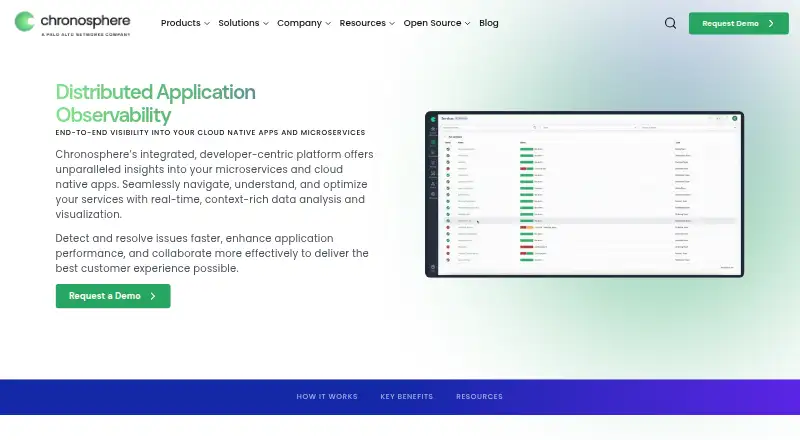
What Chronosphere Application Observability is
Chronosphere Application Observability is a cloud service for observing cloud-native applications and microservices so teams can detect and resolve issues. Chronosphere Lens generates service-focused views that reflect application architecture. Teams can use RED metrics and service-level objectives to understand service performance and dependencies. The platform correlates metrics, logs, traces, and events in context, including links between system changes and performance effects. Distributed tracing maps request paths across components to help investigate latency and inter-service communication. Dynamic trace sampling is offered to balance observability insight with cost. The service ingests open-source telemetry formats including Prometheus and OpenTelemetry, and lists alerting integrations for Slack, PagerDuty, OpsGenie, VictorOps, email, and webhooks. Pricing is based on useful data retained and determined with each organization. Pilots are typically free and average 2–3 weeks, though large-scale or long-term pilots may be paid. The platform is a business-to-business SaaS service, and the company describes use by teams from startups to Fortune 500 companies. A free trial is listed, but there is no free plan.
Who it suits
Chronosphere suits teams operating cloud-native applications and microservices that need service-level views, telemetry correlation, or distributed tracing. It is positioned for business organizations, from startups to large enterprises.
What it does well
- Correlates metrics, logs, traces, and events
- Distributed tracing shows request paths across components
- Ingests Prometheus and OpenTelemetry formats
- Lists integrations for paging and alerting
- Typically free pilots average 2–3 weeks
What to know first
- No free plan is available
- Pricing is provided on request
- Large-scale or long-term pilots may be paid
Limits
There is no free plan. The typical free pilot averages 2–3 weeks; large-scale or long-term pilots may be paid. Ongoing platform pricing is customized based on useful data retained.
Plans
| Plan | Billed and limits | Price |
|---|---|---|
| Chronosphere pilot | Typically free; average pilot is 2–3 weeks. · Large-scale or long-term pilots may be paid. | Free |
| Pilot | Typically 2-3 weeks · Production-data evaluation · longer pilots may be paid | Free |
| Chronosphere Observability Platform | Contact Chronosphere for a customized price. · Price is based on useful data retained; pricing varies by organization. | On request |
| Custom enterprise subscription | Usage-based; primarily by retained observability data, with ingestion fee · Metrics, logs, traces and events · custom retention and aggregation | On request |
As chronosphere.io lists them, read 9 Oct 2026. The maker's own page has the final word.
Getting started
- Visit the Application Observability website.
- Request a pilot or free trial from Chronosphere.
- Discuss organization-specific pricing based on useful data retained.
- Use the cloud service with telemetry in Prometheus or OpenTelemetry formats.
Verdict
Chronosphere combines service views, telemetry correlation, and tracing for cloud-native systems. Budgeting requires a direct pricing discussion, and pilots beyond the typical scope may have a cost.
Questions
Is Chronosphere Application Observability free?
There is no free plan. A free trial is listed, and pilots are typically free and average 2–3 weeks, though large-scale or long-term pilots may be paid.
How is the platform priced?
Pricing is customized for each organization and based on useful data retained. Contact Chronosphere for a price.
Which telemetry formats does it ingest?
The platform ingests open-source formats including Prometheus and OpenTelemetry.
Which alerting integrations are listed?
They include Slack, PagerDuty, OpsGenie, VictorOps, email, and a general-purpose webhook.
What deployment model does it use?
Chronosphere Application Observability is a cloud service.
What support does Chronosphere provide?
Customer support includes 24/7 year-round communication through Slack, Zendesk, or email, plus optional office hours and calls.
Facts from Chronosphere Application Observability's own pages
- Acquisition news
- Palo Alto Networks announced on November 19, 2025 that it would acquire Chronosphere for $3.35 billion and reported Chronosphere ARR above $160 million at September 2025. · paloaltonetworks.com, 19 Oct 2026
- AI investigations
- AI Investigations reasons over topology, telemetry and incident signals to suggest likely root causes. · paloaltonetworks.com, 19 Oct 2026
- AI Operator
- AI Operator accepts natural-language requests to query telemetry, tune alerts and build dashboards. · paloaltonetworks.com, 19 Oct 2026
- Alerting integrations
- Chronosphere lists Slack, PagerDuty, OpsGenie, VictorOps, email, and a general-purpose webhook for paging and alerting. · chronosphere.io, 9 Oct 2026
- API and CLI
- Chronoctl is a public command-line wrapper for the Chronosphere API and manages resources with YAML or JSON. · github.com, 19 Oct 2026
- API resources
- Chronoctl supports dashboards, monitors, notification policies, recording rules, drop rules, teams and service accounts, among other resources. · github.com, 19 Oct 2026
- Chronoctl licence
- The public chronoctl-core repository is licensed Apache-2.0. · github.com, 19 Oct 2026
- Company founding
- LinkedIn lists Chronosphere’s founding year as 2019. · linkedin.com, 19 Oct 2026
- Company size and headquarters
- LinkedIn lists Chronosphere as privately held, headquartered in New York, with 201-500 employees. · linkedin.com, 19 Oct 2026
- Current product branding
- The former Chronosphere application-observability page now redirects to Palo Alto Networks Cortex XCOR application observability. · chronosphere.io, 19 Oct 2026
- Data formats
- The platform ingests telemetry in open-source formats including Prometheus and OpenTelemetry. · chronosphere.io, 9 Oct 2026
- Differential diagnosis
- Differential Diagnosis compares degraded telemetry with healthy baselines to identify state changes. · paloaltonetworks.com, 19 Oct 2026
- Distributed tracing
- Trace exploration maps request paths across microservices to expose latency and dependency problems. · chronosphere.io, 19 Oct 2026
- Documentation depth
- Chronosphere documentation covers trace ingestion, querying, dashboards, alerts, linking, analysis and control workflows. · docs.chronosphere.io, 19 Oct 2026
- Dynamic trace sampling
- Dynamic head and tail sampling adjusts trace collection to preserve important data while controlling cost. · chronosphere.io, 19 Oct 2026
- Founded
- 2019 · chronosphere.io, 28 Sept 2026
- G2 implementation
- G2 reports an average implementation time of five months based on 20 user reviews. · g2.com, 19 Oct 2026
- Headquarters
- New York, New York, United States · chronosphere.io, 28 Sept 2026
- Independent product classification
- Gartner describes Chronosphere Platform as cloud-native monitoring software for collecting, storing and analyzing distributed-system metrics with querying, visualization and alerting. · gartner.com, 19 Oct 2026
- Intended users
- The company describes Chronosphere as a business-to-business SaaS observability service trusted by teams from startups to Fortune 500 companies. · chronosphere.io, 9 Oct 2026
- Language support
- OpenTelemetry compatibility covers Java, Go, Python, Node.js, .NET and Rust applications. · paloaltonetworks.com, 19 Oct 2026
- Limit: Gartner reviewers
- Gartner feedback includes concerns that costs can rise without telemetry-quality improvements and requests for more SLO-dashboard customization. · gartner.com, 19 Oct 2026
- Limit: interface gaps
- G2 reviewers mention difficult mobile use, unintuitive UI components and missing or incomplete cloud-provider and AWS Lambda integrations. · g2.com, 19 Oct 2026
- Limit: pricing complexity
- A G2 reviewer reported that processing and persistence costs were separate and that processing cost was not fully apparent during the proof of concept. · g2.com, 19 Oct 2026
Where Chronosphere Application Observability stands on Freedom251
- Cloud Monitoring#17 of 31
- Application Performance Monitoring#22 of 37
- Observability Platforms#19 of 30
- Kubernetes Monitoring#35 of 54
- Metrics Monitoring Tools#27 of 37