Freedom251 › Error Monitoring Software

Checkend
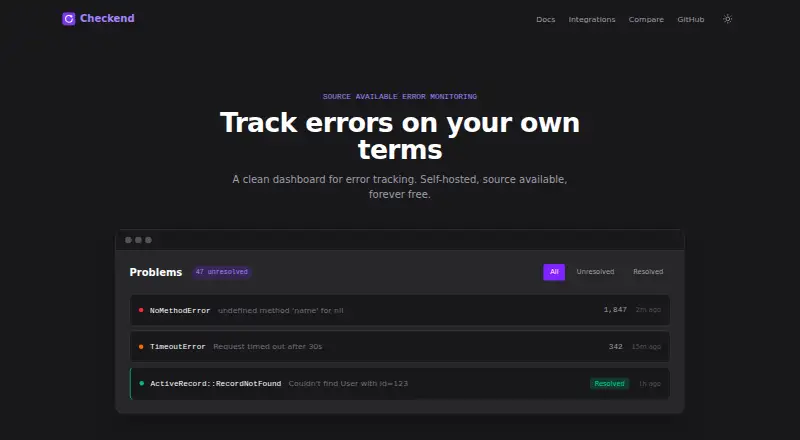
What Checkend is
Checkend is self-hosted error monitoring for applications, with a dashboard for tracking errors while keeping error data on your own servers. Similar errors are grouped automatically through fingerprinting, and teams can define custom fingerprints. Notifications can be routed to email, Slack, Discord, webhooks, or GitHub Issues, with rules configured separately for each app. Teams can invite members by email, assign apps to teams, and use role-based access. A full REST API covers apps, problems, teams, and users, with fine-grained permissions.
Checkend supports frontend monitoring and source maps. Its listed Ruby integrations include Rails, Sinatra, Rack, Sidekiq, and Resque, and a single Ruby SDK serves major Ruby frameworks, web apps, and background jobs. For Python, it captures errors together with tracebacks, request data, and other context. The product can be deployed using one Docker command and uses PostgreSQL without requiring Redis. Checkend describes its source as available under the O'SASSY License and welcomes contributions for additional SDKs. The Free plan costs nothing, billed Forever, with no subscriptions or per-event fees.
Who it suits
Checkend suits developers and teams who want to monitor application errors while keeping the data on infrastructure they control. It is relevant to Ruby and Python projects, as well as teams that need app-level notification rules, role-based access, and API management.
What it does well
- Self-hosting keeps error data on your servers.
- Automatic and custom fingerprints group similar errors.
- Alerts can reach email, Slack, Discord, webhooks, and GitHub Issues.
- Team roles, invitations, and app assignments are supported.
- Ruby integrations and Python error context are available.
- Free plan has no subscriptions or per-event fees.
What to know first
- Self-hosted deployment requires running it on your own infrastructure.
- The listed integrations focus on Ruby and Python.
Limits
The Free plan is self-hosted and costs nothing, billed Forever. It has no subscriptions or per-event fees.
Plans
| Plan | Billed and limits | Price |
|---|---|---|
| Free | Forever · No subscriptions · No per-event fees · Self-hosted | Free |
As checkend.com lists them, read 9 Oct 2026. The maker's own page has the final word.
Getting started
- Open the Checkend website.
- Deploy Checkend with Docker, using PostgreSQL.
- Connect an application using a listed Ruby integration or the Python error reference.
- Configure app fingerprints and notification rules.
- Invite team members and assign apps as needed.
Verdict
Choose Checkend if you want self-hosted error monitoring with team controls, flexible notifications, and no per-event fees. Its listed integrations focus on Ruby and Python, so teams using other stacks should check whether their needs are covered before choosing it.
Questions
What does Checkend cost?
The Free plan costs nothing, billed Forever. It has no subscriptions or per-event fees.
Is Checkend self-hosted?
Yes. It can be deployed with Docker and uses PostgreSQL without requiring Redis. Error data stays on your servers.
Which integrations does Checkend list?
Its Ruby integrations include Rails, Sinatra, Rack, Sidekiq, and Resque. For Python, it captures errors with tracebacks, request data, and other context.
What notification options are available?
Notifications can go to email, Slack, Discord, webhooks, or GitHub Issues, with per-app rules.
Is Checkend open source?
Checkend describes its source as available under the O'SASSY License and welcomes contributions for new SDKs.
What can teams manage through the API?
The full REST API supports managing apps, problems, teams, and users with fine-grained permissions.
Facts from Checkend's own pages
- API
- The full REST API supports managing apps, problems, teams, and users with fine-grained permissions. · checkend.com, 9 Oct 2026
- Data control
- Checkend says that, because it is self-hosted, error data stays on the user's servers. · checkend.com, 9 Oct 2026
- Deployment
- The site says Checkend can be deployed with one Docker command and does not require Redis, using PostgreSQL instead. · checkend.com, 9 Oct 2026
- Grouping
- Automatic fingerprinting groups similar errors, and custom fingerprints are supported. · checkend.com, 9 Oct 2026
- Integrations
- The available Ruby integrations listed are Rails, Sinatra, Rack, Sidekiq, and Resque. · checkend.com, 9 Oct 2026
- Notifications
- Notifications are available through email, Slack, Discord, webhooks, and GitHub Issues, with per-app rules. · checkend.com, 9 Oct 2026
- Open source
- The site describes Checkend as source available under the O'SASSY License and welcomes contributions for new SDKs. · checkend.com, 9 Oct 2026
- Product
- Checkend is self-hosted error monitoring with a dashboard for tracking application errors. · checkend.com, 9 Oct 2026
- Python errors
- The Python error reference says Checkend captures Python errors with tracebacks, request data, and other context. · checkend.com, 9 Oct 2026
- SDK
- The integrations page says one Checkend Ruby SDK works across major Ruby frameworks, including web apps and background jobs. · checkend.com, 9 Oct 2026
- Security
- The site states that Checkend provides encrypted storage for sensitive data, secure tokens, session management, and password history protection. · checkend.com, 9 Oct 2026
- Teams
- Teams support role-based access, email invitations, and assigning apps to specific teams. · checkend.com, 9 Oct 2026
Where Checkend stands on Freedom251
- Error Monitoring Software#7 of 30