Cayley
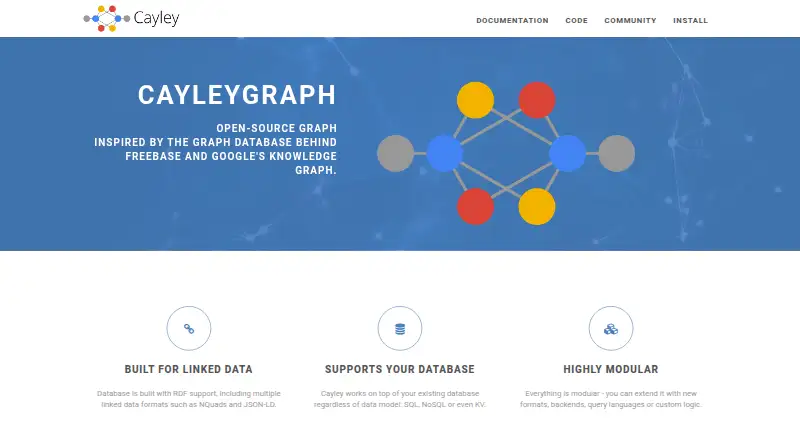
What Cayley is
Cayley is an open-source graph database for storing and querying connected data. It supports RDF and linked data formats such as NQuads and JSON-LD, with Gizmo, a Gremlin dialect, MQL and a GraphQL dialect available for queries. Its storage layer can use SQL, NoSQL or key-value databases. Listed backends include LevelDB, Bolt, MongoDB, Elasticsearch, CouchDB, PouchDB, PostgreSQL, CockroachDB, MySQL, MariaDB and SQLite.
The project includes a query editor, a REPL and a visualizer. The visualizer can show query results as a graph when results carry source and target tags. Cayley also documents HTTP query endpoints for Gizmo, GraphQL and MQL. It can be extended with new formats, storage backends, query languages or custom logic.
Cayley is available for web, API, Linux, macOS and self-hosted use. Installation instructions cover Ubuntu through Snap, macOS through Homebrew, Docker and building from source. The project is licensed under Apache 2.0 and is free to use in any project. Its default in-memory store is suited to datasets that fit in machine memory and workloads that do not require persistence; Bolt is recommended for large datasets or persistent workloads. The project invites users to join its community on Slack or Discourse.
Who it suits
Cayley suits developers and teams building applications around graph data, RDF or linked data who want to choose among several query languages and storage backends. It is also suited to users who can install and operate a self-hosted database and want an Apache 2.0 licensed project.
What it does well
- Supports RDF, NQuads and JSON-LD linked data formats.
- Offers Gizmo, MQL and a GraphQL dialect for queries.
- Works with SQL, NoSQL and key-value storage backends.
- Includes a query editor, REPL and graph visualizer.
- Apache 2.0 licensed and free to use in any project.
What to know first
- The default in-memory store suits only datasets that fit in machine memory.
- Persistent workloads call for a different backend, with Bolt recommended for them.
- Self-hosted deployment requires following installation instructions or building from source.
Limits
The default in-memory store is best for datasets that fit in machine memory and workloads that do not require persistence. Bolt is recommended for large datasets or persistent workloads.
Plans
| Plan | Billed and limits | Price |
|---|---|---|
| Open-source CayleyGraph | Free to use in any project · Apache 2.0 license | Free |
As cayley.io lists them, read 4 Oct 2026. The maker's own page has the final word.
Getting started
- Open https://cayley.io/.
- Choose an installation route: Ubuntu via Snap, macOS via Homebrew, Docker or source build.
- Select a storage backend; the default in-memory store is for data that fits in machine memory without persistence.
- Use the query editor, REPL or HTTP query endpoints for Gizmo, GraphQL or MQL.
- Join the project community on Slack or Discourse.
Verdict
Choose Cayley if you need an open-source graph database with multiple query languages, linked data support and a choice of storage backends. Look elsewhere if the workload needs persistence but cannot use a persistent backend such as Bolt.
Questions
How much does Cayley cost?
The Open-source CayleyGraph plan costs nothing. It is free to use in any project under Apache 2.0.
Can Cayley be self-hosted?
Yes. Self-hosted deployment is supported, and installation guidance covers Snap, Homebrew, Docker and building from source.
Which query languages does Cayley support?
It supports Gizmo, a Gremlin dialect, MQL and a GraphQL dialect. HTTP query endpoints are described for all three.
Which storage backends are listed?
They include LevelDB, Bolt, MongoDB, Elasticsearch, CouchDB, PouchDB, PostgreSQL, CockroachDB, MySQL, MariaDB and SQLite.
What license does Cayley use?
Cayley is developed under the Apache 2.0 license.
Where can users find community support?
The project invites users to join its community on Slack or Discourse.
Facts from Cayley's own pages
- API
- Cayley's documentation describes HTTP query endpoints for Gizmo, GraphQL, and MQL. · cayley.gitbook.io, 4 Oct 2026
- Database integrations
- The configuration guide lists LevelDB, Bolt, MongoDB, Elasticsearch, CouchDB, PouchDB, PostgreSQL, CockroachDB, MySQL, MariaDB, and SQLite backends. · cayley.gitbook.io, 4 Oct 2026
- Data size guidance
- The guide says the default in-memory store is best for datasets that fit in machine memory and workloads that do not require persistence; it recommends Bolt for large datasets or persistent workloads. · cayley.gitbook.io, 4 Oct 2026
- Extensibility
- Cayley can be extended with new formats, backends, query languages, or custom logic. · cayley.io, 4 Oct 2026
- Installation
- The installation guide gives instructions for Ubuntu via Snap, macOS via Homebrew, Docker, and building from source. · cayley.gitbook.io, 4 Oct 2026
- License
- Cayley is developed under the Apache 2.0 license and is free to use in any project. · cayley.io, 4 Oct 2026
- Linked data
- Cayley supports RDF and linked data formats including NQuads and JSON-LD. · cayley.io, 4 Oct 2026
- Query languages
- Cayley supports Gizmo, described as a Gremlin dialect, MQL, and a GraphQL dialect. · cayley.io, 4 Oct 2026
- Query tools
- Cayley includes a query editor, visualizer, and REPL. · github.com, 4 Oct 2026
- Storage
- Cayley works on top of SQL, NoSQL, or key-value databases. · cayley.io, 4 Oct 2026
- Support and community
- The project invites users to join its community on Slack or Discourse. · cayley.io, 4 Oct 2026
- Visualization
- The UI overview says the visualizer can display query results as a graph when results are tagged with source and target. · cayley.gitbook.io, 4 Oct 2026
- What it does
- Cayley is an open-source graph database inspired by the graph database behind Freebase and Google's Knowledge Graph. · cayley.io, 4 Oct 2026
Where Cayley stands on Freedom251
- Graph Databases#6 of 39