
Apache HugeGraph
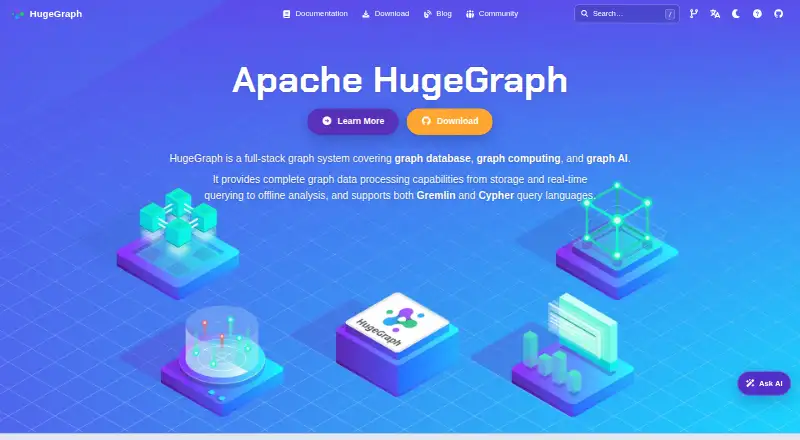
What Apache HugeGraph is
Apache HugeGraph is a graph system combining a database, graph computing, and graph AI. It supports Gremlin and Cypher/OpenCypher queries, a REST API, ACID transactions, graph algorithms, and vector search. HugeGraph-AI includes Python clients, graph machine-learning tools, and LLM tools for knowledge graph construction and GraphRAG. The Server supports RocksDB for standalone storage, HStore for distributed storage, and HBase. Its toolchain covers graph loading, visualization, backup, restore, and migration; Hubble provides a web interface for graph visualization and management. Documentation describes standalone deployments up to 2 TB and distributed deployments up to 1 PB. The project also describes high-speed imports and millisecond-level real-time queries for graph data at a scale of hundreds of billions. It runs on Linux and macOS and can be self-hosted. The open-source plan is free. Java 11 is recommended for downloads and required from version 1.5.0. Authentication is disabled by default, so production deployments need careful access configuration.
Who it suits
It suits teams building or operating graph applications that need Gremlin or Cypher queries, graph computing, or GraphRAG tools. It may also suit organizations that can manage a self-hosted deployment and its security configuration.
What it does well
- Supports Gremlin and Cypher/OpenCypher queries.
- Includes graph algorithms, ACID transactions, and vector search.
- Hubble offers web-based graph visualization and management.
- Integrates with Spark and SeaTunnel; compatible with Hadoop and Flink.
- Open-source plan costs nothing.
What to know first
- Authentication is disabled by default.
- Java 11 is required from version 1.5.0.
- Known CVEs are listed for Server and Hubble.
Limits
The listed open-source plan costs nothing and covers the self-hosted graph database and related components. No plan quota or feature cap is stated in the supplied facts.
Plans
| Plan | Billed and limits | Price |
|---|---|---|
| Apache HugeGraph (open source) | Self-hosted graph database and related components | Free |
As hugegraph.apache.org lists them, read 7 Oct 2026. The maker's own page has the final word.
Getting started
- Visit the Apache HugeGraph website and review the download documentation.
- Prepare Java 11; it is required starting with version 1.5.0.
- Choose a standalone or distributed deployment and a supported storage backend.
- Enable authentication and authorization, maintain an IP allowlist, and restrict public access to query endpoints.
- Use the Apache community, GitHub issues or discussions, mailing list, or Slack for help.
Apache HugeGraph is an open-source graph system that combines a database, graph computing and AI tools. It is best suited to teams building graph-backed applications that can manage their own infrastructure. Its broad scope is compelling, but production use calls for deliberate security configuration.
Overview
HugeGraph supports Gremlin and Cypher/OpenCypher, a REST API, ACID transactions and graph algorithms. Its Server can use RocksDB for standalone storage, HStore for distributed storage, or HBase. That choice gives teams options for different deployment models, but also puts storage selection and operation in their hands.
The project says HugeGraph supports high-speed imports and millisecond-level real-time queries across up to hundreds of billions of graph data. Its documentation describes standalone deployments up to 2 TB and distributed deployments up to 1 PB. These stated scales make it a candidate for substantial workloads, though teams still need to plan deployment and capacity around their own needs.
Key features
Queries and graph workloads
Gremlin and Cypher/OpenCypher give teams two ways to express graph queries, while the REST API offers an interface for other applications and services. ACID transactions suit workloads that need transactional guarantees, and graph algorithms extend the system beyond storing and querying connected data.
AI and integrations
HugeGraph-AI provides Python clients, graph machine-learning tools and LLM tools for knowledge-graph construction and GraphRAG applications. This makes the project relevant to teams that want graph data in AI workflows without treating AI tooling as a separate product. Integration documentation covers Spark and SeaTunnel, with compatibility for Hadoop and Flink, which may help fit HugeGraph into existing data pipelines.
Management tools
The HugeGraph toolchain includes graph loading, visualization, backup, restore and migration tools. Hubble supplies a web interface for visualization and management. That bundled tooling can reduce the need to assemble separate utilities, although it does not remove the work of operating a self-hosted system.
Security and operation
Authentication is disabled by default, so teams should enable authentication and authorization, maintain an IP allowlist and keep query endpoints from direct public exposure in production. The built-in StandardAuthenticator supports multiple users and fine-grained permissions; teams can also implement custom authentication through HugeAuthenticator. The project lists known CVEs for HugeGraph Server and Hubble and asks users to report security issues privately through its dedicated channel first. These safeguards give operators a path to tighten access, but security setup is a necessary part of deployment, not an optional finishing step.
Pricing
Apache HugeGraph (open source): free. The plan includes a self-hosted graph database and related components. The project is open source, describes itself as an Apache top-level project built in the open, and the HugeGraph-AI documentation identifies the Apache License 2.0. There is no paid tier or trial to weigh against the free plan in the plan described here; the trade-off is that teams run the software themselves.
HugeGraph is a fit for organizations that want control over deployment and can provide the operational expertise. It is less suitable for buyers who need a hosted service or want infrastructure management included.
Platforms
HugeGraph supports API access and is available for Linux and macOS in self-hosted deployments, with web access through its tools. The download page recommends Java 11 and requires it starting with version 1.5.0, an important runtime requirement for teams planning installation.
Who it's for
Choose HugeGraph if your team needs a self-managed graph system that spans database, computation and AI use cases, or if its query languages, storage choices and data-pipeline integrations fit an existing architecture. It is also worth considering for large graph workloads, given the scale the project says it supports.
Look elsewhere if you need a hosted, turnkey graph database, or cannot take responsibility for securing and maintaining query endpoints. Community support runs through the Apache community, GitHub issues and discussions, a developer mailing list and Slack; teams should be prepared to work through those channels rather than rely on a paid support plan in this offering.
Pros and cons
Pros
- Broad graph stack: database, graph computation, AI tools and management utilities sit within one project.
- Flexible access and storage: Gremlin, Cypher/OpenCypher and REST API access pair with RocksDB, HStore and HBase options.
- Useful AI and pipeline reach: GraphRAG and graph machine-learning tools complement documented Spark and SeaTunnel integrations and Hadoop and Flink compatibility.
- Free and open source: the self-hosted plan costs nothing, leaving deployment choices with the team.
Cons
- Operators own production readiness: authentication is off by default, and the project recommends several safeguards before exposing query endpoints.
- Java is required: version 1.5.0 and later require Java 11, adding a runtime dependency to deployment planning.
- Self-hosting is part of the deal: there is no hosted plan in the offering described, so teams must manage their own infrastructure.
Alternatives
Browse graph databases to compare more options. Consider these alternatives when their pricing or platform details better match your requirements:
- LadybugDB is another free, MIT-licensed option, with pre-compiled binaries and support across mobile, desktop, web and API platforms.
- ArcadeDB is worth considering if you want its free Community plan, which is billed forever and includes its full feature set, documentation and community support.
- Sparksee may suit academic users: it offers a free academic licence that requires a valid university or school ID, as well as a free trial.
- AllegroGraph has a free plan capped at 5 Million Triples, while its Enterprise plan uses customized quotes; consider it if that cap or its enterprise pricing model fits your needs.
- GraphDB offers a free plan with one query in parallel and five repositories, among other limits; it may suit teams whose workload fits those constraints.
- Memgraph offers a free, open-source Community Edition with an in-memory graph database and ACID transactions with on-disk persistence; consider it if that model fits your workload.
- NebulaGraph has a free Apache 2.0 open-source edition described as a subset of core features, with community collaboration and support; its free trial may also help teams evaluate it.
- OrientDB offers a free Community database distribution, with a separate Basic support plan at €1,000 a month.
Verdict
Apache HugeGraph is a strong choice for technically capable teams that want a free, self-hosted graph platform spanning storage, queries, computation and AI tooling. Its breadth and stated scale are the main reasons to choose it; the need to run the infrastructure and secure access controls carefully are the main reasons to look elsewhere.
Verdict
Apache HugeGraph brings graph storage, computation, AI tooling, and management utilities into one open-source system. Account for the Java requirement and configure access controls before exposing query endpoints in production.
Questions
How much does Apache HugeGraph cost?
The open-source plan costs nothing.
Is there a free plan or trial?
The project lists a free open-source plan. There is no free trial.
Which platforms does it support?
The listed platforms are API, Linux, macOS, self-hosted, and web.
Which query languages can I use?
HugeGraph supports Gremlin and Cypher/OpenCypher, as well as a REST API.
What storage backends does the Server support?
RocksDB is the default standalone backend. HStore supports distributed storage, and HBase is also supported.
How is access controlled?
Authentication is disabled by default. Built-in StandardAuthenticator supports multi-user authentication and fine-grained permissions; custom authentication can be implemented through HugeAuthenticator.
Facts from Apache HugeGraph's own pages
- Access control
- HugeGraph supports multi-user authentication and fine-grained access control, including dynamically assigning or revoking permissions. · hugegraph.apache.org, 7 Oct 2026
- AI features
- HugeGraph-AI provides Python clients, graph machine learning tools, and LLM tools for knowledge graph construction and GraphRAG applications. · hugegraph.apache.org, 7 Oct 2026
- Community support
- The project points users to its Apache Slack channel for community discussions and welcomes contributions through GitHub pull requests. · hugegraph.apache.org, 7 Oct 2026
- Deployment
- The documentation describes standalone deployments up to 2 TB and distributed deployments up to 1 PB. · hugegraph.apache.org, 7 Oct 2026
- Graph AI
- HugeGraph-AI provides GraphRAG, graph machine learning, and a Python client. · hugegraph.apache.org, 7 Oct 2026
- Integrations
- The project documents integration with Spark and SeaTunnel and compatibility with Hadoop and Flink. · hugegraph.apache.org, 7 Oct 2026
- License
- The HugeGraph-AI documentation identifies Apache License 2.0. · hugegraph.apache.org, 7 Oct 2026
- Product
- Apache HugeGraph is a graph system covering graph database, graph computing, and graph AI. · hugegraph.apache.org, 7 Oct 2026
- Project status
- Apache HugeGraph describes itself as an Apache top-level project built in the open. · hugegraph.apache.org, 7 Oct 2026
- Queries
- The system supports Gremlin and Cypher query languages and provides a REST API. · hugegraph.apache.org, 7 Oct 2026
- Runtime requirement
- The download page recommends Java 11 and says Java 11 is required starting with version 1.5.0. · hugegraph.apache.org, 7 Oct 2026
- Scale
- The project says it supports high-speed import and millisecond-level real-time queries for up to hundreds of billions of graph data. · hugegraph.apache.org, 7 Oct 2026
- Security
- User authentication is disabled by default; the project advises enabling authentication and authorization, maintaining an IP allowlist, and avoiding direct public exposure of query endpoints in production. · hugegraph.apache.org, 7 Oct 2026
- Security advisories
- The security page lists known CVEs for HugeGraph Server and Hubble and provides a private channel for reporting security issues. · hugegraph.apache.org, 7 Oct 2026
- Security configuration
- Authentication is disabled by default; the security guide recommends enabling authentication and authorization, maintaining an IP allowlist, and restricting public access to query endpoints. · hugegraph.apache.org, 7 Oct 2026
- Security reporting
- The project asks users to report security issues privately to its dedicated security mailing list first. · hugegraph.apache.org, 7 Oct 2026
- Storage
- The Server supports RocksDB as its default standalone backend, HStore for distributed storage, and HBase. · hugegraph.apache.org, 7 Oct 2026
- Support
- The project directs users to its Apache community, GitHub issues and discussions, developer mailing list, and Slack channel. · hugegraph.apache.org, 7 Oct 2026
- Toolchain
- The HugeGraph toolchain includes graph loading, visualization, backup, restore, and migration tools. · hugegraph.apache.org, 7 Oct 2026
- Visualization
- HugeGraph Toolchain includes Hubble, a web UI for graph visualization and management. · hugegraph.apache.org, 7 Oct 2026
Where Apache HugeGraph stands on Freedom251
- Graph Databases#5 of 39