Freedom251 › Network as a Service (NaaS) Platforms
Cato SASE Platform
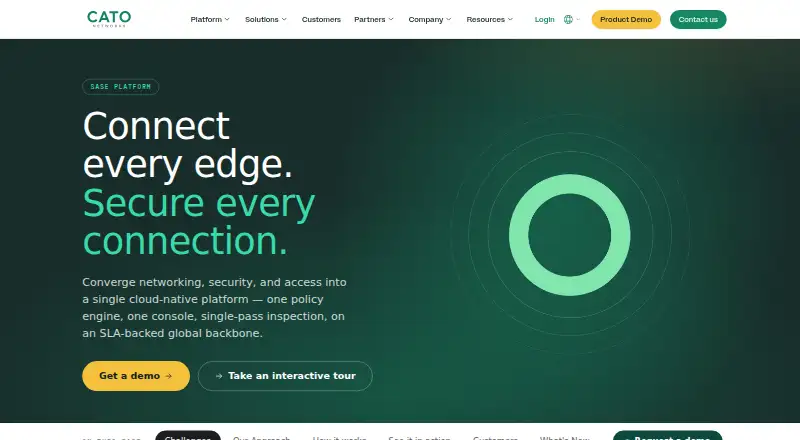
What Cato SASE Platform is
Cato SASE Platform brings networking, security, and private application access into a cloud-native service managed through one console and shared policy engine. Its backbone provides global connectivity, network segmentation, and multi-cloud access. Security features include firewall-as-a-service, secure web gateway, intrusion and malware prevention, DNS security, and remote browser isolation, using single-pass inspection. Users can access private applications through a ZTNA client, Enterprise Browser, or clientless portal; browser access also reaches hosted applications and RDP or SSH resources without installing the Cato Client. Other capabilities include SD-WAN, CASB, DLP, XDR, endpoint protection, digital experience monitoring, and a platform API. The Integration Hub lists 100 integrations, though some third-party integrations require a license. The Cato Client is available for Windows, macOS, Linux, iOS, and Android, with support depending on operating-system and client versions. Pricing is on request. Cato Networks was founded in 2015 and is based in Tel Aviv, Israel.
Who it suits
It suits organizations seeking a cloud-delivered platform for network connectivity, security, and private application access. Its client supports Windows, macOS, Linux, iOS, and Android, subject to version requirements.
What it does well
- Combines networking, security, and access in one platform.
- Provides global connectivity, segmentation, and multi-cloud access.
- Offers clientless browser access to hosted apps and RDP or SSH.
- Lists 100 integrations across several categories.
What to know first
- Pricing is available on request.
- Some third-party integrations require a license.
- Client support depends on operating-system and client versions.
Limits
Pricing is by request, and some third-party integrations require a license. Cato Client support depends on operating-system and client versions.
Plans
| Plan | Billed and limits | Price |
|---|---|---|
| Basic | Per User, Per Year · Capterra listing · free version not included | $1 a year |
| Cato SASE Platform | Pricing by request; contact sales for a tailored discussion | On request |
| SASE Cloud Platform | Contact Cato for pricing · Custom enterprise quote · platform modules and licenses vary | On request |
As catonetworks.com lists them, read 21 Oct 2026. The maker's own page has the final word.
Getting started
- Visit the Cato SASE Platform website.
- Contact Cato for a tailored pricing discussion.
- Choose an access route: Cato Client, Enterprise Browser, or clientless portal.
- Install the Cato Client on a supported platform if using client-based access.
- Review the Integration Hub and confirm licensing for required third-party integrations.
Cato SASE Platform is a cloud-delivered service that unifies enterprise networking, security, and private-application access. It suits organizations replacing separate branch, security, and remote-access tools with one policy and console. The trade-off is a sales-led purchase whose licensing and client-version requirements need careful confirmation.
Overview
Cato uses a cloud-native backbone for global connectivity, segmentation, branch connectivity, and multi-cloud access. A shared policy engine and single-pass inspection are intended to keep network and security controls consistent rather than managing parallel systems. That architecture is most compelling for distributed organizations that want one operating model across users, branches, and cloud environments.
Remote users have several access paths: a ZTNA client, Enterprise Browser, or clientless portal. Browser access can reach hosted applications plus RDP and SSH resources without installing the Cato Client, which is useful for contractors, unmanaged devices, or quick administrative sessions.
See the wider category in Secure Access Service Edge Software.
Key features
Unified network and security stack
Firewall-as-a-service, secure web gateway, intrusion prevention, malware prevention, DNS security, and remote browser isolation cover the principal inspection and policy layers. SD-WAN, CASB, DLP, XDR, endpoint protection, digital experience monitoring, and a platform API extend the scope beyond a basic secure gateway. The breadth can reduce product sprawl, but buyers should map which capabilities they will actually license and operate.
Private access and client coverage
The Cato Client supports Windows, macOS, Linux, iOS, and Android. Support depends on operating-system and client versions, so mixed or older endpoint estates should be checked before rollout. Clientless browser access provides a practical fallback where installing software is undesirable.
Integrations and compliance
Cato’s Integration Hub lists 100 integrations spanning authentication, asset management, EDR, ITSM, SaaS security, and SIEM. Licensing is not uniform: some integrations are included in the default account license while others require an additional license. The Trust Center lists SOC 2 Type II, PCI, ISO 27001:2022, ISO 27701, GDPR, HIPAA, and other compliance badges, useful for organizations with formal assurance requirements.
Pricing
Cato SASE Platform uses paid, cloud delivery with pricing by request. Contact sales for a tailored discussion; no public seat price, quota, trial term, renewal term, or free-plan cap is provided. That suits larger deployments needing a scoped package, but makes direct budget comparison difficult. Ask specifically which security modules and third-party integrations carry separate licenses, and which client versions are supported for the intended endpoint mix.
Platforms
The service is available through web access, an API, and clients for Windows, macOS, Linux, iOS, and Android. Browser-based access can reach hosted applications and RDP or SSH resources without the client. This broad endpoint coverage is valuable for mobile and distributed workforces, subject to version support.
Who it's for
Cato is a strong fit for organizations with multiple branches, cloud environments, and remote users that want networking, secure web access, zero-trust private access, and data controls governed together. It is less suitable when a transparent self-serve price, a permanent free tier, or narrowly focused firewall functionality is the priority.
Pros and cons
- Pro: One policy engine and console span connectivity, segmentation, security inspection, and access.
- Pro: ZTNA client, Enterprise Browser, and clientless portal cover different private-application access scenarios.
- Pro: Broad endpoint support and 100 listed integrations can fit heterogeneous estates.
- Con: Pricing is sales-led, with no published plan cost or usage limits for straightforward comparison.
- Con: Some integrations require separate licensing, and client support varies by operating-system and client version.
Alternatives
Cloudflare One is the better starting point for a freemium option with a $0 forever plan for up to 50 users and 24-hour standard log retention. Choose Pangolin when a free tier with explicit limits—five users, sites, and domains—is appropriate. Arista NG Firewall fits buyers seeking a web-based firewall with a free plan and limited capabilities.
Fortinet Unified SASE is an alternative for teams wanting named Standard and Advanced tiers, up to three devices per user, Fortinet cloud locations, 24x7 premium support, and a REST API. Sangfor EasyConnect provides a paid, cross-platform remote-access option. Broadcom Symantec SASE suits organizations seeking annual per-user Symantec SSE licensing with cloud and on-premises options. Skyhigh Private Access is another paid private-access choice. Cloudbrink Personal SASE is worth considering for a limited free trial covering up to three people per organization.
For adjacent categories, compare Network Firewall Software and Business VPN Software.
Verdict
Choose Cato SASE Platform when you need a broad, cloud-native SASE stack with unified policy, branch and multi-cloud connectivity, and multiple private-access methods. Look elsewhere if transparent pricing, a free tier, or tightly bounded firewall-only functionality matters more than consolidating network and security operations.
Verdict
Cato SASE Platform combines a broad set of network, security, and access capabilities with several ways to reach private applications. Organizations should confirm pricing, integration licensing, and client-version support for their requirements.
Questions
How much does Cato SASE Platform cost?
Pricing is available on request. Cato directs prospective customers to contact sales for a tailored discussion.
Which platforms are supported?
The listed platforms are Android, API, iOS, Linux, macOS, web, and Windows. Cato Client support depends on operating-system and client versions.
Can users access private applications without installing the client?
Yes. Users can use an Enterprise Browser or clientless portal; browser-based access can reach hosted applications and RDP or SSH resources without the Cato Client.
What integrations are available?
Cato’s Integration Hub lists 100 integrations across categories including authentication, asset management, EDR, ITSM, SaaS security, and SIEM. Some third-party integrations require a license.
What security capabilities are listed?
The platform lists firewall-as-a-service, secure web gateway, intrusion and malware prevention, DNS security, remote browser isolation, CASB, DLP, XDR, and endpoint protection.
Where is Cato Networks based?
Cato Networks was founded in 2015 and is based in Tel Aviv, Israel.
Facts from Cato SASE Platform's own pages
- Additional capabilities
- Other listed capabilities include SD-WAN, CASB, DLP, XDR, endpoint protection, digital experience monitoring, and a platform API. · catonetworks.com, 30 Sept 2026
- AI security
- AI Security discovers and categorizes public AI usage, enforces intent-based policies and detects attacks such as prompt injection and jailbreaks against private AI. · catonetworks.com, 21 Oct 2026
- API
- Cato exposes a public GraphQL API with schema introspection, permission-controlled queries and APIs marked as rollout, beta or early-access. · api.catonetworks.com, 21 Oct 2026
- Automation
- The integration documentation lists an included Terraform provider for infrastructure-as-code and DevOps automation. · knowledge.catonetworks.com, 21 Oct 2026
- Browser access
- Browser-based remote access can reach hosted applications and RDP or SSH resources without installing the Cato Client. · support.catonetworks.com, 30 Sept 2026
- CASB and DLP
- CASB provides sanctioned and unsanctioned application visibility while DLP applies granular data policies across on-premises and cloud destinations. · catonetworks.com, 21 Oct 2026
- Client platforms
- The Cato Client is available for Windows, macOS, Linux, iOS, and Android, with support depending on operating-system and client versions. · support.catonetworks.com, 30 Sept 2026
- Cloud on-ramps
- Cloud connectivity can use vSocket appliances, provider cross-connects or IPSec tunnels to AWS, Azure, GCP, Oracle and other environments. · knowledge.catonetworks.com, 21 Oct 2026
- Company
- Cato Networks says it was founded in 2015 and is based in Tel Aviv, Israel. · catonetworks.com, 30 Sept 2026
- Company legal name
- Crunchbase identifies the company as Cato Networks Ltd., founded by Gur Shatz and Shlomo Kramer. · crunchbase.com, 21 Oct 2026
- Company location and size
- Gartner lists headquarters in Tel Aviv, Israel, year founded 2015 and 1,001–5,000 employees. · gartner.com, 21 Oct 2026
- Compliance
- Cato’s Trust Center lists SOC 2 Type II, PCI, ISO 27001:2022, ISO 27701, GDPR, HIPAA, and other compliance badges. · security.catonetworks.com, 30 Sept 2026
- Digital experience monitoring
- Cato DEM uses synthetic probes and AI/ML monitoring for internet, SaaS and WAN applications without sensor deployment. · catonetworks.com, 21 Oct 2026
- Documentation
- The vendor provides a searchable knowledge center with client installation, integrations, licensing and configuration articles. · knowledge.catonetworks.com, 21 Oct 2026
- Downloads
- Windows, macOS and Linux clients are distributed through a download portal, while iOS and Android clients come from their app stores. · knowledge.catonetworks.com, 21 Oct 2026
- Endpoint security
- The Cato Client includes endpoint protection and detection capabilities and forwards endpoint context into Cato XDR. · catonetworks.com, 21 Oct 2026
- Firewall and segmentation
- FWaaS controls traffic across ports, protocols and directions and segments networks using identities, applications, services and VLANs. · catonetworks.com, 21 Oct 2026
- Founded
- 2015 · catonetworks.com, 23 Sept 2026
- Global backbone
- The platform uses an SLA-backed private backbone with more than 85 physical points of presence. · catonetworks.com, 21 Oct 2026
- Headquarters
- Tel Aviv, Israel · catonetworks.com, 23 Sept 2026
- Integration licensing
- Cato’s support documentation says some third-party integrations are included with the default account license and others require a license. · support.catonetworks.com, 30 Sept 2026
- Integrations
- Published integrations include Microsoft Entra ID, Okta, Google, CrowdStrike, Microsoft Defender, SentinelOne, Salesforce, Slack, Microsoft 365, Splunk, Sentinel, AWS S3 and Azure Blob. · knowledge.catonetworks.com, 21 Oct 2026
- Licence and hosting
- Cato’s master agreement assigns service, hardware, scripts and API-tool intellectual-property rights to Cato or its licensors, indicating proprietary software rather than open source, and the service is cloud delivered. · catonetworks.com, 21 Oct 2026
- Limit: client reliability
- App Store reviewers report authentication or connection failures after an iPhone update and problems using an HTTP proxy while on VPN. · apps.apple.com, 21 Oct 2026
Where Cato SASE Platform stands on Freedom251
- Network as a Service (NaaS) Platforms#8 of 25
- Network Firewall Software#12 of 37
- Secure Access Service Edge Software#8 of 24
- Zero Trust Architecture Software#8 of 19
- Zero Trust Platforms#13 of 23
- Business VPN Software#58 of 94
- Connectivity Solutions#17 of 23