Freedom251 › Competency Management Software
CaSS
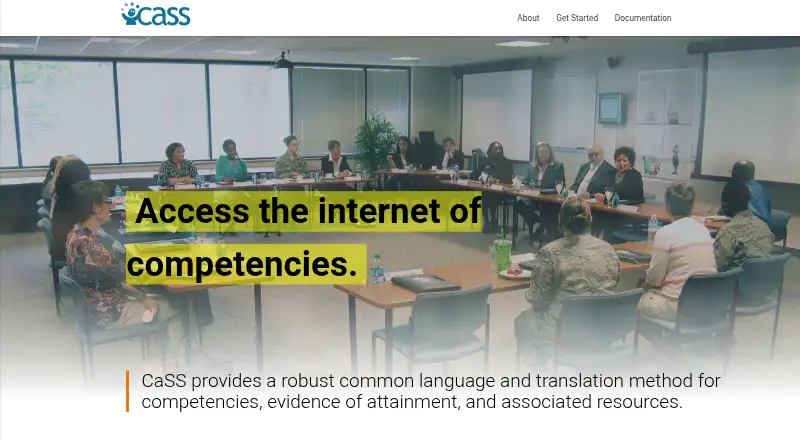
What CaSS is
CaSS is an open-source system for describing competencies, evidence of attainment, and related resources in a form that different systems can translate and exchange. It can help users discover courses, assessments, books, and games through competencies and framework alignments. CaSS stores competency-based profiles, transcripts, badges, and credentials for training, credentialing, and career management. Its developer tools include a REST JSON-LD API, a JavaScript library for browser and Node.js environments, and adapters for IMS CASE, Open Badges, xAPI, and JSON-LD. Assessment evidence can include scored xAPI events, self-declarations, activity completion, supervisor observation, and tests. Organizations can configure who may view, access, or edit competency information. Deployment options include public or private cloud and federated architectures, with lightweight or stronger-cryptography configurations. CaSS is released under the Apache 2.0 license for commercial and non-commercial use and modification, and code is available to host an instance. Eduworks also offers a hosted, customizable, supported service. The project began in 2015 with US Department of Defense Advanced Distributed Learning Initiative funding, which the project page says continues.
Who it suits
CaSS suits organizations that need to exchange competency data across systems or manage competency profiles, transcripts, badges, and credentials. It may fit teams choosing between self-hosting and a hosted service, including educational institutions, businesses, and government agencies.
What it does well
- Apache 2.0 licensing permits commercial and non-commercial adoption.
- Supports REST JSON-LD APIs and a JavaScript library.
- Adapters include IMS CASE, Open Badges, and xAPI.
- Access controls can be customized.
- Can be deployed in cloud or federated architectures.
What to know first
- Self-hosting requires hosting an instance from the available code.
- Hosted service details require contacting Eduworks.
- Competency exchange depends on system integrations and adapters.
Getting started
- Visit the CaSS website.
- Choose a deployment approach: host an instance from the code, or use a public or private cloud solution.
- Configure access controls for who can view, access, and edit competencies.
- Use the API, JavaScript library, or adapters to work with competency data.
- For Eduworks’ hosted service, contact [email protected].
CaSS is open-source infrastructure for sharing competency definitions, evidence, and related learning resources between otherwise incompatible systems. It fits education, training, credentialing, and workforce programs that need portable records and developer-level integration. The trade-off is that implementation and deployment choices sit largely with the adopting organization rather than behind a fixed subscription package.
Overview
CaSS establishes common identifiers and translation methods so competency data can move between systems with different structures. This is valuable when profiles, transcripts, badges, or credentials must flow among learning platforms, credentialing services, and career-management tools instead of remaining trapped in one product.
Competencies can be aligned to courses, assessments, books, and games, allowing those resources to be discovered through a competency or framework relationship. Evidence models cover assessments, scored xAPI events, self-declarations, completed activities, supervisor observations, and tests, giving institutions multiple ways to record attainment.
Key features
Integration and exchange
A REST JSON-LD API and JavaScript library for browser and Node.js applications provide a practical foundation for custom integrations. Adapters for IMS CASE, Open Badges, xAPI, and JSON-LD reduce the work of connecting common competency and credential formats. Import and export as linked data, plus API connections to learning-management systems and O*NET, suit organizations with existing data pipelines. The benefit is broad interoperability; the cost is that teams must still map their own systems and maintain those connections.
Records, discovery, and control
CaSS stores competency-based profiles, transcripts, badges, and credentials for training, credentialing, and career use. Alignment-based discovery links those records to relevant learning resources. Configurable permissions determine who may view, access, or edit competency information, so administrators can shape governance for public, private, or federated deployments.
Security and architecture
The developer overview describes a no-knowledge security model in which the server cannot access unencrypted private data or user credentials. Deployments can range from a lightweight open system to one using strong cryptography, and can operate in public or private clouds or a federated architecture. These options are useful for organizations with specific privacy or sovereignty requirements, but they also place architectural decisions and operational responsibility on the customer.
Pricing
CaSS is free and released under the Apache 2.0 license, permitting commercial and non-commercial use, modification, and self-hosting. That makes it suitable for organizations able to fund implementation internally or through a technology partner, without per-seat licensing for the software itself.
Eduworks also provides a hosted, customizable, supported software-as-a-service offering for businesses, academic institutions, and government agencies. It has custom pricing; contact [email protected] for assistance. Hosted service removes some infrastructure work, while self-hosting offers more control over architecture and data but requires the organization to operate the instance.
Platforms
CaSS is offered for web use, API integration, Linux, Windows, and self-hosted deployment. The JavaScript library supports browser and Node.js environments, making it adaptable to both web applications and server-side services.
Who it's for
CaSS is a strong choice for universities, training providers, credentialing bodies, government programs, and employers building competency-based education or workforce systems across multiple platforms. It is especially appropriate where open standards, linked-data exchange, configurable permissions, or federated architecture matter.
It is less suitable for a small team wanting an immediately packaged skills-management application with transparent seat pricing and minimal integration work. Those buyers may prefer a conventional subscription product unless they specifically need CaSS's interoperability model or self-hosting rights.
Pros and cons
- Pros: Apache 2.0 licensing supports commercial adoption, modification, and self-hosting.
- Pros: Global identifiers, REST JSON-LD APIs, linked-data import/export, and adapters support exchange across varied systems.
- Pros: Profiles, transcripts, badges, credentials, and several evidence types cover education and workforce use cases.
- Pros: Configurable access controls and no-knowledge security architecture support demanding privacy models.
- Cons: Self-hosting and integration require technical resources to design, operate, and govern the deployment.
- Cons: The hosted service uses custom pricing, so budget comparisons are not immediate.
Alternatives
For a broader directory of options, browse Competency Management Software or Skills Management Software.
- Skima is a free, self-hostable option spanning Linux, macOS, Windows, and web, with a commercial license available.
- MyPass Global Competency Management suits personnel wanting a free Worker Skills Passport on Android, iOS, web, and API-connected environments; employer subscriptions are custom.
- Klayo Workforce Intelligence offers a web free tier with courses, certificate uploads, public profiles, and limited intelligence features.
- Skiloope is aimed at small teams, with a free Starter plan for up to five members and role-based skills matrices.
- TalentClick provides a free basic account with one 30-day assessment link and up to 20 free AVP uses, plus a trial.
- Kahuna Skills Manager is a paid Android, iOS, and web alternative.
- Noova Skill Framework is a paid Android, iOS, and web product with a free trial.
- Sphere Competency Management is a free option for Android, iOS, web, API, and self-hosted environments.
Verdict
Choose CaSS when your organization needs competency records to travel across systems and wants Apache-licensed code, flexible deployment, and developer-accessible APIs. Look elsewhere if you need a ready-made, transparently priced subscription with little infrastructure or integration responsibility.
Verdict
CaSS focuses on making competency information portable and usable across different systems. Its open-source code, configurable access controls, and hosted option offer different deployment paths.
Questions
Is CaSS free?
CaSS is listed as free and open source under the Apache 2.0 license.
Can a business use and modify CaSS?
Yes. The Apache 2.0 license permits commercial and non-commercial adoption and modification.
Can I host CaSS myself?
Yes. Code is available to host an instance.
Is there a hosted version?
Eduworks offers CaSS as hosted, customizable, supported software as a service.
What API and integrations does CaSS support?
It has a REST JSON-LD API, a JavaScript library for browser and Node.js environments, and adapters for IMS CASE, Open Badges, xAPI, and JSON-LD.
What kinds of assessment evidence can CaSS handle?
Listed methods include assessments, scored xAPI events, self-declarations, activity completion, supervisor observation, and tests.
Facts from CaSS's own pages
- Access controls
- The product offers configurable controls over who can view, access, and edit competencies. · cassproject.org, 9 Oct 2026
- API and integrations
- The current developer overview describes a REST JSON-LD API, a JavaScript library for browser and Node.js environments, and adapters including IMS CASE, Open Badges, xAPI, and JSON-LD. · docs.cassproject.org, 4 Oct 2026
- Competency exchange
- CaSS uses global identifiers and APIs to define and share competencies across systems. · cassproject.org, 9 Oct 2026
- Competency records
- CaSS can store competency-based profiles, transcripts, badges, and credentials for training, credentialing, and career management. · cassproject.org, 4 Oct 2026
- Deployment
- CaSS can be deployed as a public or private cloud based solution, and its open source code can be used to host an instance. · cassproject.org, 9 Oct 2026
- Discovery
- CaSS supports finding learning resources, including courses, assessments, books, and games, through competencies and framework alignments. · cassproject.org, 4 Oct 2026
- Formats and APIs
- CaSS supports importing and exporting competencies in common formats and describes API integrations with learning management systems and sources such as O*NET. · cassproject.org, 4 Oct 2026
- Funding and project history
- The project began in 2015 with funding from the US Department of Defense Advanced Distributed Learning Initiative, which the page says continues to support and fund CaSS. · cassproject.org, 4 Oct 2026
- Hosted offering
- Eduworks offers hosted, customizable, supported CaSS software as a service to businesses, academic institutions, and government agencies; the page gives no price and directs interested parties to email. · cassproject.org, 9 Oct 2026
- Hosted service
- Eduworks offers CaSS as hosted, customizable, supported software as a service to businesses, academic institutions, and government agencies. · cassproject.org, 4 Oct 2026
- Import and export
- CaSS supports importing and exporting competencies in commonly used formats as linked data, and describes integration with learning management systems and O*NET through APIs. · cassproject.org, 9 Oct 2026
- Interoperability
- CaSS is designed to translate and exchange competency data between systems with different structures. · cassproject.org, 4 Oct 2026
- License
- CaSS is released under the Apache 2.0 license for commercial and noncommercial adoption and modification. · cassproject.org, 9 Oct 2026
- Mission and audience
- The project aims to support competency based education, training, and credentialing through open source infrastructure and tools. · cassproject.org, 9 Oct 2026
- Open source
- CaSS is released under the Apache 2.0 license for commercial and non-commercial adoption and modification, and code is available to host an instance. · cassproject.org, 4 Oct 2026
- Profiles and credentials
- CaSS stores and provides access to competency based profiles, transcripts, badges, and credentials for training, credentialing, and career management. · cassproject.org, 9 Oct 2026
- Project history
- The project began in 2015 with funding from the US Department of Defense Advanced Distributed Learning Initiative, which the page says continues to support and fund it. · cassproject.org, 9 Oct 2026
- Purpose
- CaSS provides a common language and translation method for competencies, evidence of attainment, and associated resources. · cassproject.org, 9 Oct 2026
- Resource discovery
- CaSS uses alignments to find resources such as courses, assessments, books, and games that support competencies and frameworks. · cassproject.org, 9 Oct 2026
- Security
- CaSS can be configured as a lightweight open system or a highly secure system with strong cryptography, and blockchain can be used for authorized, verifiable competency records. · cassproject.org, 9 Oct 2026
- Security architecture
- The current developer overview says CaSS uses a no-knowledge security architecture in which the server does not access unencrypted private data or user credentials. · docs.cassproject.org, 4 Oct 2026
- Support contact
- The maker directs interested users to contact [email protected] to learn how Eduworks can help. · cassproject.org, 4 Oct 2026
Where CaSS stands on Freedom251
- Competency Management Software#1 of 22
- Skills Management Software#2 of 27