Freedom251 › School Bus Routing Software
BusPlan
What BusPlan is
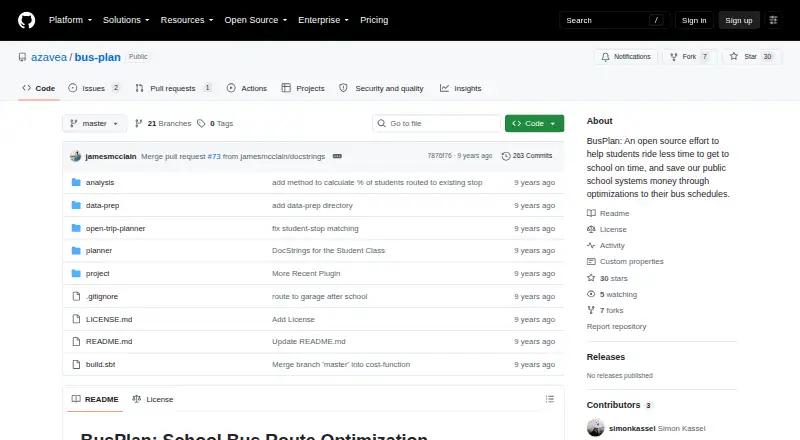
BusPlan is an open-source tool for school districts planning routes for existing students, stops and school locations. It aims to reduce bus driving time, with an option to constrain routes by the maximum time a student may ride. The workflow starts with CSV data for locations, students, candidate stops, stop eligibility and garage bus limits. Its preparation instructions identify candidate stops within one mile of each student and calculate walking-distance eligibility. OpenStreetMap extracts supply routing data to OpenTripPlanner, which calculates route costs; OptaPlanner handles the constraints. The planner produces CSV files listing ordered stops and assigning students to route-and-stop combinations. A separate script calculates student ride times, and a Jupyter notebook supports route analysis. Azavea developed the effort in work with the School District of Philadelphia to investigate algorithmically optimized routing. BusPlan is available as source code under the Apache License, Version 2.0. Setup requires generating OpenTripPlanner routing graphs from OpenStreetMap extracts. The project page also describes planned improvements for fleet size, capacity, student age, special needs and buses serving multiple schools.
Who it suits
BusPlan suits school districts that want to generate routes from student, stop and school data using a configurable, CSV-based workflow. It may also suit teams able to set up its routing graphs and run source-code software themselves.
What it does well
- Can constrain routes by maximum student ride time
- Outputs ordered stops and student assignments as CSV
- Includes ride-time calculation and route-analysis tools
- Apache License, Version 2.0
- Free plan listed as free
What to know first
- Requires generating routing graphs from OpenStreetMap extracts
- No packaged desktop or mobile download is listed
- No support service is stated
- Some solver improvements are described as planned
Limits
The free plan is listed as free, with no hosted plan or usage limits stated. The project page describes several solver improvements as planned, including constraints for fleet size, capacity, student age, special needs, and buses serving multiple schools.
Plans
| Plan | Billed and limits | Price |
|---|---|---|
| BusPlan | Open source; no hosted plan or usage limits stated | Free |
As github.com lists them, read 9 Oct 2026. The maker's own page has the final word.
Getting started
- Open the project repository on GitHub.
- Review the README setup and usage instructions.
- Prepare the documented CSV inputs for locations, students, candidate stops, stop eligibility, and garage bus limits.
- Generate OpenTripPlanner routing graphs from OpenStreetMap extracts.
- Run the workflow to produce route and student assignment CSV files.
BusPlan is open-source software for school districts that want to generate routes from their own student and stop data. It suits teams able to prepare CSV files and run a self-hosted routing workflow. Its focused drive-time optimization and ride-time limits are useful, but the routing graph setup and planned solver improvements make it a narrower choice than a ready-to-run service.
Overview
BusPlan generates routes for existing students, stops and schools, aiming to minimize bus drive time while allowing districts to cap maximum student ride time. The project grew from Azavea’s work with the School District of Philadelphia on algorithmically optimized bus routing. Its source code is available under the Apache License, Version 2.0.
The workflow depends on OpenTripPlanner to calculate route costs and OptaPlanner to solve the routing constraints. Districts must generate OpenTripPlanner routing graphs from OpenStreetMap extracts, so adopting BusPlan involves technical setup as well as route planning. It is distributed as source code and setup instructions, without a packaged desktop or mobile download.
Key features
Drive-time optimization with ride-time limits
BusPlan optimizes routes to reduce bus drive time and can constrain the maximum time a student spends riding. That gives districts two concrete priorities to balance: efficient vehicle routes and limits on long journeys. The project describes solver improvements for fleet size, vehicle capacity, student age, special needs and buses serving multiple schools as planned work. Districts that need those factors in their routing decisions should account for that gap.
CSV inputs, assignments and analysis
The workflow uses CSV files for locations, students, candidate stops, stop eligibility and garage bus limits. Its data-preparation instructions generate candidate stops within one mile of each student and calculate eligibility by walking distance. The planner outputs CSVs with ordered route stops and assignments linking students to routes and stops. A ride-time calculation script and a Jupyter notebook support further analysis, giving a technically equipped district ways to inspect results beyond the route output itself.
Open routing components
OpenStreetMap extracts supply the map data used by OpenTripPlanner, while OptaPlanner handles constraint solving. This component-based approach makes the workflow reproducible, but districts need the skills and infrastructure to prepare routing graphs and work with the source code. The repository includes setup and usage instructions; it does not state a support service or product-specific security certifications or compliance claims.
Pricing
BusPlan — free. The software is open source, with no hosted plan or usage limits stated. This is a strong fit for districts that can operate the workflow themselves and want to avoid a software charge. The free plan does not come with a packaged desktop or mobile app, and the route-graph generation and CSV preparation remain part of the district’s work.
Platforms
BusPlan is self-hosted. The repository provides source code and setup instructions rather than a desktop or mobile download, so districts should be prepared to run the software in their own environment.
Who it's for
BusPlan is best suited to school districts with staff who can prepare structured student and stop data, generate OpenTripPlanner graphs and analyze CSV outputs. It is a practical fit when reducing drive time while limiting student ride time are central goals. Districts seeking packaged software, a stated support service or solver constraints for fleet capacity, student age, special needs and multi-school buses should consider other options.
Pros and cons
- Drive-time and ride-time objectives: The solver can minimize bus driving while enforcing a maximum student ride time.
- Inspectable outputs: Ordered stops and student assignments are exported as CSV, with a separate ride-time script and analysis notebook.
- No software charge: The source is free under the Apache License, Version 2.0.
- Technical setup required: Districts must generate routing graphs from OpenStreetMap extracts and prepare multiple CSV inputs.
- Some fleet constraints are planned improvements: The project identifies capacity, fleet size, student age, special needs and multi-school service as areas for solver improvement.
Alternatives
School Bus Routing Software is a broader category to explore when comparing school transportation tools.
- RollCall suits readers looking for mobile parent access: its parent app is free to download and use on iOS and Android, while schools or bus operators subscribe to the service.
- RouteCabin is a freemium option whose free plan covers up to 15 passengers, one vehicle and two drivers, with live tracking, attendance and basic fee records.
- AlphaRoute uses demo-based pricing for readers who prefer to discuss a paid product with its maker.
- BusPlanner is a paid option with custom pricing and self-hosted and Windows platform support.
- HNH HTSTM is another paid option.
- RouteBot is a paid option with a free plan.
- Busology Tech Routing & Scheduling is worth considering if you want a paid routing and scheduling product with pricing based on bus count and feature level.
- BusRight is a paid option whose pricing is discussed by demo for your fleet.
Verdict
Choose BusPlan if your district can manage a self-hosted, CSV-based workflow and wants open-source route optimization that balances drive time against a maximum student ride time. Its strongest advantage is control without a software charge; look elsewhere if you need a packaged service or routing decisions built around the project’s planned fleet and student constraints.
Verdict
BusPlan provides a reproducible, source-code route-planning workflow with ride-time constraints and analysis tools. Districts should account for the graph-generation setup and the project's planned solver improvements when considering it.
Questions
How much does BusPlan cost?
The BusPlan plan is listed as free.
Is BusPlan open source?
Yes. The repository provides the software under the Apache License, Version 2.0.
Which platforms does it support?
BusPlan is listed as self-hosted. The repository provides source code and setup instructions, with no packaged desktop or mobile download listed.
What data does BusPlan use?
The workflow uses CSV data for locations, students, candidate stops, stop eligibility, and garage bus limits.
Which routing and optimization tools does it use?
OpenTripPlanner generates route costs using OpenStreetMap extracts, and OptaPlanner acts as the constraint solver.
Does BusPlan offer support?
The repository README provides setup and usage instructions. No support service is stated.
Facts from BusPlan's own pages
- Analysis
- The repository includes instructions and a Jupyter notebook for analyzing student ride times and routes. · github.com, 9 Oct 2026
- Distribution
- The repository provides source code and setup instructions, with no packaged desktop or mobile download listed. · github.com, 9 Oct 2026
- Headquarters
- Philadelphia, Pennsylvania, USA · github.com, 28 Sept 2026
- Input data
- The setup instructions use CSV files for network nodes, students, eligible stops, and garage bus limits. · github.com, 9 Oct 2026
- Integrations
- The documented workflow uses OpenStreetMap extracts with OpenTripPlanner for routing and OptaPlanner for optimization. · github.com, 8 Oct 2026
- Intended users
- The project describes its goal as reducing public school budgets and helping students spend less time riding to school. · github.com, 9 Oct 2026
- License
- The repository provides the software under the Apache License, Version 2.0. · github.com, 9 Oct 2026
- Open source license
- The repository provides the software under the Apache License, Version 2.0. · github.com, 8 Oct 2026
- Optimization
- Routes are optimized to minimize bus drive time and can be constrained by maximum student ride time. · github.com, 8 Oct 2026
- Optimization engine
- BusPlan uses OptaPlanner as its constraint solver. · github.com, 9 Oct 2026
- Outputs
- The solver produces CSV files containing ordered route stops and student assignments, which can then be converted into mappable routes. · github.com, 9 Oct 2026
- Potential constraints
- The project page describes planned solver improvements for bus fleet size, capacity, student age, special needs and buses serving multiple schools. · fellowship.azavea.com, 8 Oct 2026
- Project context
- Azavea says it worked with the School District of Philadelphia to investigate algorithmically optimized school bus routing. · fellowship.azavea.com, 8 Oct 2026
- Purpose
- BusPlan generates school bus routes for existing students, stops, and school locations, optimizing for minimum bus drive time. · github.com, 9 Oct 2026
- Ride time constraint
- Routes can be constrained to limit maximum student ride time. · github.com, 9 Oct 2026
- Routing and solver
- The project uses OpenTripPlanner to generate route costs and OptaPlanner as a constraint solver. · github.com, 8 Oct 2026
- Routing engine
- BusPlan uses OpenTripPlanner to generate route costs. · github.com, 9 Oct 2026
- Security
- The repository page does not state any product-specific security certifications or compliance claims. · github.com, 9 Oct 2026
- Setup requirement
- The getting-started instructions require generating OpenTripPlanner routing graphs from OpenStreetMap extracts. · github.com, 9 Oct 2026
- Stop eligibility
- The data-preparation instructions generate candidate stops within a one-mile radius of each student and calculate walk-distance eligibility. · github.com, 9 Oct 2026
- Support
- The repository provides setup and usage instructions in its README; it does not state a support service. · github.com, 8 Oct 2026
Where BusPlan stands on Freedom251
- School Bus Routing Software#2 of 24