Freedom251 › DDoS Protection Software

AWS Shield
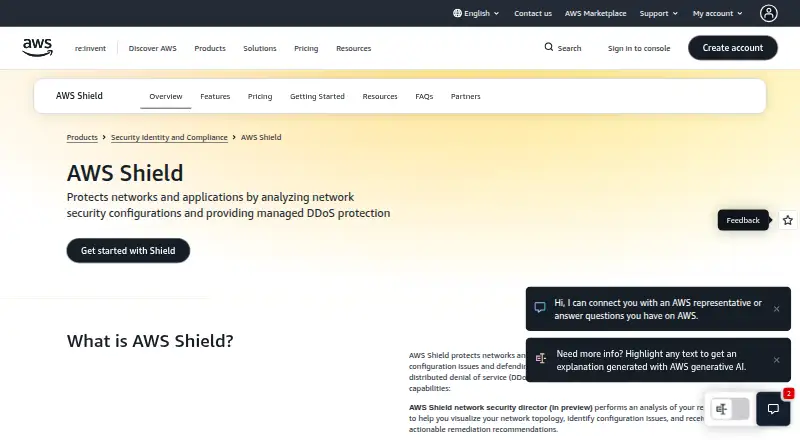
What AWS Shield is
AWS Shield helps AWS customers identify network security configuration issues and defend applications from web exploitation and distributed denial of service events. Shield Standard is automatically configured for AWS customers and provides common network- and transport-layer DDoS protection at no charge. Shield Advanced detects sophisticated events across network, transport, and application layers and applies automatic inline mitigation. It baselines application traffic to flag anomalies such as HTTP floods and DNS query floods, and supports EC2, Elastic Load Balancing, CloudFront, Global Accelerator, and Route 53 resources. Advanced integrates with AWS WAF and AWS Firewall Manager, with event visibility through Amazon CloudWatch. It also includes DDoS cost protection for qualifying usage spikes on protected resources and up to 50 billion AWS WAF requests per subscribed payer account per calendar month. Advanced costs $3,000 a month, requires a one-year subscription commitment, and usage fees may apply. Network security director, which analyzes resources and recommends remediations, is in preview and is not included in either listed plan.
Who it suits
Shield is for AWS customers protecting websites and applications, while Shield Advanced is directed at internet-facing applications on eligible AWS resources. Advanced may suit customers who need the listed mitigation, traffic monitoring, or cost-protection features.
What it does well
- Standard protection is automatically configured for AWS customers.
- Advanced automatically mitigates DDoS events across three layers.
- Supports five listed AWS protected resource types.
- Integrates with AWS WAF and Firewall Manager.
- Advanced includes qualifying DDoS cost protection.
What to know first
- Advanced costs $3,000 a month.
- Advanced requires a one-year subscription commitment.
- Usage fees may apply.
- Network security director is in preview and not included.
Limits
Shield Standard provides common network- and transport-layer DDoS protection. Shield Advanced costs $3,000 a month, requires a one-year subscription commitment, and may incur usage fees. Its allowance covers up to 50 billion AWS WAF requests per subscribed payer account per calendar month for protected resources.
Plans
| Plan | Billed and limits | Price |
|---|---|---|
| AWS Shield Standard | Common network and transport layer DDoS protection · Automatically configured for AWS customers · Does not include network security director | Free |
| AWS Shield Advanced | Monthly fee; requires a 1-year subscription commitment; usage fees may apply · Advanced DDoS protection · Up to 50 billion AWS WAF requests per subscribed payer account per calendar month · Network security director not included | $3,000 a month |
As aws.amazon.com lists them, read 29 Sept 2026. The maker's own page has the final word.
Getting started
- Open the AWS Shield website.
- Use Shield Standard, which is automatically configured for AWS customers, or review the Advanced subscription.
- For Advanced, account for the one-year commitment and annual renewal.
- Select eligible resources such as EC2, Elastic Load Balancing, CloudFront, Global Accelerator, or Route 53 for protection.
- Connect AWS WAF or AWS Firewall Manager if needed.
AWS Shield protects AWS-hosted websites and applications from distributed denial-of-service attacks, with network security analysis also offered through Network Security Director in preview. It suits AWS customers, particularly teams running internet-facing services on eligible AWS resources. Standard is a sensible baseline; Advanced adds broader mitigation and operational protections, but its annual commitment makes it a considered upgrade.
Overview
Shield Standard is automatically configured for AWS customers and covers common network- and transport-layer DDoS protection. Shield Advanced extends that coverage with automatic inline mitigation across network, transport and application layers, plus traffic monitoring that can flag patterns such as HTTP and DNS query floods. That split gives AWS users a no-charge starting point, while making Advanced most relevant when application-layer defense and ongoing visibility are priorities.
Network Security Director analyzes AWS resources, maps network topology and identifies configuration issues with remediation recommendations. It is in preview, and neither Shield Standard nor Shield Advanced includes it, so it should not be treated as part of either plan.
Key features
Mitigation and monitoring
Advanced continuously monitors application traffic against baselines and automatically mitigates sophisticated attacks. This combination is useful for internet-facing applications that need more than common network and transport protection, though it does not remove the need to plan support access: custom mitigations from the Shield Response Team require Business or Enterprise support.
AWS service coverage and integrations
Protected resources include EC2, Elastic Load Balancing, CloudFront, Global Accelerator and Route 53. Integrations with AWS WAF and AWS Firewall Manager fit organizations already managing AWS security through those services, while Amazon CloudWatch provides event visibility. Advanced also includes up to 50 billion AWS WAF requests per subscribed payer account per calendar month for protected resources.
Incident and cost protections
Shield Response Team access is available around the clock to Business or Enterprise support customers. Advanced also includes DDoS cost protection for qualifying usage spikes on protected resources. These provisions strengthen the case for Advanced in supported AWS environments, but the support eligibility condition matters when evaluating incident response.
Pricing
| Plan | Price | What it includes |
|---|---|---|
| AWS Shield Standard | free | Common network and transport layer DDoS protection, automatically configured for AWS customers. |
| AWS Shield Advanced | $3,000 a month | Advanced DDoS protection and up to 50 billion AWS WAF requests per subscribed payer account per calendar month for protected resources. |
Standard is the practical fit for AWS customers seeking common DDoS protection without a plan charge. Advanced is for teams that need its broader mitigation, monitoring and cost protection; it requires a one-year subscription commitment, renews annually, and usage fees may apply. The commitment and possible additional charges make it a poor fit for organizations that need a short-term or easily scaled commitment. Network Security Director is not included in either plan.
Platforms
Shield is offered on API and web platforms, with cloud deployment. Its protections are aimed at AWS resources, so platform availability should not be mistaken for coverage of services outside the supported AWS environment.
Who it's for
Shield is best suited to AWS customers protecting websites and applications. Standard makes sense as the default layer of common network and transport protection. Advanced is a better match for teams with internet-facing applications on eligible resources that need application-layer mitigation, traffic anomaly monitoring, qualifying cost protection or the included WAF request allowance. Organizations that cannot accept a one-year subscription or do not qualify for the Response Team support level should weigh those constraints before upgrading.
Pros and cons
- Pro: Standard is automatically configured for AWS customers at no charge, providing a baseline without a separate plan purchase.
- Pro: Advanced adds automatic mitigation across three attack layers and traffic baselining for HTTP and DNS query floods.
- Pro: Advanced combines CloudWatch visibility, AWS security integrations, qualifying DDoS cost protection and a substantial monthly WAF request allowance.
- Con: Advanced costs $3,000 a month and commits customers for one year, with annual renewal and possible usage fees.
- Con: Custom event mitigations from the Shield Response Team depend on Business or Enterprise support.
- Con: Network Security Director is in preview and is not included with either Shield plan.
Alternatives
Compare DDoS Protection Software if you want to assess a wider set of DDoS tools. Gcore DDoS Protection is worth considering for a freemium option with a PAYG plan that starts free and has no clean-traffic commitment. Cloudflare DDoS Protection may suit web-focused buyers seeking a free plan with unmetered DDoS protection and a WAF. Check Point DDoS Protector is another paid DDoS protection option.
Fastly Image Optimizer is a separate image optimization option with a free allowance of 100,000 image requests per month. Oracle Cloud Infrastructure Secret Management is a free secret-management alternative, rather than a DDoS protection service. F5 BIG-IP APM is a paid access management product with a free trial. FastNetMon is a freemium option available for web, Linux and macOS. Nexusguard DDoS Protection offers custom DDoS protection plans.
Verdict
Choose AWS Shield if your applications run on AWS and you want an automatically configured baseline or, with Advanced, broader mitigation and monitoring for eligible resources. Advanced's protections are substantial, but its 3000.00 USD monthly price, one-year commitment and possible usage fees make it the right choice only when those capabilities justify the ongoing obligation. Look elsewhere if you need a shorter commitment or a web-focused free plan.
Verdict
Shield Standard provides common DDoS protection without a listed charge, while Advanced adds broader mitigation and monitoring for eligible AWS resources. The Advanced plan's monthly price, annual commitment, and possible usage fees are important constraints.
Questions
Is AWS Shield free?
Shield Standard costs nothing and is automatically configured for AWS customers. Shield Advanced costs $3,000 a month, requires a one-year commitment, and usage fees may apply.
What does Shield Standard protect against?
It provides common DDoS protection at the network and transport layers. It does not include network security director.
What does Shield Advanced add?
Advanced detects and automatically mitigates sophisticated events across network, transport, and application layers. It also monitors traffic anomalies and includes DDoS cost protection for qualifying usage spikes.
Which AWS resources can Shield Advanced protect?
Listed protected resources include EC2, Elastic Load Balancing, CloudFront, Global Accelerator, and Route 53.
Does Shield Advanced include AWS WAF requests?
Its subscription includes up to 50 billion AWS WAF requests per subscribed payer account in a calendar month for protected resources.
Who can get custom event mitigations from the Shield Response Team?
Custom mitigations during events require Business or Enterprise support. Shield Advanced also provides 24/7 access to the team for customers with either support level.
Facts from AWS Shield's own pages
- Automatic mitigation
- Shield Advanced detects and blocks sophisticated DDoS events across network, transport, and application layers with automatic inline mitigation. · aws.amazon.com, 29 Sept 2026
- AWS launch
- Amazon Web Services says it launched in 2006. · aws.amazon.com, 29 Sept 2026
- Cost protection
- Shield Advanced includes DDoS cost protection for qualifying usage spikes on protected EC2, ELB, CloudFront, Global Accelerator, and Route 53 resources. · aws.amazon.com, 29 Sept 2026
- Incident support
- Shield Advanced provides 24/7 access to the Shield Response Team for Business or Enterprise support customers. · aws.amazon.com, 29 Sept 2026
- Integrations
- Shield Advanced integrates with AWS WAF and AWS Firewall Manager, and provides event visibility through Amazon CloudWatch. · aws.amazon.com, 29 Sept 2026
- Intended users
- Shield is for AWS customers protecting websites and applications, with Shield Advanced covering internet-facing applications on eligible AWS resources. · aws.amazon.com, 29 Sept 2026
- Network security analysis
- Network security director, which is in preview, analyzes AWS resources, visualizes network topology, identifies configuration issues, and offers remediation recommendations. · aws.amazon.com, 29 Sept 2026
- Protected services
- Shield Advanced supports protected resources including EC2, Elastic Load Balancing, CloudFront, Global Accelerator, and Route 53. · aws.amazon.com, 29 Sept 2026
- Purpose
- AWS Shield identifies network security configuration issues and defends applications against active web exploitation and distributed denial of service events. · aws.amazon.com, 29 Sept 2026
- Subscription commitment
- Shield Advanced requires a one-year subscription commitment and renews annually. · aws.amazon.com, 29 Sept 2026
- Support limitation
- Custom mitigations from the Shield Response Team during events require Business or Enterprise support. · aws.amazon.com, 29 Sept 2026
- Traffic monitoring
- Shield Advanced baselines application traffic patterns to detect anomalies such as HTTP floods and DNS query floods. · aws.amazon.com, 29 Sept 2026
- WAF allowance
- The Shield Advanced subscription includes up to 50 billion AWS WAF requests per subscribed payer account in a calendar month for protected resources. · aws.amazon.com, 29 Sept 2026
Where AWS Shield stands on Freedom251
- DDoS Protection Software#2 of 37