Freedom251 › Task Queue Software
Asynq
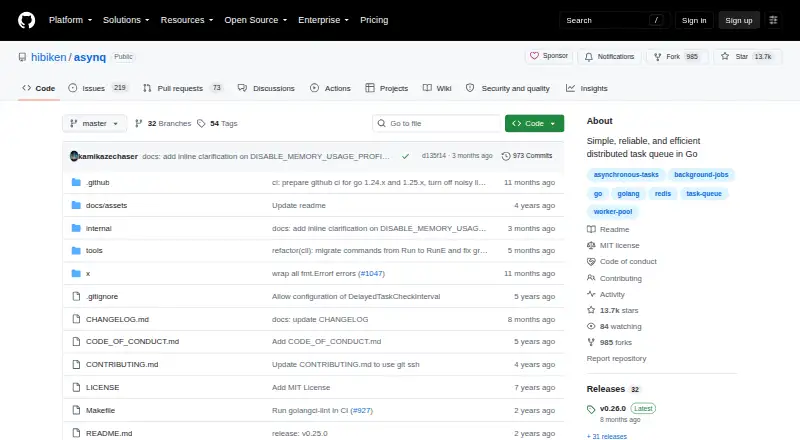
What Asynq is
Asynq is a Go library for queuing tasks and processing them asynchronously with workers, using Redis as its backend. It supports at-least-once execution, retries after failures, and automatic recovery after a worker crash. Tasks can be scheduled or run periodically, with controls for weighted and strict priority queues, pausing, deduplication, timeouts, and deadlines. The project describes using multiple worker servers and brokers for high availability and horizontal scaling. For monitoring and queue operations, it lists Prometheus metrics integration, plus a web UI and CLI for inspecting and remotely controlling queues and tasks. The companion Asynqmon tool can run as a binary or be imported as a library, and supports Prometheus time-series data. The quickstart requires Redis 4.0 or higher, and Redis Sentinel is supported; the project cautions that some Lua scripts may not work with Redis Cluster. Asynq is free and open source under the MIT license. Its current major version is 0.x, and the public API may change before version 1.0.0.
Who it suits
It suits Go developers building Redis-backed background task queues, scheduled jobs, or worker-based processing. Teams using it should be prepared for possible public API changes before version 1.0.0.
What it does well
- Supports retries and recovery after worker crashes.
- Offers scheduled and periodic task processing.
- Provides queue controls for priorities, pausing, and deduplication.
- Includes Prometheus metrics integration and queue inspection tools.
- Supports multiple worker servers and brokers for scaling.
What to know first
- Requires Redis 4.0 or higher.
- Some Lua scripts may not be compatible with Redis Cluster.
- Its 0.x public API may change before version 1.0.0.
- The project has no security policy file.
Limits
Redis version 4.0 or higher is required. The project cautions that some Lua scripts may not be compatible with Redis Cluster, and the public API may change before version 1.0.0.
Plans
| Plan | Billed and limits | Price |
|---|---|---|
| Free and open-source | MIT-licensed Go library · requires Redis 4.0 or higher | Free |
As github.com lists them, read 4 Oct 2026. The maker's own page has the final word.
Getting started
- Visit the Asynq project at https://github.com/hibiken/asynq.
- Use a self-hosted deployment.
- Set up Redis version 4.0 or higher.
- Use the Go library to queue tasks for workers.
- Use the listed web UI or CLI to inspect and remotely control queues and tasks.
Verdict
Asynq provides task queueing and worker processing for Go applications backed by Redis, with scheduling and operational controls. Check Redis compatibility and the 0.x API status when assessing it for a project.
Questions
How much does Asynq cost?
It is listed as free and open source at no cost, under the MIT license.
Which language is Asynq for?
Go is its official SDK language, and Asynq is described as a Go library.
What does Asynq require?
The quickstart requires Redis version 4.0 or higher.
Does Asynq support scheduled jobs?
Yes. It supports scheduled and periodic tasks.
Can Asynq work with Redis Cluster?
The project cautions that some Lua scripts may not be compatible with Redis Cluster. Redis Sentinel is supported.
Is its API stable?
Its current major version is 0.x, and the public API may change before the 1.0.0 release.
Facts from Asynq's own pages
- Compatibility
- The project says its current major version is 0.x and its public API may change before the 1.0.0 release. · github.com, 4 Oct 2026
- Intended users
- The project asks people using the package in production to consider sponsoring it and welcomes community contributions through issues, pull requests, and feedback. · github.com, 4 Oct 2026
- Monitoring
- The project lists Prometheus metrics integration and a web UI and CLI for inspecting and remotely controlling queues and tasks. · github.com, 4 Oct 2026
- Purpose
- Asynq is a Go library for queueing tasks and processing them asynchronously with workers, backed by Redis. · github.com, 4 Oct 2026
- Queue controls
- It supports weighted and strict priority queues, queue pausing, task deduplication, and per-task timeouts and deadlines. · github.com, 4 Oct 2026
- Redis requirement
- The quickstart requires Redis version 4.0 or higher. · github.com, 4 Oct 2026
- Redis support
- Asynq supports Redis Sentinel, while the project cautions that some Lua scripts may not be compatible with Redis Cluster. · github.com, 4 Oct 2026
- Scaling
- The project describes using multiple worker servers and brokers for high availability and horizontal scaling. · github.com, 4 Oct 2026
- Scheduling
- Asynq supports scheduled and periodic tasks. · github.com, 4 Oct 2026
- Security
- The GitHub security page says the project has no security policy file and no published security advisories. · github.com, 4 Oct 2026
- Task delivery
- Its listed features include at-least-once task execution, retries after failure, and automatic recovery after a worker crash. · github.com, 4 Oct 2026
- Web UI
- The companion Asynqmon tool can be used as a binary or imported as a library, and supports Prometheus time-series data. · github.com, 4 Oct 2026
Where Asynq stands on Freedom251
- Task Queue Software#9 of 37