Freedom251 › Dropshipping Software

AppScenic
What AppScenic is
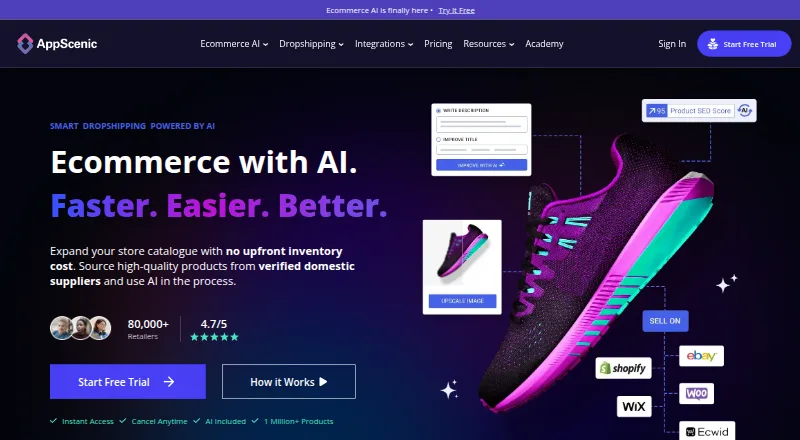
AppScenic connects retailers with suppliers for dropshipping and ecommerce operations. It can route orders, support supplier fulfillment, import tracking information, and synchronize inventory and prices. Its marketplace lists more than 1,000,000 products across more than 100 categories, with suppliers in regions including the USA, UK, EU, Canada, and Australia. Built-in store connections include Shopify, WooCommerce, Wix, Ecwid, and Walmart. AI tools can rewrite product titles and descriptions, adjust tone, and enlarge product images up to four times their original resolution. The free tier allows catalog browsing and one connected store but no orders, and the pricing FAQ says it does not expire. Standard costs $39 a month, Pro costs $79 a month, and Elite costs $99 a month. The supplier-syncing API is available; the retailer-focused public API is described as close to launch. AppScenic's wallet supports automatic funding and multiple backup payment methods for order payments.
Who it suits
AppScenic suits retailers looking to source products from a supplier marketplace and automate order handling or inventory updates. Its free tier can be used to browse the catalog, but it does not allow orders.
What it does well
- Catalog lists over 1,000,000 products
- Automates routing, tracking, and inventory synchronization
- Built-in connections include Shopify and WooCommerce
- AI tools rewrite copy and enlarge images
- Free tier does not expire
What to know first
- Free tier does not allow orders
- Free tier has one connected store
- Retailer-focused public API is not yet launched
- Paid plans start at $39 a month
Limits
The Free plan allows catalog browsing and one connected store, but no orders or premium products. Standard allows one store and 100 pushed products, with no premium products; its listed AI allowance is 20 tokens per day.
Plans
| Plan | Billed and limits | Price |
|---|---|---|
| Free | Browse catalog · 1 connected store · no orders · no premium products | Free |
| Standard | Monthly · 20 AI tokens/day · 1 connected store · 100 pushed products · no premium products | $39 a month |
| Pro | Monthly · 500 AI tokens/day · 3 connected stores · 5,000 pushed products · premium products | $79 a month |
| Elite | Monthly · 2,000 AI tokens/day · 10 connected stores · 20,000 pushed products · premium products | $99 a month |
As appscenic.com lists them, read 28 Sept 2026. The maker's own page has the final word.
Getting started
- Visit https://appscenic.com/.
- Create a Free account to browse the catalog, or select a paid plan.
- Connect a store using a supported integration.
- Browse products and push them to your store within your plan's limits.
- Use the supplier-syncing API if your workflow requires it.
AppScenic is a supplier marketplace and ecommerce operations platform for retailers running dropshipping stores. It suits sellers who want sourcing, product importing and fulfillment automation tied to their storefront. The main qualification is scale: store, product and AI quotas make the paid tier choice important as a catalog grows.
Overview
AppScenic brings supplier discovery and day-to-day dropshipping operations into one service. Its marketplace contains more than 1,000,000 products across over 100 categories, with suppliers in regions including the USA, UK, EU, Canada and Australia. That range can help retailers compare supply options and potentially source closer to customers, but every product still needs its own checks for suitability and delivery.
The service automates order routing, supplier fulfillment, tracking imports, and inventory and price synchronization. Its wallet supports automatic funding and multiple backup payment methods for order payments, which can reduce interruptions when a primary payment method fails. AppScenic describes ISO 27001, CyberEssentials and PCI DSS as technical measures, and its data-processing agreement references the EU GDPR and UK Data Protection Act 2018.
Key features
Product importing and synchronized inventory and pricing reduce the repetitive work of keeping a storefront aligned with supplier data. Automated routing and tracking imports extend that workflow after checkout, so retailers can manage fulfillment updates without moving orders manually between systems.
Built-in store connections cover Shopify, WooCommerce, Wix, Ecwid and Walmart; the storefront-platform list also includes eBay. Amazon, Etsy, Squarespace, TikTok, Magento, Shift4Shop, Volusion, OpenCart, PrestaShop and BigCommerce are marked as coming soon, so retailers dependent on those channels should not treat them as current integrations.
AI tools can rewrite product titles and descriptions, change their tone, and upscale product images to as much as four times their original resolution. These tools are most useful for preparing a large imported catalog, although the daily token allowance varies sharply by plan. The public API currently supports supplier syncing, while a retailer-focused public API is described as close to launch; businesses requiring that retailer API now should look elsewhere or wait.
Pricing
AppScenic uses a freemium model, with a 14-day trial and paid plans from $39 a month. The free account never expires, but it is a catalog-browsing tier rather than an operating plan: it allows one connected store, no orders and no premium products.
| Plan | Price | What it includes | Best fit |
|---|---|---|---|
| Free | free | Catalog browsing, 1 connected store, no orders, no premium products | Researching suppliers before committing |
| Standard | $39 a month, billed Monthly | 20 AI tokens/day, 1 connected store, 100 pushed products, no premium products | A small store with a tightly selected range |
| Pro | $79 a month, billed Monthly | 500 AI tokens/day, 3 connected stores, 5,000 pushed products, premium products | Growing operators managing several stores |
| Elite | $99 a month, billed Monthly | 2,000 AI tokens/day, 10 connected stores, 20,000 pushed products, premium products | Multi-store retailers with large catalogs |
Standard is the lowest paid route to order processing, but its 100-product cap and single store limit leave little room for a broad catalog. Pro adds premium products, three stores and a much larger AI allowance; Elite is the practical choice only when ten stores or 20,000 pushed products justify the extra monthly cost. Support questions are directed to AppScenic customer support and its Help Desk.
Platforms
AppScenic is available through web and API access. Storefront connections currently include Shopify, WooCommerce, Wix, Ecwid, Walmart and eBay, with additional channels marked as coming soon.
Who it's for
It is a strong fit for dropshippers who want a broad, geographically varied supplier marketplace and automated synchronization across a supported store. Standard suits a small, focused range; Pro and Elite suit retailers operating multiple stores or pushing thousands of products. It is less suitable for a retailer that needs more than one store on the entry paid tier, wants premium products without upgrading, or depends on a retailer-facing public API immediately.
Pros and cons
Pros
- More than 1,000,000 products across over 100 categories gives retailers substantial sourcing breadth.
- Order routing, fulfillment, tracking, inventory and price synchronization cover the core repetitive dropshipping workflow.
- Automatic wallet funding and backup payment methods can help prevent payment-related fulfillment pauses.
- AI copy editing and image upscaling support faster catalog preparation.
Cons
- The free tier cannot process orders, so it is useful for browsing rather than running a store.
- Standard permits only 100 pushed products, one store and no premium products.
- Several major channels, including Amazon and Etsy, are still marked as coming soon.
- The retailer-focused public API has not yet launched.
Alternatives
Choose Spocket instead if you want Android, iOS, extension, API and web access, with a Starter plan at $39.99 a month and 25 unique products. CJdropshipping is a better fit when five daily sourcing requests, free and unlimited listing, unlimited employee accounts and unlimited store authorization match your operation.
EPROLO suits sellers seeking a forever-free model with no membership or monthly subscription, paying product and delivery costs when ordering. Pick Modalyst for a smaller catalog ladder, from a 25-product Hobby plan to a 250-product Start Up plan at $35 a month. Trendsi offers a free plan with up to 500 listings, access to 40K+ products and unlimited order processing.
Avasam is an option for a UK-focused catalog, with a 30.00 USD monthly Starter plan. DropCommerce provides a forever-free browsing and sampling tier with a 25-product limit, while Dropshipman offers free monthly imports from AliExpress, Temu and Dropshipman plus unlimited order fulfillment.
Verdict
AppScenic is best for retailers who want a large supplier marketplace and automated order, inventory and tracking workflows connected to Shopify, WooCommerce, Wix, Ecwid, Walmart or eBay. Its strongest reason to choose it is the breadth of sourcing and automation in one service. Look elsewhere if your store needs a larger entry-tier catalog, unsupported channels today, or a retailer-facing public API now.
Verdict
AppScenic combines supplier sourcing with order and inventory automation, plus store connections and AI product tools. The free tier is limited to browsing, while order processing requires a paid plan.
Questions
Is AppScenic free, and does the free plan expire?
Yes. The Free plan is listed as free and allows catalog browsing with one connected store, no orders, and no premium products. The pricing FAQ says the tier never expires.
How much do the paid plans cost?
Standard is $39.00 per month, Pro is $79.00 per month, and Elite is $99.00 per month. A 14-day trial is listed.
Which stores can connect to AppScenic?
Built-in connections are listed for Shopify, WooCommerce, Wix, Ecwid, and Walmart. The storefront platforms list also includes eBay; Amazon, Etsy, Squarespace, TikTok, Magento, Shift4Shop, Volusion, OpenCart, PrestaShop, and BigCommerce are labeled coming soon.
What does AppScenic automate?
It automates order routing, supplier fulfillment, tracking imports, and inventory and price synchronization. Product importing is also listed.
Does AppScenic have an API?
Its public API supports supplier syncing. A retailer-focused public API is described as close to launch.
Where are AppScenic’s suppliers located?
The listed supplier regions include the USA, UK, EU, Canada, and Australia.
Facts from AppScenic's own pages
- AI tools
- AI tools can rewrite product titles and descriptions, adjust tone, and upscale product images up to four times their original resolution. · appscenic.com, 28 Sept 2026
- API availability
- The public API supports supplier syncing, while the integrations page says a retailer-focused public API is close to launch. · appscenic.com, 28 Sept 2026
- Automation
- The service automates order routing, supplier fulfillment, tracking imports, and inventory and price synchronization. · appscenic.com, 28 Sept 2026
- Catalog
- The pricing page describes a catalog of more than 1,000,000 products across more than 100 categories. · appscenic.com, 28 Sept 2026
- Coming integrations
- The integrations page labels Amazon, Etsy, Squarespace, TikTok, Magento, Shift4Shop, Volusion, OpenCart, PrestaShop, and BigCommerce as coming soon. · appscenic.com, 28 Sept 2026
- Data protection
- The company publishes a GDPR data processing agreement that references EU GDPR and the UK Data Protection Act 2018. · appscenic.com, 28 Sept 2026
- Free account limit
- The free tier allows catalog browsing but lists no orders, and it never expires according to the pricing page FAQ. · appscenic.com, 28 Sept 2026
- Headquarters
- Huddersfield, West Yorkshire, UK · appscenic.com, 28 Sept 2026
- Payments
- Its wallet supports automatic funding and multiple backup payment methods for order payments. · appscenic.com, 28 Sept 2026
- Purpose
- AppScenic connects retailers with suppliers and supports dropshipping and ecommerce operations. · appscenic.com, 28 Sept 2026
- Security
- The privacy policy says AppScenic uses ISO 27001, CyberEssentials, and PCI DSS as technical measures to protect user privacy. · appscenic.com, 28 Sept 2026
- Store integrations
- The integrations page lists built-in connections for Shopify, WooCommerce, Wix, Ecwid, and Walmart. · appscenic.com, 28 Sept 2026
- Supplier regions
- AppScenic says its suppliers are located in regions including the USA, UK, EU, Canada, and Australia. · appscenic.com, 28 Sept 2026
- Support
- The pricing page directs customers with questions to AppScenic customer support and its Help Desk. · appscenic.com, 28 Sept 2026
Where AppScenic stands on Freedom251
- Dropshipping Software#3 of 34