Freedom251 › Mobile App Testing Software

Appium
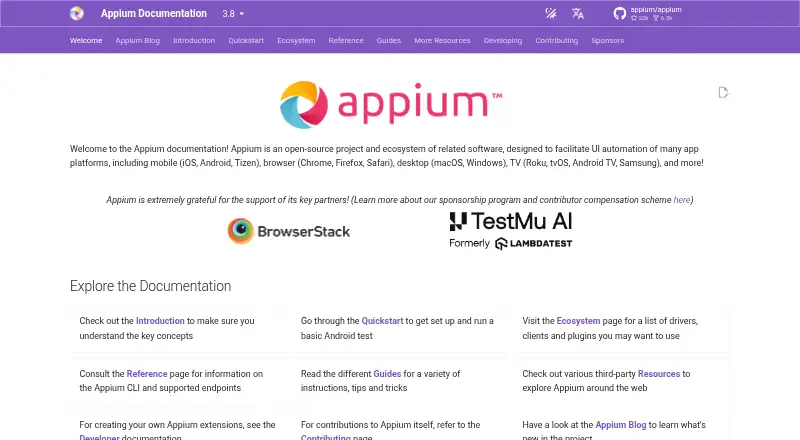
What Appium is
Appium is an open-source project and software ecosystem for automating user interfaces across mobile, browser, desktop, TV, and other app platforms. It is used mostly for software test automation, with coded scenarios interacting through an app’s interface. Its client-server architecture follows the W3C WebDriver specification: clients send commands to a server, while drivers connect the server to a target platform. The system is organized around core APIs, drivers, language clients, and optional plugins. Official drivers cover targets including Android, iOS, Chromium browsers, macOS apps, Safari, and Windows apps; documented targets also include Roku, tvOS, and Android TV. Official clients are available for Java, Python, Ruby, and C#, with other documented options including WebdriverIO. Appium Inspector can show screenshots and application hierarchies, find elements, run commands, and record interactions. The server runs on macOS, Linux, or Windows and requires a supported Node.js version and npm 10 or later. A driver must be installed separately, and platform drivers may need additional SDKs and toolchains. Appium is licensed under Apache 2.0.
Who it suits
Appium suits developers and testers who write code to automate UI scenarios across supported app platforms. It also suits teams that can install and maintain the server, platform drivers, and any additional SDKs or toolchains.
What it does well
- Open source under Apache 2.0.
- Official clients for Java, Python, Ruby, and C#.
- Inspector can record interactions and search for elements.
- Optional plugins extend functionality.
What to know first
- Requires a supported Node.js version and npm 10 or later.
- Drivers must be installed separately.
- Platform drivers may need additional SDKs and toolchains.
- Microsoft's WinAppDriver server has not been maintained since 2022.
Getting started
- Open the Appium website.
- Install Node.js and npm 10 or later on macOS, Linux, or Windows.
- Install the Appium server globally with npm.
- Install the driver for the platform you want to automate.
- Add any SDKs or toolchains required by that driver.
- Choose a supported Appium client or documented third-party client for your automation code.
Verdict
Appium offers a client-server approach to UI automation with multiple platform drivers and language clients. Setup involves installing the server and a separate driver, while Windows automation depends on a Microsoft server that has not been maintained since 2022.
Questions
Is Appium free?
Yes. Appium is free and open source under the Apache 2.0 license.
Which operating systems can run the Appium server?
The server runs on macOS, Linux, or Windows and requires a supported Node.js version and npm 10 or later.
Which languages have official Appium clients?
Official clients are available for Java, Python, Ruby, and C#. Documented third-party clients include WebdriverIO and Nightwatch.js.
Does Appium include platform drivers?
Appium requires a driver for the target platform, and users install that driver separately. Official drivers include Chromium, Espresso, Gecko, Mac2, Safari, UiAutomator2, Windows, and XCUITest.
What does Appium Inspector do?
It can inspect screenshots and application hierarchies, search for elements, run commands, and record interactions.
What should I know about the Windows driver?
The Appium team maintains the Node.js portion of its Windows driver. The Microsoft-provided WinAppDriver server executable has not been maintained since 2022.
Facts from Appium's own pages
- Architecture
- Appium consists of core APIs, platform-specific drivers, language clients and optional plugins. · appium.io, 11 Oct 2026
- Client languages
- The project maintains official clients for Java, Python, Ruby and C#, and documents third-party clients including WebdriverIO and Nightwatch.js. · appium.io, 11 Oct 2026
- Client-server model
- Appium uses a client-server architecture based on the W3C WebDriver specification, with clients sending commands to the server over a network. · appium.io, 11 Oct 2026
- Drivers
- Appium requires a driver for the target platform; official drivers include Chromium, Espresso, Gecko, Mac2, Safari, UiAutomator2, Windows and XCUITest. · appium.io, 11 Oct 2026
- Extensibility
- Appium's drivers and plugins let developers add platform support or modify and extend core functionality. · appium.io, 11 Oct 2026
- Extensions
- Drivers connect Appium to test devices, clients connect it to automation code, and plugins modify or extend its functionality. · appium.io, 10 Oct 2026
- Inspector
- Appium Inspector can inspect screenshots and application hierarchies, search for elements, run commands, and record interactions. · appium.io, 10 Oct 2026
- Installation
- The server is installed globally with npm, and users install a driver separately for the platform they want to automate. · appium.io, 10 Oct 2026
- Languages
- The documentation lists official Appium clients for Java, Python, Ruby, and C#, plus other clients such as WebdriverIO for Node.js. · appium.io, 10 Oct 2026
- License and stewardship
- Appium is available under the Apache 2.0 license, and its copyright is held by the OpenJS Foundation. · appium.io, 10 Oct 2026
- MCP tool
- Appium MCP is an MCP server that provides mobile test development and automation capabilities using Appium. · appium.io, 10 Oct 2026
- Notable dependency
- The Appium team maintains the Node.js portion of its Windows driver, while the Microsoft-provided WinAppDriver server has not been maintained since 2022. · appium.io, 11 Oct 2026
- Platform support
- Official drivers target Chromium browsers, Android, macOS apps, Safari, Windows apps, and Apple platforms including iOS, iPadOS, tvOS, and watchOS. · appium.io, 10 Oct 2026
- Plugins
- Optional official plugins add command batching, image matching and comparison, Inspector integration, relaxed capability prefixes, server-side storage and common XML output. · appium.io, 11 Oct 2026
- Project history
- Appium was donated to the JS Foundation in 2016 and is currently an Impact Project in the OpenJS Foundation. · appium.io, 10 Oct 2026
- Project stewardship
- The documentation says Appium is an OpenJS Foundation project supported by Appium contributors. · appium.io, 11 Oct 2026
- Purpose
- Appium is an open-source project and ecosystem of software for UI automation across mobile, browser, desktop, TV and other platforms. · appium.io, 11 Oct 2026
- Security
- Appium recommends running its server locally or within a protected internal network, avoiding untrusted users and not exposing its ports to the wider internet. · appium.io, 11 Oct 2026
- Security defaults
- Certain insecure server features are disabled by default and require explicit opt-in by the server host; client sessions cannot enable them. · appium.io, 11 Oct 2026
- Server requirements
- The Appium server runs on macOS, Linux or Windows and requires a supported Node.js version and npm version 10 or later. · appium.io, 11 Oct 2026
- Supported targets
- The documentation lists automation for iOS, Android, Tizen, Chrome, Firefox, Safari, macOS, Windows, Roku, tvOS, Android TV and Samsung platforms. · appium.io, 11 Oct 2026
- System requirements
- The server requires macOS, Linux, or Windows, a supported Node.js version, and npm 10 or later; platform drivers may require additional SDKs and toolchains. · appium.io, 10 Oct 2026
- Testing use
- Appium is used mostly for software test automation, letting testers run coded user scenarios through an app’s UI. · appium.io, 10 Oct 2026
- Windows driver limitation
- The Appium team maintains only the Node.js portion of its Windows driver; its WinAppDriver server executable from Microsoft has not been maintained since 2022. · appium.io, 10 Oct 2026
Where Appium stands on Freedom251
- Mobile App Testing Software#5 of 32
- Functional Testing Software#6 of 38
- Mobile Device Testing Software#3 of 18
- GUI Testing Software#6 of 34
- Testing Automation Software#7 of 26
- Software Testing Tools#9 of 33
- Testing And Qa#9 of 33
- End-to-End Testing Software#8 of 29
- Automated Testing#10 of 34
- Regression Testing Software#9 of 29