Freedom251 › Integration Software
APIANT
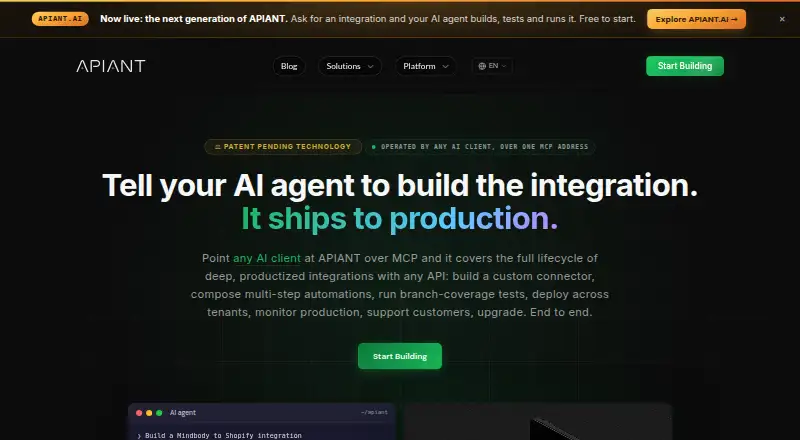
What APIANT is
APIANT is a platform for building, deploying, and monitoring integrations across APIs, with an AI agent that can build and test integrations. It supports workflow orchestration, data transformation, and real-time sync. Automations can combine steps, branching, mappings, transformations, scheduled triggers, and branch coverage tests. APIANT says it tests success paths, failure paths, and retries with real calls before an integration runs. It also provides run histories, monitoring, alerts, webhook replay, and rollback.
The platform overview describes 500+ prebuilt connectors, while the APIANT.AI app directory lists 1,996 apps. Custom connectors can use OAuth, API keys, webhooks, dynamic field discovery, throttling, and retries. Supported payload formats include JSON, XML, CSV, EDI, HL7, and binary. Deployment options include SaaS, dedicated customer cloud, and on-premise. APIANT says paid tiers run on dedicated servers, with separate development and production environments and no shared tenancy. Plans include a free account and paid options from Sandbox at $99 a month to Enterprise billed from $3,500/mo. Enterprise includes dedicated AWS infrastructure, a contractual SLA, priority support, migration help, and training. APIANT identifies SaaS companies, system integrators, and enterprises as audiences.
Who it suits
APIANT suits SaaS companies, system integrators, and enterprises that need to build and operate integrations across APIs. Its workflow tools, connector options, and deployment choices support teams handling data exchange across services and systems.
What it does well
- Supports workflow orchestration, data transformation, and real-time sync.
- Offers 500+ prebuilt connectors in the platform overview.
- Automations include branching, scheduled triggers, and transformations.
- Provides monitoring, alerts, webhook replay, and rollback.
- Offers SaaS, dedicated customer cloud, and on-premise deployment.
What to know first
- Paid plans start at $99 a month.
- Enterprise is billed from $3,500/mo.
Limits
The free account is listed as providing the same integration engine as paid plans and unlimited automation steps. Paid Sandbox, Pro, and Scale plans each cost at least $99 a month; Enterprise is billed from $3,500/mo.
Plans
| Plan | Billed and limits | Price |
|---|---|---|
| Free | Free account · same integration engine as paid plans · unlimited automation steps | Free |
| Scale | $1,500/mo · Dedicated server · full Automation and Assembly editors with AI Co-Pilot · Admin Console · FormApps · 500+ prebuilt connectors · platform-level monitoring | $1,500 a month |
| Enterprise | from $3,500/mo · Dedicated server · full platform features · contractual SLA · priority support · migration and training help | $3,500 a month |
| Pro | $499/mo · Dedicated server · full Automation and Assembly editors with AI Co-Pilot · Admin Console · FormApps · 500+ prebuilt connectors · platform-level monitoring | $499 a month |
| Sandbox | $99/mo · Dedicated server · full Automation and Assembly editors with AI Co-Pilot · Admin Console · FormApps · 500+ prebuilt connectors · platform-level monitoring | $99 a month |
As apiant.com lists them, read 9 Oct 2026. The maker's own page has the final word.
Getting started
- Visit the APIANT website.
- Create a free account or choose a paid plan.
- Use the browser assistant or a remote MCP client for APIANT.AI.
- Choose SaaS, dedicated customer cloud, or on-premise deployment as needed.
Verdict
Pick APIANT if you need a platform to build and manage API integrations with workflow, testing, and monitoring capabilities. The free account may be a starting point, while teams needing dedicated infrastructure, contractual SLA, or priority support should consider Enterprise and its higher listed price.
Questions
Is APIANT free?
A free account is listed as free, with the same integration engine as paid plans and unlimited automation steps.
What do the paid plans cost?
Sandbox is $99 a month, Pro is $499 a month, Scale is $1,500 a month, and Enterprise is billed from $3,500/mo.
What platforms and deployment options does it support?
Listed platforms are API, self-hosted, and web. Deployment options include SaaS, dedicated customer cloud, and on-premise.
How many connectors are available?
The platform overview describes 500+ prebuilt connectors. The APIANT.AI app directory lists 1,996 apps.
Does APIANT use customer data to train AI models?
APIANT says it does not use customer data or MCP tool-call data to train AI or machine-learning models.
What does Enterprise include?
Enterprise lists dedicated AWS infrastructure, a contractual SLA, priority support, migration and training assistance, 500+ prebuilt connectors, and platform-level monitoring.
Facts from APIANT's own pages
- Automation
- Automations support multiple steps, branching, mappings, transformations, scheduled triggers, and branch coverage tests. · apiant.com, 9 Oct 2026
- Client access
- APIANT.AI works through a browser assistant or a remote MCP client, and its site says there is nothing to install. · apiant.ai, 9 Oct 2026
- Connector count
- 500 · apiant.com, 20 Sept 2026
- Custom connectors
- The platform can build connectors for APIs using OAuth, API keys, webhooks, dynamic field discovery, throttling, and retries. · apiant.com, 9 Oct 2026
- Data formats
- The platform overview lists JSON, XML, CSV, EDI, HL7, and binary payloads as supported formats. · apiant.com, 9 Oct 2026
- Data transformation
- Yes · apiant.com, 20 Sept 2026
- Dedicated infrastructure
- APIANT says paid tiers run on dedicated servers, with separate development and production environments and no shared tenancy. · apiant.com, 9 Oct 2026
- Deployment
- The platform overview lists SaaS, dedicated customer cloud, and on-premise deployment options. · apiant.com, 9 Oct 2026
- Deployment model
- hybrid · apiant.com, 20 Sept 2026
- Free plan
- No · apiant.com, 20 Sept 2026
- Integrations
- The APIANT.AI app directory lists 1,996 apps, and the platform overview separately describes 500+ prebuilt connectors. · apiant.ai, 9 Oct 2026
- Intended users
- APIANT identifies SaaS companies, system integrators, and enterprises as audiences for its platform. · apiant.com, 9 Oct 2026
- Monitoring
- The platform provides run histories, monitoring, alerts, webhook replay, and rollback features. · apiant.com, 9 Oct 2026
- Privacy
- APIANT says it does not use customer data or MCP tool-call data to train AI or machine-learning models. · apiant.com, 9 Oct 2026
- Purpose
- APIANT lets an AI agent build, test, deploy, and monitor integrations across APIs. · apiant.com, 9 Oct 2026
- Real-time sync
- Yes · apiant.com, 20 Sept 2026
- Security
- APIANT's DPA describes TLS encryption in transit, encryption at rest, need-to-know access controls, authenticated access, monitoring, and breach notification within 72 hours. · apiant.com, 9 Oct 2026
- Paid from
- 99 · apiant.com, 20 Sept 2026
- Support
- The platform overview says Enterprise includes priority support, migration help, and training. · apiant.com, 9 Oct 2026
- Testing
- APIANT says it tests success paths, failure paths, and retries with real calls before an integration runs. · apiant.ai, 9 Oct 2026
- Workflow orchestration
- Yes · apiant.com, 20 Sept 2026
Where APIANT stands on Freedom251
- Integration Software#4 of 28
- Integration Platform as a Service Software#17 of 113